The Divergent Trajectories of the Global Migration and Refugee Compacts: Implementation amid Crisis
The two 2018 global Compacts on Migration and Refugees have diverged in implementation, shaped by political resistance, crises, and differing governance structures.
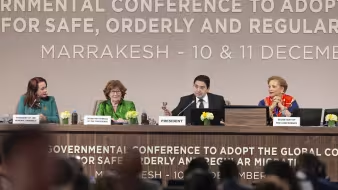
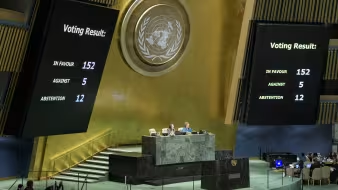
The world has changed dramatically since the international community came together in December 2018 to adopt the Global Compact on Refugees and the Global Compact for Safe, Orderly, and Regular Migration. Two years on, national governments and UN agencies are working to implement the compacts in an environment of new and intensifying challenges, including those associated with the COVID-19 pandemic and the increasingly severe impacts of climate change.
Given the significant political energy invested in the compacts, there is immense pressure to turn the commitments made on paper into reality, challenges or not. And while the migration landscape continues to change, the movement of people across borders remains at the heart of many pressing issues, including public health, economic recovery, and social inequality.
This policy brief examines how implementation of the two compacts has played out thus far, highlighting areas in which the pacts have lived up to or fallen short of expectations. It also identifies sticking points and opportunities at the intersection of the compacts that merit greater attention. To do so, the brief draws on interviews with government officials and UN agency representatives in Europe, Africa, and the Americas, as well as an in-depth review of countries’ implementation plans and progress updates.
Table of Contents
1 Introduction
2 Living up to Expectations?
A. Providing a Common Language to Address New Challenges
B. Making Progress on Complex, Intersecting Issues
C. Clarifying the Division of Labor
D. Boosting Fundraising and Covering Resource Needs
E. Raising the Profile of Migration in Conversations with Partners
3 From Paper to Reality: Observations on Implementation
4 Sticking Points and Opportunities at the Compacts’ Intersections
A. Climate Change and Migration
B. Mixed Migration
5 Conclusion
About the Global Program
The Global Program bridges policy advice, research, and candid dialogue to design effective migration policies, drawing on global evidence and anticipating the forces reshaping how people move.
About Critical Migration Governance Issues in a Changed World
This MPI-GIZ project sought to inform Global Compact for Migration implementation in the areas of governance architecture, return and reintegration, and south-south migration.





Related Content