Camille Le Coz

Camille Le Coz is Director of MPI Europe, specialising in EU migration and development policies. Her research spans areas such as return and reintegration, labour migration, refugee protection and inclusion, and climate mobility.
Ms. Le Coz works closely with EU institutions, national authorities, civil society, and international organisations on issues ranging from the implementation of the New Pact on Migration and Asylum and return policies to labour migration policies and refugee situations. Most recently, she has done research on future EU engagement in skills partnerships in North Africa and Kenya.
In parallel, she convenes a community of practice on voluntary return and sustainable reintegration, fostering dialogue among policymakers and practitioners from origin and destination countries. She also regularly conducts research for national development agencies and multilateral development banks on strategic positioning, project design, and monitoring and evaluation in the migration-development field.
She teaches at Sciences Po Paris and serves on the board of the French NGO Désinfox Migrations.
Before joining MPI Europe, Ms. Le Coz was Project Director at Altai Consulting, where she led the migration practice and managed studies and evaluations for institutions such as the European Union, UN High Commissioner for Refugees (UNHCR), and International Organization for Migration (IOM). While based in Kenya and Afghanistan, she conducted research in multiple countries in Europe, Africa, and Asia. She also previously worked for Sayara International in Afghanistan and for the École de Gouvernance et d’Économie in Morocco.
She holds a dual master’s degree in international relations from Sciences Po Paris and the London School of Economics, as well as a bachelor’s degree from Sciences Po Paris.
- Media Inquiries
Explore Content by Camille Le Coz
Showing 1-10 of 42 total results
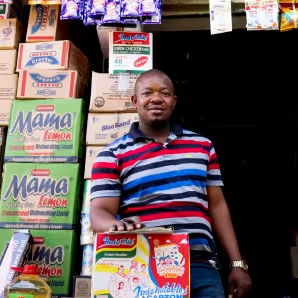
Private-Sector Engagement: A key element of supporting returnee reintegration through employment
Involving companies and other private-sector actors in helping returning migrants find jobs is a promising—but underdeveloped—approach to returnee reintegration.
A New Prime Minister, a New Deal: Time for an ambitious UK–EU pact on small boats
The arrival of a new UK Prime Minister offers a window to strike an ambitious UK-EU deal on Channel crossings, trading increased returns for humanitarian routes from Europe.

The Future of Reintegration Is a Key Missing Piece in Europe’s Focus on Returns
As EU return policy tightens, reintegration is being overlooked—including the need for more coherent strategies and locally embedded systems.

The Role of Counselling & Reintegration Support in Shaping Migrants’ Return Decisions
How do reintegration programs shape migrants' return decisions? Analysts examined how counselling approaches, an intervention's timing, and origin-country partners can improve outcomes.

To Leave or Stay? Examining the role of counseling and reintegration assistance in the return decision-making of migrants ordered to leave the Netherlands
More counselling and better reintegration support increase uptake of assisted return in the Netherlands, but neither factor alone determines the return decisions of migrants ordered to leave.

Reframing Return and Reintegration: Origin-country priorities and strategies for cooperation
As origin-country reintegration frameworks evolve, governance gaps and misaligned donor support remain major obstacles to effective cooperation on migrant return.

Supporting Migrants Returning to Fragile Contexts: Lessons from Iraq and Somalia
Speakers explored challenges in designing and delivering reintegration support in for returning migrants to Iraq, Somalia, and other fragile environments.

Engaging Local Communities for More Effective Climate Mobility Programming
Local NGOs and municipalities must be treated as genuine partners, not just implementers, if climate mobility programs are to deliver effective, sustainable, and just outcomes.

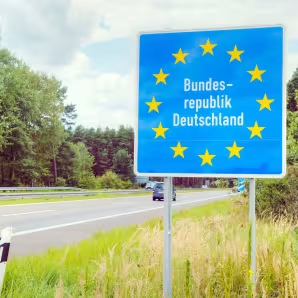
Germany, and Maybe the European Union, Are at a Migration Crossroads
Germany's reinstatement of border controls with its nine neighbors runs the risk of creating a chain reaction, with other EU Member States following suit. In the process, this go-it-alone approach could pose a serious threat to the Schengen free movement zone as well as put the common European asylum system at risk, as this MPI Europe commentary explains.
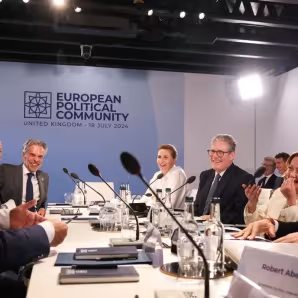
The Door Opens for a New Chapter in European Cooperation on Migration
New leadership in London and in European capitals, alongside continuity at the European Commission, could offer a window for greater European cohesion and creativity on immigration policy. This MPI Europe commentary explores the opportunities for greater UK-EU cooperation on migration and asylum if both sides smartly rekindle their relationship and prioritise strategic engagement.