Legal Pathways and Enforcement: What the U.S. Safe Mobility Strategy Can Teach Europe about Migration Management
The Biden administration's ambitious migration management strategy, which combined increased regional cooperation and expanded lawful pathways with a more orderly system for border arrivals, eventually led to a significant drop in irregular migration to the U.S.-Mexico border. The strategy holds promise for governments in Europe also tackling mixed migration flows—however sequencing matters, among other lessons.
As the Biden administration comes to an end on January 20, so does one of the most ambitious migration management policy agendas in recent memory. Over the last four years, the administration initiated an innovative strategy mixing increased regional cooperation on immigration enforcement and a more orderly system for border arrivals with a significant expansion of lawful pathways and efforts to push humanitarian protection decisions away from the border. Based on the notion of “safe mobility,” this strategy eventually saw irregular migration to the U.S.-Mexico border drop to its lowest level in almost five years after a period of record arrivals. But it took a long time to implement the various elements—a period during which the U.S. public became increasingly restive over perceived chaos at the border and large numbers of irregular arrivals. Even as some key aspects of the strategy have yet to be fully implemented, the incoming Trump administration will assert its own, differing vision for migration management at U.S. borders and relations with neighboring countries.
Still, the Biden-era innovations have been watched with interest across the Atlantic, where many European governments are struggling to find an effective answer to similar mixed movements of asylum seekers and irregular migrants. While some of the U.S. measures were more developed than others, together they provide the seeds of an approach that ensures greater border control while advancing pathways for humanitarian protection.
The Biden experience makes clear, though, that sequencing matters. Many of the elements promoting protection pathways preceded the efforts for greater regional enforcement and heightened U.S. requirements to seek asylum at borders. It was not until June 2024 that many enforcement measures, including greater cooperation with the Mexican and Panamanian governments and narrowing of asylum eligibility at borders, were fully implemented, with irregular arrivals then dropping precipitously. As a result, the administration will likely be remembered more for the several million migrants who were allowed across the U.S.-Mexico border, rather than the combination of measures that finally brought irregular migration under control.
The incoming Trump administration will undoubtedly pursue a strategy based primarily on enforcement, not lawful pathways, and further reduce access to humanitarian protection. That does not mean, however, that a balanced approach that includes robust enforcement and lawful pathways is dead. Instead, for countries that want to pursue this, it points to the need for a more pragmatic approach that achieves early reductions in arrivals while also preserving pathways for protection, not delaying the enforcement-focused elements of the strategy.
Alphabet Soup—CHNV, SMOs, CBP One, and the Los Angeles Declaration
A critical innovation of the U.S. safe mobility approach was the pairing of large-scale legal pathways for refugees and other migrants with an expanded enforcement regime at the U.S. southern border and with transit countries in the region, including cooperation on returns. The expansion of existing pathways and creation of new ones, targeted at the groups crossing the U.S. border irregularly in the greatest numbers, drew from a mix of tools.
The Cuban, Haitian, Nicaraguan, and Venezuelan Process and Other Initiatives
Beginning in October 2022, the administration launched a sponsorship process allowing lawfully present U.S. residents to sponsor Venezuelans for a two-year grant of humanitarian parole and permission to work. In return, the Mexican government agreed to accept an equal number of Venezuelan returnees who could not be sent to their home country. The process was expanded in January 2023 to include Cubans, Haitians, and Nicaraguans, with the goal of letting in up to 30,000 individuals monthly and Mexico’s agreement to receive deportations of citizens of those countries as well. While there was no individual determination of protection needs, the presumption was that conditions in these four countries created protection needs for most individuals. The U.S. government has few ways of returning these nationals encountered at the U.S.-Mexico border due to strained diplomatic ties with their governments, so the Cuban, Haitian, Nicaraguan, Venezuelan (CHNV) process serves humanitarian and enforcement purposes by creating a lawful pathway combined with the possibility of return to a third country.
In parallel, the administration dramatically scaled up refugee resettlement from Latin America and the Caribbean (a region rarely prioritized for resettlement) and increased access to seasonal work visas for Central Americans.
Safe Mobility Offices
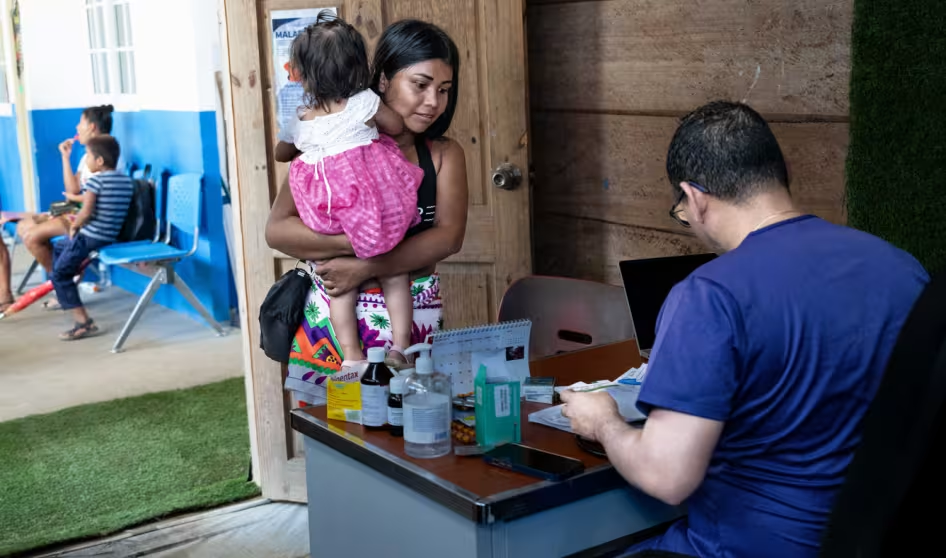
In June 2023, the administration announced the launch of the Safe Mobility Initiative as a tool to connect migrants and refugees from and transiting Central and South America with legal pathways, both humanitarian and non-humanitarian. Safe Mobility Offices (SMOs) were opened in Colombia, Costa Rica, Ecuador, and Guatemala. These offices, jointly operated by the UN High Commissioner for Refugees (UNHCR) and the International Organization for Migration (IOM), screen applicants for refugee resettlement or existing U.S. labor and family reunification pathways. While resettlement to the United States has been the primary vehicle used by the SMOs, with more than 20,000 refugees resettled through this avenue, towards the end of the Biden administration, the offices had begun to tie into efforts to access other pathways, including some to Canada and Spain—the beginning of what was envisioned to be a “many-to-many” approach, where migrants and refugees from multiple countries would be connected to pathways not just in the United States but other countries.
The Carrot-and-Stick Approach at the U.S. Border
These efforts to expand legal pathways were paired with attempts to create a narrower and more orderly border process for entering the United States with the intent to pursue asylum and increasingly stringent enforcement measures intended to deter migrants from using irregular channels. U.S. officials expanded the CBP One app in January 2023 to require migrants transiting Mexico to make appointments to present themselves at official entry points and be allowed into to the United States, where they could then pursue an asylum claim. This was followed by the Circumvention of Lawful Pathways rule in May 2023, restricting access to asylum for individuals who enter irregularly without having used one of the available legal pathways or the CBP One app to manage their arrival. The administration issued a proclamation in June 2024 barring migrants who cross between ports of entry from asylum and significantly streamlining processing for deportation—actions that seemed far more effective at deterring irregular entries.
Los Angeles Declaration on Migration and Protection
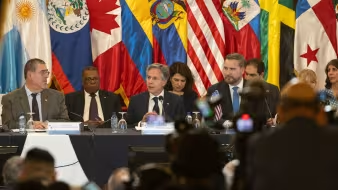
Central to all of these efforts was the endorsement of the Los Angeles Declaration on Migration and Protection in June 2022 by 22 governments in the Western Hemisphere. The agreement set out three central principles on lawful pathways, migration management, and support for countries that host significant displaced populations. This effort paved the way for broader cooperation and responsibility sharing across countries in the hemisphere, most of which were already dealing with significant migrant and refugee arrivals due to displacement crises in Venezuela, Haiti, Nicaragua, Cuba, and other countries. The U.S. government supplied hundreds of millions of dollars to countries including Colombia, Costa Rica, Ecuador, and Peru to integrate the large numbers of migrants and refugees there, and helped push for support from international financial institutions. At the same time, several governments collaborated on efforts to reduce irregular mobility through the hemisphere. They coordinated on visa restrictions to prevent arrivals from countries where irregular migrants originated, while the Mexican and Panamanian governments, in particular, tried to restrict onward movement towards the United States.
In the end, the approach opening lawful pathways while restricting irregular migration was not just a U.S. effort but a shared strategy across countries in the hemisphere, even if each government had a slightly different interpretation of what this meant.
Did the Strategy Work?
When evaluated on the metric of reduced U.S. irregular arrivals, the pathways-plus-enforcement approach appears to have had a measurable impact in the administration’s final year. In the 2022 and 2023 U.S. fiscal years (which run from October 1 to September 30), about 200,000 irregular encounters on average took place monthly at the U.S.-Mexico border. This continued to be the case in early FY 2024, reaching a peak of nearly 302,000 in December 2023. But after that, the numbers started to decrease, largely as the Mexican government engaged in greater immigration control. After June 2024, when the U.S. government issued the second executive action on asylum access at the border and the Panamanian government began deportation flights, the numbers fell further to 54,000 in September 2024, and then dropped even more after that. The decrease was especially notable for nationalities with eligibility for the CHNV program and potential deportation to Mexico. In fact, Cubans, Haitians, and Nicaraguans were rarely encountered crossing illegally after the CHNV program was created and CBP One appointments were required to arrive at the border to seek asylum; Venezuelan irregular arrivals fell to a few thousand in early January 2024 and only a few hundred after the June 2024 executive order. Of those continuing to arrive at the U.S. border, most Cubans, Haitians, and Venezuelans were presenting at official crossing points by late 2024 rather than using clandestine means to cross.
How the Strategy Worked and How It Fell Short
As an approach to migration management, the combination of restrictions on asylum, enforcement across countries, and opening of lawful pathways may have rewired the risk calculation for potential migrants by encouraging them to see regular routes as a viable alternative. It did so, in part, by making bold increases in the scale of regular pathways. Nearly 532,000 individuals were allowed in through CHNV as of October 2024, together with more than 24,000 through refugee resettlement to the United States initiated at an SMO, with another 1,000-plus referred for resettlement to other countries. By contrast, most legal pathways programs internationally have struggled to create more than a few thousand places. Under the 2016 EU-Turkey deal, for example, EU countries admitted a little more than 40,000 Syrians from Turkey—an average of just 5,000 admissions per year.
At the same time, the U.S. approach worked to make crossing the border between official entry points the choice of last resort, by introducing significant disincentives. Asylum access at the U.S. border was limited almost entirely to those using the CBP One app, who processed in at a port of entry and could later seek asylum. The approach significantly reduced the likelihood of migrants and asylum seekers entering the United States irregularly, particularly after implementation of the second executive action tightening requirements and streamlining processes.
The landmark agreement by Mexico to receive non-Mexican returnees in tandem with the CHNV process was also a part of this, as were enforcement efforts by the Mexican and Panamanian governments, regional operations to tackle migrant-smuggling networks, and coordinated shifts in visa requirements by several countries in the region. It is worth noting, however, that restrictions on access to asylum at the U.S. border significantly pushed the bounds of U.S. obligations under international law and raised concerns whether migrants and refugees were at risk of harm while waiting in Mexico, particularly as wait times for appointments with CBP One lengthened. As partner countries reflect on the U.S. lessons, they could consider alternative measures, such as border procedures or formal safe third country mechanisms, which could better preserve legal safeguards.
In many ways, it was the LA Declaration that made all this possible—even if each country had somewhat different interpretations of what the declaration commitments meant. The diplomatic agreements with countries that host SMOs have played a critical role in this approach, as have the significant resources that the United States and Canada have provided to help South and Central American countries hosting significant displaced populations.
Lessons for the International Community
Clearly, an effective approach to managing mixed movements requires a package of pathways, enforcement, and returns. But destination countries have long struggled with how to apply this formula in practice. What is the correct balance? In what sequence should these measures be implemented? And how can they be effectively operationalized? The experiments launched over the last four years by the U.S. government offer three answers.
First, a frequently heard argument in policy circles is that governments want to regain control of their border (and thus win back public trust) before expanding pathways. The EU-Turkey Statement, for example, explicitly conditioned the launch of a humanitarian admissions program from Turkey on arrivals in the Eastern Mediterranean going down. But the United States largely sought to introduce carrots and sticks in tandem, as part of a larger strategic approach. If anything, the debility of the U.S. approach was that it privileged the pathways first and enforcement and restrictions second. But once all the elements were in place, there was a clear effect on irregular arrivals. It was the application of these measures together—creating a viable alternative to irregular migration—that generated an effective shift in calculus for many migrants. The lesson for other states is that, clearly, lawful pathways and enforcement are two sides of the same coin.
At the same time, these successes would not have been possible without the close and strong cooperation of regional partners. Building an effective, balanced approach along mixed migration routes also means building asylum capacity in neighboring and transit countries, supporting local integration, and opening labor and other non-humanitarian pathways, rather than just intercepting particular movements. UNHCR has called for a similar model under its “route-based approach” to mixed migration.
Second, there is the design of the pathways programs themselves. The U.S. initiatives offer several innovations that are worth considering for application in other contexts. The design of the CHNV process, which enables individuals to sponsor potential migrants through an online portal, removes control from gatekeepers and allows migrants more agency in seeking out legal pathways—thus making it a more credible alternative to smugglers. It also operates on a prima facie basis—humanitarian need is assumed based on nationality—which effectively widened the scope of potential beneficiaries beyond those with more narrowly defined protection needs. There were challenges, though. The requirement to have travel documents, purchase a plane ticket to the United States, and have a sponsor in the first place may have meant that many people who intended to use irregular routes were still ineligible for CHNV. And the status that beneficiaries have received is precarious, leaving them vulnerable to changes in policy by the incoming administration.
The design of the SMOs was also innovative and is worth preserving. The digital platform created by UNHCR and partners to allow individuals to self-refer to the SMOs introduced an important element of agency for migrants and refugees, similar to CHNV, and has allowed for triaging and information collection that could speed the resettlement process. The platform is owned by UNHCR and could conceivably be deployed again in the Americas or adapted to other contexts. Most importantly, however, the ambition of providing a central point to give migrants information and support to identify and access a variety of pathways across a range of countries was a smart one. That the United States struggled to make good on this ambition should be seen, in part, as the result of domestic constraints. The U.S. immigration architecture provides limited options for legal labor migration, particularly for middle- or lower-wage workers. In addition, the ecosystem of labor intermediaries and recruiters did not yet exist to recruit from the region. As a result, the initiative became largely focused on providing resettlement and humanitarian pathways. A revamped Safe Mobility Initiative, deployed with partners facing fewer legal and political constraints on the opening of labor pathways—as is the case for many European countries—together with holistic investments in recruitment infrastructure across a region, could meet with more success. Embarking on such an initiative in coalition with other states at the outset would also help make it more viable.
Future initiatives would also do well to make more of an effort to connect to existing local integration programs and regional migration opportunities, an element of the U.S. strategy that was also underdeveloped. To be accessible, many labor migration opportunities require prerequisite language or skills training. Destination countries already fund integration, education, and livelihoods efforts in many first-asylum and transit countries. These programs should be supported and funded alongside pathways investments, and better linking pathways with existing or expanded training options could support a viable train-to-hire model that creates more and better opportunities for migrants and destination-country employers alike. These could be provided in a one-stop shop that merges SMO-style pathways guidance with connections to local supports. UNHCR has, for example, proposed setting up “multipurpose hubs” along key mixed migration routes that could take on such a role. Such efforts could also grow to tap into regional or South-South migration opportunities, which often dwarf destination-country opportunities but are overlooked by donor states. The U.S. strategy, for example, did not seek to exploit migration opportunities within the region directly, nor did it offer opportunities to host-country nationals (with the exception of some in-country resettlement for Guatemalans).
Finally, the Biden administration initiatives offer a crucial lesson about managing public trust and messaging. First, it has become almost gospel that the orderliness of migration (in a planned, legal way) matters almost as much or more than the absolute numbers arriving. The CHNV and SMO programs would seem to have fulfilled this criteria—migrants arrived with authorization at airports and with a sponsor or local agency ready to receive them and support their initial reception costs. Yet there was little messaging to U.S. publics by the government about either program, leaving the door open for critics to exploit the narrative, accusing the administration of paying to fly in future voters. It also seems that numbers may, in fact, matter after all. While more than 860,000 migrants came in through CBP One appointments and another 800,000-plus through the CHNV process and similar parole processes for Ukrainians and Afghans, nearly 4.2 million other migrants were allowed in after crossing a border without authorization, in addition to others who managed to cross the border undetected. For many local communities and service providers, who received minimal support from the federal government for the costs incurred in addressing the needs of these new arrivals, the pace of change and demands placed upon them were great.
Looking Ahead
As governments across the Atlantic seek to broaden their toolbox for managing migration, many are exploring new approaches that seek to prevent irregular movements upstream. But many of these, from the idea of a return hub in Uganda being explored by the Dutch government, to the Italy-Albania partnership that seeks to intercept people in the Mediterranean and take those with limited chance of getting asylum to Albania for processing, face legal challenges or are unlikely to move the needle on mixed migration flows because they focus on the enforcement part of the puzzle alone.
As the European Union and European states search for their own innovative solutions to mixed migration, they would do well to learn from the level of ambition and holistic nature of the experiment in the Americas. These include solid grounding in regional partnerships, innovative approaches to technology and infrastructure, and working with (rather than against) the agency of migrants. Amid a huge backlash to migration, destination countries are likely facing a period of significant retrenchment. And making the political case for lawful migration pathways as part of an effective migration management package will become increasingly difficult. Nonetheless, the U.S. example suggests that even if legal pathways attract some people to move who would not otherwise have done so (the oft-heard “net-widening” concern), they can help shift the movement of people out of the hands of smugglers.
Ultimately, a blend of enforcement and legal pathways—together with strong partnerships and support for capacity building and integration in neighboring and transit countries—offers the best prospects for reducing irregular migration and a worthy rival to the slick smuggling architecture. Messaging this and getting the trust of publics themselves, however, will be a major challenge in the years to come.
Latin America and Caribbean Initiative
The Initiative combines rigorous research with direct engagement of governments, institutions, and stakeholders to help build orderly, rights-respecting migration systems across one of the world's most dynamic migration regions.
About the U.S. Immigration Policy Program
The U.S. Immigration Policy Program provides analysis of U.S. immigration pathways, the impacts of enforcement and other policies, and the characteristics of immigrant populations.
About the Global Program
The Global Program bridges policy advice, research, and candid dialogue to design effective migration policies, drawing on global evidence and anticipating the forces reshaping how people move.


Related Content