Countries Are Pushing Borders Outward to Expand Deterrence and Protection Alike

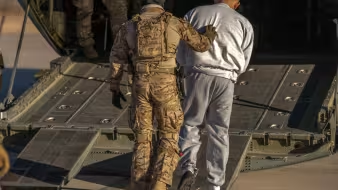
A Turkish coast guard vessel in the Aegean Sea.
iStock.com/BT1976
Related Content
Highlights
Externalization—the enlistment of partner countries to manage migration before people arrive or assist with removals and returns—has shifted from the policy fringe into the mainstream. Models range from deterrence to protection.
- In June 2026, the European Union agreed on a Return Regulation allowing rejected asylum seekers to be sent to third-country return hubs. The move was praised by some as a pragmatic tool but criticized by advocates as creating potential "legal black holes" with inadequate protection safeguards.
- Critics argue the most immediate effect of many externalization deals is symbolic, signaling control to domestic publics, while few cases are actually processed.
- Externalization models include four broad types: bilateral prevention deals, offshore processing agreements, return hubs, and legal pathway arrangements. Each has distinct legal, ethical, and operational differences.
Enlisting partner countries to help manage borders—a strategy known as externalization—has moved from a fringe idea into the policy mainstream. Under rising pressure to prevent irregular migration, destination countries in Europe, North America, and beyond are getting creative in which tasks they outsource to others, using carrots and sticks to get them to comply.
Deals between high-income countries and migrant transit or origin countries to conduct deterrence, screening, and enforcement before migrants arrive are not new. Many recent efforts trace their lineage to Australia’s policy beginning in 2001 to move asylum seekers to the Pacific Island country of Nauru and Papua New Guinea’s Manus Island. Others have been inspired by the European Union’s landmark 2016 deal with Turkey to limit arrivals into Greece.
But the arrangements have proliferated in both number and scope over the last five years. Most recently, in June 2026, the European Union took another step toward creating “return hubs” in third countries where Member States could send migrants without legal status or a valid protection claim whom authorities would otherwise be unable to return. There, migrants would either stay until returning to their home country or be provided an opportunity to settle locally. The European Union and Italy have also supported the Libyan coast guard to intercept migrants at sea and return them to Libya, despite ongoing conflict and danger in that country. And the United States has entered into deals with countries in Central and South America and Africa to accept deportees who are non-nationals, sometimes by offering inducements, other times after threatening tariffs or other sanctions, resulting in removals such as Jamaicans being sent to Eswatini and Vietnamese going to South Sudan.
These and other instances of externalization are often intended to address the rising challenge of mixed migration, in particular to assess who is in need of protection away from borders and to ensure that people deemed to lack a protection need return to their country of origin. But sometimes their main purpose is more symbolic, to tell would-be irregular migrants that they will face hostility upon arrival and convey to anxious domestic publics that the government is in control of its borders. For instance, the Trump administration has negotiated more than two dozen third-country deportation agreements (which allow other countries to accept deportees of non-nationals), but has removed only a small number of people through them.1
This article explores various externalization models and how they have evolved over time.
Many Models Under One Umbrella
While externalization arrangements come in all shapes and sizes, many have been criticized for allowing countries to offload their human-rights obligations and turn a blind eye to ill treatment of migrants away from their shores.2 Transit and other countries agreeing to these arrangements often receive financial support, trade or mobility concessions, or other benefits; sometimes their agreement comes less willingly, under threat of negative consequences such as visa sanctions.
Externalization is a broad label encompassing a number of models with key legal, ethical, and operational differences. These include:
- Bilateral or regional deals to prevent arrivals, wherein transit countries agree to police their borders and prevent onward movement. These commitments often come in return for funding, visa liberalization, or political concessions, or in response to threats to remove any of these. European countries have struck such deals with Tunisia and Libya, and multiple U.S. presidential administrations have also engaged in such cooperation with Mexico.
- Offshore processing and safe third country agreements, in which destination countries transfer people to a third country for asylum processing. That processing can be conducted either by the destination or host country, with a view to keeping asylum seekers there following adjudication or ultimately giving those with a positive claim access to the transferring country or another resettlement country. Australia has done this with Nauru and Papua New Guinea, and the United States has done so with its naval base at Guantanamo Bay, Cuba. The United Kingdom’s agreement with Rwanda was another such arrangement, though it never became operational.
- Return hubs and third-country return deals, wherein destination countries send unauthorized immigrants, people whose asylum claims have been refused, and other removable individuals to a third country, usually because the individual cannot be easily returned to their origin. These agreements are often struck in exchange for funding. The United States has recently agreed to such deals with a number of Latin American and African countries.
- Access to safe pathways along routes, designed to divert people from irregular channels. This can include combined pathways and enforcement agreements (sometimes known as “routes-for-returns” deals) or hubs and processing centers designed to screen people for various legal migration pathways. The United States previously set up Safe Mobility Offices (SMOs) in several Latin American countries that aimed to provide pathways to refugees and other migrants en route, though these have since been shut down.
"While externalization arrangements come in all shapes and sizes, many have been criticized for allowing countries to offload their human-rights obligations and turn a blind eye to ill treatment of migrants away from their shores."
The History and Evolution of Externalization
The enlistment of partner countries to play a role in migration management has a long history. Since the 1980s, these ideas have come up cyclically as destination countries explore new ways to stop migrants from reaching their borders irregularly, through efforts such as carrier sanctions and visa restrictions, as well as shifting more visa processing functions to partner countries in a move often described as “pushing the border out.”
A series of bilateral deals between the United States and Cuba in the 1990s set the stage for these arrangements. Initially, Cuba agreed to prevent irregular departures from its shores in exchange for the United States agreeing to process at least 20,000 Cuban migrants per year through family reunification, a visa lottery, and refugee admissions.3 A companion agreement allowed the United States to interdict boats at sea, with Cuba agreeing to accept returns of its nationals who did not qualify for asylum, while those found in need of protection were resettled in third countries including Australia.
But it was large-scale mixed movements that propelled destination countries to consider more radical approaches. Under Australia’s Pacific Solution, initiated in 2001, boats intercepted at sea were redirected to tiny islands such as Nauru, where asylum claims would be assessed in remote detention centers, effectively outsourcing both the processing and the deterrence to third countries. Australia also has longstanding cooperation with Indonesia to prevent the departure of migrant boats as well as to support humanitarian operations, voluntary returns, and resettlement out of Indonesia.4
The 2016 EU-Turkey Statement, agreed at the height of the European migration crisis of 2015-16, remains the emblematic externalization deal. In exchange for Turkey preventing departures and readmitting migrants who managed to arrive to the Greek islands, the European Union pledged an initial 6 billion euros in financial support, resettlement places, and visa liberalization.5 The arrangement sharply reduced irregular arrivals via the Aegean, as did border closures in the Balkans and more efforts by Turkey to prevent departures. Critics argue it entrenched a transactional relationship focused on containment, with EU funds shaping Turkey’s asylum and border policies around short-term European priorities rather than long-term regional protection needs. However, it included substantial resettlement and humanitarian admission commitments, as well as payments to support refugees in Turkey.
By contrast, subsequent European partnerships with Libya and Tunisia in particular have raised significant human-rights concerns, due to inhumane detention conditions in those countries, state violence against migrants, and aggressive interception tactics.
2020-25: New Models Pushing Enforcement—and Protection—Farther Afield
Recently, externalization efforts have taken on a harder deterrence edge, relying on arrangements that give less attention to humanitarian and protection needs or international responsibility sharing. The Trump administration in its first term signed Asylum Cooperation Agreements with El Salvador, Guatemala, and Honduras in 2019, under which migrants passing through those countries who arrived at the U.S.-Mexico border could be redirected back to one of the countries (even if not their country of origin) to seek asylum; only the Guatemala agreement was ever implemented, and fewer than 1,000 people were processed before it was suspended during the COVID-19 pandemic.6 The Trump administration also deployed the Remain in Mexico program, which required more than 81,000 would-be asylum seekers who arrived at the southern border to wait in Mexico while their U.S. immigration cases were processed.7 (See below for actions of the second Trump term).
Some efforts never got off the ground. The 2022 UK-Rwanda model proposed to deter irregular boat crossings by transferring certain asylum seekers who reached UK territory to Rwanda for processing; critically, this processing would happen under Rwanda’s jurisdiction, rather than that of the United Kingdom. The UK government pledged hundreds of millions of pounds in financial support, with the idea that migrants would be settled in Rwanda if their claims were successful. This was contested on both ethical and legal grounds, and eventually scrapped by the new Labour government in 2024.
Not all models have focused on deterrence alone. Increasingly, some experiments have included pragmatic and humanitarian rationales for conducting immigration functions farther away from the border. For instance, the Biden administration’s SMOs in Colombia, Costa Rica, Ecuador, and Guatemala sought to expand access to counselling and screening for refugee resettlement and other pathways from those countries, to obviate the need for dangerous journeys and reduce the power of smuggling organizations.8 The United States also worked with Canada and Spain to provide pathways alongside the SMOs, and more than 20,000 people traveled through a legal channel as result of the SMOs. However, this experiment was shut down in early 2025 with the change in administration in the United States, leaving many applicants in limbo and raising questions around whether this type of model can survive political shifts long enough to gain traction.
Meanwhile, European governments and international organizations began exploring whether such models could be compatible with European and international conventions. In a notable shift given its traditional role as the guardian of territorial asylum, the UN High Commissioner for Refugees (UNHCR) started engaging with European actors interested in exploring “innovative solutions,” including disembarkation models and return hubs. UNHCR developed a “route-based approach” to support interventions along key mixed and onward movement routes and enable refugees and other migrants to find protection, solutions, and legal pathways in countries closer to their places of origin. While critics charged that this was UNHCR protecting its budget, which largely comes from high-income destination countries, internally the rationale was driven by concerns that asylum systems were under pressure; thus, intervening earlier could help offer protection in the middle of people’s journeys. Additionally, Italy set up an asylum-screening facility in Albania, which was designed to push the boundaries on burden-sharing but in a way that respected human rights—namely, by intercepting people in international waters, applying Italian jurisdiction, transferring only those cases unlikely to get protection, and ultimately providing successful claimants with status in Italy.9 This model has been mired in legal challenges but is seen as a test case that other European countries may wish to emulate.
Thus, externalization has become a part of the playbook for migration management worldwide, although there are important nuances between different models. While some approaches have narrowly targeted particular nationality groups, others have wide scope regardless of the strength of individuals’ protection claims or connection to the receiving country (see Table 1). It is also clear that a huge amount of political and financial capital has been expended, often on models that never got off the ground. Still, some of the more extreme models that never saw the light of day nonetheless shifted the parameters of the conversation; for instance, many European officials credit the UK-Rwanda agreement with kickstarting current EU discussions about externalization.
Table 1. Migration Externalization Models, 2026
|
Model |
Example(s) and Current State |
Target Group and Screening Location |
Final Status or Protection |
| Post-Arrival Transfer |
Australia Pacific Solution/Operation Sovereign Borders: Ongoing |
All irregular arrivals intercepted at sea or on arrival in destination country, screened offshore in Nauru, Papua New Guinea, or (would have been in) Rwanda |
Australia: Resettlement to third country, local Pacific settlement, and some resettlement to Australia |
| Offshore Screening: EU Jurisdiction, EU Resettlement |
Italy-Albania: Largely suspended |
Non-vulnerable adults intercepted at sea from designated "safe" countries, screened in Albania under Italian jurisdiction |
Positive claims given status in Italy; negative claims to be returned to country of origin |
| Offshore Screening: Third-Country Jurisdiction, Third-Country Resettlement |
Danish Safe Harbor proposal: Never operational |
All asylum seekers arriving irregularly would have been screened in offshore center in willing partner state under that state's jurisdiction |
All claimants would have been offered status in third country only; protection obligation would have fully transferred away from Denmark |
| Return Hubs |
EU Return Regulation: Agreed June 2026 |
Rejected asylum seekers following final decision could be held in unspecified third-country facility outside European Union, could be closed or open facility |
Deportation or voluntary return to country of origin could be organized from hub, could be given local status |
| Third-Country Deportations |
Trump administration agreements: Ongoing |
All removable noncitizens including those with no connection to receiving country, directly deported to receiving countries |
No U.S. status; no guarantee of protection or due process in receiving country |
| Legal Pathway / Pre-Departure Screening |
Biden administration parole for Cubans, Haitians, Nicaraguans, and Venezuelans (CHNV) and Safe Mobility Offices (SMOs): Suspended |
CHNV nationals were pre-screened online before departure to United States; others processed in SMOs in Colombia, Costa Rica, Ecuador, and Guatemala (co-managed with UN High Commissioner for Refugees and International Organization for Migration |
Legal entry on humanitarian parole or refugee resettlement in the United States |
A New Era of Deterrence
The externalization policies that proliferated during and after the COVID-19 pandemic have since evolved in multiple directions. Third-country return agreements are among these new approaches.
New Deals to Expand Deportation
Since the beginning of the second Trump term, the United States has pursued a much sharper strategy of third-country cooperation to deliver on its mass deportation agenda, striking deals with at least 34 countries as of May 4, 2026.10 These agreements fall into four categories: Safe Third Country/Asylum Cooperation Agreements (such as Ecuador’s agreement to receive up to 300 asylum seekers per year), deportation bridge agreements (in which a country accepts foreign nationals while negotiating their removal to the origin country or elsewhere), incarceration agreements (in which a country agrees to detain deportees, such as El Salvador’s agreement to receive alleged gang members), and hybrid agreements (which may involve a combination of these features).11
The United States also seems to have taken inspiration from EU-Africa cooperation and ramped up offers of capacity-building funds to induce governments to conduct more muscular enforcement and return operations. A U.S.-Panama agreement first signed in 2024, under the Biden administration, provides around $14 million for charter flights and tickets for deportees; nearly 2,000 people were removed under the arrangement in less than a year.12 U.S. officials frame the program as a way to reduce dangerous journeys through the Darien Gap and disrupt smuggling networks, but human-rights advocates counter that it pushes people back into unstable situations without adequate screening or access to protection.
New EU Frameworks
Meanwhile, on the other side of the Atlantic, externalization grew from a discussion among a few governments to become official EU policy—or at least officially tolerated. While the Trump administration’s actions are seen by some as proof that enforcement-first policies can deter irregular migration, the majority view among European governments is that such models should better accommodate human-rights concerns. Thus, they want to put their own European stamp on these models.
The most significant development is the reform of the safe third country concept in EU law. Previously, safe third country arrangements only allowed for transfer to another country with which the asylum seeker had a meaningful connection, such as one they had lived in previously. Now, EU Member States may, under certain conditions, transfer asylum seekers to third countries with which they have no prior connection. This paves the way for deals to redirect asylum seekers to third countries for processing, without establishing an individual’s link to the country, provided it has sufficient systems for providing asylum. So far, there are no real contenders for such agreements.
Additionally, a Council of Europe declaration in Chișinău, backed by 27 governments and welcomed by Brussels, acknowledges states can pursue offshore processing, return hubs, and closer cooperation with transit countries. However, not all EU Member States are on board, and countries such as Spain have raised concerns about protection safeguards.
While the European Union has thus made some progress on new frameworks, the political, legal and operational challenges that have plagued externalization models still loom large.
Return Hubs
In June 2026, the European Parliament and the Council of the European Union reached an agreement on the Return Regulation, which includes the possibility of opening return hubs outside the bloc where rejected asylum seekers can be sent. On paper, these hubs can be pragmatic tools to manage people with rejected claims who nevertheless cannot be removed quickly, offering them a place to stay in a third country while resolving options for their return home, onward movement elsewhere, or local integration. In reality, though, they risk becoming parking lots for migrants deemed undesirable by destination states, which advocates have called “legal black holes.”13
Previously, in March 2026, the new Dutch government abandoned a deal with Uganda involving a small transit center for temporarily hosting rejected asylum seekers from neighboring countries en route to other destinations. Instead, the Netherlands announced it would seek a broader deal with a group of four other European countries exploring return hubs (Austria, Denmark, Germany, and Greece). The list of partner countries under consideration is long and revealing: Armenia, Egypt, Ethiopia, Ghana, Libya, Mauritania, Montenegro, Rwanda, Senegal, Tunisia, Uganda, and Uzbekistan. That list spans democracies and autocracies, EU candidate countries and conflict-affected states, countries that already host hundreds of thousands of displaced people and those with virtually no asylum infrastructure.
Thus, while Europeans have built elaborate legal scaffolding for return hubs, the foundations will remain shaky without partners who are willing and able to execute these plans. Moreover, European countries’ reasons for being interested in return hubs differ, with some focused on increasing the proportion of rejected asylum seekers who are returned, others focused on the hubs’ use for foreign criminals, and still others looking to the future amid the new Pact on Migration and Asylum, which came into force on June 12 and calls for expedited asylum processing. The design of such hubs is also unclear; they could include closed detention centers or brief waystations where returnees get support while voluntarily returning home or moving elsewhere.
Humanitarian and Pragmatic Options Along Routes
Although the Trump administration ended SMOs when it took office, there remains interest in many policy circles in pursuing similar interventions to divert migrants and asylum seekers into regular channels. While many EU countries are focused on returns and enforcement, others—namely Spain—have sought to expand regular pathways particularly in North Africa through more comprehensive models that combine border management and development investments. In this vein, the EU-Mauritania partnership signed in 2024 provides 250 million euros for a range of infrastructure and development purposes, all explicitly linked to migration management objectives.
A more ambitious vision for the future could include multipurpose hubs that would facilitate return, external asylum processing, resettlement, and even potentially screening for legal pathways in third countries. Such a model has been proposed by UNHCR and referenced in passing in the European Asylum and Migration Management Strategy unveiled in January 2026,14 and also bears similarities to the German Centers for Migration and Development.15 But this idea is quite nascent, and it is unclear who would be sent, under what procedures, with what rights, and for how long. These hubs could either function as a next-generation, digitally enabled SMO expanding access to durable solutions by better matching people on the move with appropriate pathways, or entrench a two-tiered system in which certain asylum seekers can be shifted indefinitely out of sight.
The Future of Externalization
While the new generation of partnerships built around deterrence has stretched the boundaries of legal and ethical norms about countries’ responsibilities to provide humanitarian protection, it has also opened the door to more pragmatic conversations about new models.
There are important differences between deals designed narrowly for deterrence at all costs, with little transparency and weak safeguards, and those that seek pragmatic ways to expand access to protection and mobility away from physical borders. As with all forms of migration partnerships, these arrangements stand a much better chance of enduring political turbulence and legal challenges if they are designed more holistically (considering the need to create pathways and invest in development) and not solely through the lens of migration management. Destination-country governments will struggle to deliver results if they pursue models designed around symbolic control signaling or transactional exchanges wherein partner countries can auction off their cooperation to the highest bidder, rather than trying to meet shared objectives between different countries and regions.
Sources
Clinton, William J. 1995. Joint Statement with the Republic of Cuba on Normalization of Migration. May 2, 1995.
Collett, Elizabeth. The Paradox of the EU-Turkey Refugee Deal. Short read, Migration Policy Institute (MPI), March 2016.
Endres de Oliveira, Pauline and Nikolas Feith Tan. 2023. External Processing: A Tool to Expand Protection or Further Restrict Territorial Asylum? Washington, DC: MPI.
European Commission. 2026. European Asylum and Migration Management Strategy. Brussels: European Commission.
Fratzke, Susan, Meghan Benton, and Andrew Selee. 2024. Legal Pathways and Enforcement: What the U.S. Safe Mobility Strategy Can Teach Europe about Migration Management. Short read, MPI, December 2024.
German Federal Ministry for Economic Cooperation and Development (BMZ). 2023. Centres for Migration and Development. Updated July 11, 2023.
International Rescue Committee (IRC). 2024. What Is the Italy-Albania Asylum Deal? October 15, 2024.
---. 2026. The EU’s New Agreement on Deportations Contains “Dangerous Gaps” that Risk Exposing People to Exploitation and Abuse, Warns IRC. Press release, June 1, 2026.
Princewill, Nimi, Sarah Dean, Larry Madowo, and Hamilton Wende. 2025. “Not Trump’s Dumping Ground”: Outrage Over Arrival of Foreign U.S. Deportees in Tiny African Nation. CNN, July 18, 2025.
Refugees International and Human Rights First. 2026. Third Country Deportation Watch. Updated May 4, 2026.
Ruiz Soto, Ariel G. 2026. U.S. Third-Country Deportation Agreements Are More About Fear than Numbers. Short read, MPI, March 2026.
Sherrell, Henry. 2022. The Central Role of Cooperation in Australia's Immigration Enforcement Strategy. Washington, DC: MPI.
Tan, Nikolas Feith. 2025. Transnational Asylum: Toward a Principled Framework. London: Routledge.
Thym, Daniel. 2024. Expert Opinion on Legal Requirements for Safe Third Countries in Asylum Law and Practical Implementation Options. SSRN working paper, Konstanz, Germany: University of Konstanz Faculty of Law, April 3, 2024.
Transactional Records Access Clearinghouse (TRAC). 2022. MPP (Remain in Mexico) Deportation Proceedings—All Cases. Updated November 2022.
UN Office of the High Commissioner for Human Rights (OHCHR). 2025. UN Expert Calls on States to End Externalisation Arrangements that Expose Migrants to Grave Rights Violations. Press release, October 3, 2025.
U.S. Mission Panama. 2025. U.S.-Panama Migration MOU Facilitates 48 Deportation Flights of Illegal Migrants. U.S. Embassy in Panama, May 6, 2025.
About the Global Program
The Global Program bridges policy advice, research, and candid dialogue to design effective migration policies, drawing on global evidence and anticipating the forces reshaping how people move.
Notes
-
1
Ariel G. Ruiz Soto, “U.S. Third-Country Deportation Agreements Are More About Fear than Numbers” (short read, MPI, March 2026).
-
2
UN Office of the High Commissioner for Human Rights (OHCHR), “UN Expert Calls on States to End Externalisation Arrangements that Expose Migrants to Grave Rights Violations” (press release, October 3, 2025).
-
3
William J. Clinton, “Joint Statement with the Republic of Cuba on Normalization of Migration,” May 2, 1995.
-
4
Henry Sherrell, The Central Role of Cooperation in Australia’s Immigration Enforcement Strategy (Washington, DC: MPI, 2022).
-
5
Elizabeth Collett, “The Paradox of the EU-Turkey Refugee Deal” (short read, MPI, March 2016).
-
6
Human Rights Watch (HRW), Deportation with a Layover: Failure of Protection under the US-Guatemala Asylum Cooperative Agreement (New York: HRW, 2020).
-
7
Transactional Records Access Clearinghouse (TRAC), “MPP (Remain in Mexico) Deportation Proceedings—All Cases,” updated November 2022.
-
8
Susan Fratzke, Meghan Benton, and Andrew Selee, “Legal Pathways and Enforcement: What the U.S. Safe Mobility Strategy Can Teach Europe about Migration Management” (short read, MPI, December 2024).
-
9
International Rescue Committee (IRC), “What Is the Italy-Albania Asylum Deal?” October 15, 2024.
-
10
Refugees International and Human Rights First, “Third Country Deportation Watch,” updated May 4, 2026.
-
11
Ariel G. Ruiz Soto, “U.S. Third-Country Deportation Agreements Are More About Fear than Numbers” (short read, MPI, March 2026).
-
12
U.S. Mission Panama, “U.S.-Panama Migration MOU Facilitates 48 Deportation Flights of Illegal Migrants,” U.S. Embassy in Panama, May 6, 2025.
-
13
International Rescue Committee (IRC), “The EU’s New Agreement on Deportations Contains ‘Dangerous Gaps’ that Risk Exposing People to Exploitation and Abuse, Warns IRC” (press release, June 1, 2026).
-
14
European Commission, European Asylum and Migration Management Strategy (Brussels: European Commission, 2026).
-
15
German Federal Ministry for Economic Cooperation and Development (BMZ), “Centres for Migration and Development,” updated July 11, 2023.