A Data Profile of Young Dual Language Learners and Implications for Early Childhood Programs

Related Content
Highlights
As of 2019–23, one in three young children in the United States was a Dual Language Learner, yet many face barriers to high-quality early childhood programs.
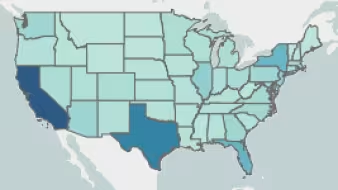
- In 2019–23, there were 7.1 million DLL children ages 0–5 in the United States, 33 percent of all young children; DLLs live in all 50 states and exceed 20 percent of young children in more than half of states.
- DLLs are disproportionately at risk: 43 percent live in low-income households versus 33 percent of non-DLLs, and 25 percent have at least one parent without a high school diploma, compared to 8 percent of non-DLLs.
- Language barriers limit access to early childhood services: 42 percent of DLLs have at least one Limited English Proficient parent, and 18 percent live in linguistically isolated households.
- Early childhood programs should adopt standardized DLL identification, train educators in culturally and linguistically responsive practices, and design bilingual models that support home language and English development.
Nationwide, there are 7.1 million children ages 0 to 5 who are Dual Language Learners (DLLs), comprising one-third of all U.S. children in this age group. These young children have at least one parent who speaks a language other than English at home, meaning when they enroll in English-speaking preschool, kindergarten, or other early childhood programs, their brains are using multiple language systems that are developing at different rates.
This series of fact sheets highlights key characteristics of DLL children and the households in which they reside, nationwide and in the 30 states with the most DLLs. The data underscore both the diversity of this population and certain factors that may hinder access to early childhood services. These characteristics should be considered in the design and implementation of such services to ensure they are equipped to support the well-being and future success of all children and their families. This information is based on MPI analysis of data from the U.S. Census Bureau’s American Community Survey.
Read the state fact sheets below, and for a spreadsheet of related data for the United States, all 50 states, and Washington, DC, click here.
About the National Center on Immigrant Integration Policy
The Center is a national hub connecting policymakers, educators, community leaders, and service providers with evidence-informed policy research, technical assistance, and data to advance effective immigrant integration at U.S., state, and local levels.



Related Content