


What Do Changes in Turkey and Syria Spell for Kurds Seeking Protection Abroad?

A farmer in the Kurdistan region of Iraq. (Photo: © FAO/Ismael Adnan)
Kurdish people seeking protection in Europe make up a sizable and yet often underexamined group of humanitarian migrants. Because Kurds come from multiple countries, including Iran, Iraq, Syria, and Turkey, their ethnic background is often overlooked, yet they comprise large portions of these national-origin groups.
Long marginalized in their origin countries, Kurds have migrated to Europe for decades, often to flee persecution by governments, some of which have been in open conflict with Kurdish militant nationalist groups that have long pressed to establish their own homeland. In recent years, Kurds have been prominent among the millions of asylum seekers who have sought protection in the European Union. For instance, as many as 70 percent of Iraqi asylum applicants in Germany from 2014 to 2020 claimed a Kurdish background, as did 73 percent of Turkish nationals seeking asylum there in 2024.
Prospects for future migration and the outlook for those already in Europe have changed recently, following the overthrow of former Syrian President Bashar al-Assad in late 2024 and Turkey’s 2025 ceasefire with insurgents from the Kurdistan Workers’ Party (PKK). These two events have reshaped relations between Kurdish groups and their governments and altered how authorities in Europe and elsewhere view situations in those homelands, potentially leading to changing migration patterns. More recently, U.S. and Israeli attacks on Iran have raised the question of whether Kurdish groups there might be drawn into the conflict or encouraged by outside actors to challenge the government in Tehran. Some Iranian Kurdish opposition groups based in northern Iraq have said they would join a U.S.-led ground invasion of Iran if one were to occur. At the same time, Turkey has strongly warned against attempts to mobilize Iran’s Kurdish population as part of the conflict, arguing that exploiting ethnic fault lines could trigger civil war in Iran and destabilize the wider region.
This article reviews the recent trends of Kurds seeking protection in the European Union, in the context of changing political dynamics. Although millions of Kurds also live in Iran and Iraq, it focuses primarily on those native to Turkey and Syria, given the earlier changes in those countries.
The Kurds are an ethnic group whose indigenous territory has been divided between multiple countries in western Asia. They have sought national self-determination since the 19th century, but apart from the short-lived Mahabad Republic, which existed for 11 months in 1946 in what is now Iran, they have never achieved an independent state. Following the collapse of the Ottoman Empire, the 1920 Treaty of Sèvres proposed the creation of a Kurdish state in southeastern Anatolia, though it was never implemented. After the Turkish War of Independence, this agreement was replaced by the 1923 Treaty of Lausanne, which recognized the modern Republic of Turkey’s borders and did not address Kurdish autonomy. As part of its nationalizing project, the new Turkish state pursued policies of centralization, suppressing Kurdish identity and contending with occasional uprisings throughout the 20th and 21st centuries.
Groups such as the PKK contested the state, often violently, adding to a tense situation. Due in part to its guerrilla tactics and attacks against civilians, the PKK has been designated as a terrorist organization by countries including Turkey, the United Kingdom, and the United States, as well as the European Union. Decades of conflict between the Turkish government and the PKK have resulted in more than 40,000 casualties, according to some estimates. Reports have also documented violence and persecution in Turkey of Kurds unaffiliated with the PKK. In the first eight months of 2024, for instance, at least 13 attacks explicitly targeted Kurdish individuals or gatherings. Kurdish cultural events such as Newroz have often been met with heavy police presence or crackdowns, with hundreds of celebrants accused of terrorist propaganda for waving Kurdish flags or chanting slogans.
Figure 1. Kurdish-Inhabited Regions in the Middle East
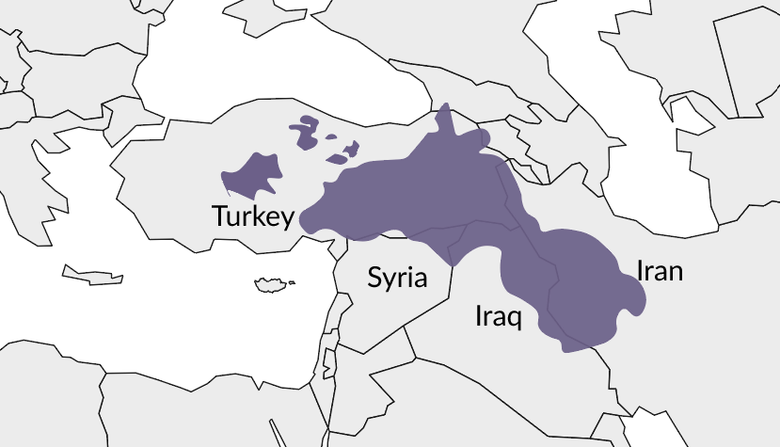
Note: Map is an approximation for illustrative purposes and is not intended to imply endorsement or acceptance of territorial boundaries.
Source: MPI artist rendering based on Lanah Hinsdale and Gianna Hanson, “Putting Kurdistan on the Map,” November 6, 2023, available online.
Turkey’s neighbor, Syria, often denied Kurds citizenship and subjected the ethnic group to assimilation campaigns. Although the Syrian civil war opened limited opportunities for Kurdish self-administration in the north, in an area known as Rojava or the Democratic Autonomous Administration of North and East Syria (DAANES), neither Turkey nor Syria has supported Kurdish independence. One reason why countries may have resisted Kurdish autonomy is the sizable oil reserves in Kurdish areas. The largest are in Iraq’s Kurdistan Region, which holds approximately one-third of the country’s estimated 145 billion gallons of untapped oil, and would rank as around the tenth largest globally if the region were an independent state, just behind Libya.
Organized activities of Kurdish communities across the four countries of their homeland have ranged from recognized political participation to armed militias and violence. Kurds in Iraq founded the Kurdistan Democratic Party (KDP) in 1946 and the Patriotic Union of Kurdistan (PUK) in 1975, which are official political parties in Iraq’s democratic system. Groups elsewhere have included the Democratic Party of Iranian Kurdistan (KDPI, founded in 1945), Syria’s Kurdistan Democratic Party (PDK-S, founded in 1957), and Turkey’s PKK (founded in 1978). During Syria’s civil war, the People’s Protection Units (YPG) emerged as the main Kurdish militia, later became the core of the Syrian Democratic Forces (SDF), and established de facto autonomous governance in the northeast. Turkey considers the YPG a terrorist group affiliated with the PKK.
The Peace Process in Turkey and Regime Change in Syria
In May 2025, after more than four decades of fighting, the PKK officially decided to dissolve and stop its armed conflict with the state of Turkey. This development followed a February call from the PKK's imprisoned founder, Abdullah Öcalan, who had been involved in previous unsuccessful peace efforts with Turkish President Recep Tayyip Erdoğan. Erdoğan welcomed the move as an “important threshold” and a key step to end decades of conflict. Pro-Kurdish politicians in Turkey also viewed it an opportunity for democratization; Tuncer Bakırhan, co-chair of the Peoples’ Equality and Democracy (DEM) Party, welcomed the PKK’s disarmament as a historical turning point and “a leap toward a democratic future.” He and other stakeholders emphasized the burden was now on Ankara to allow Kurds to participate fully in politics. The PKK’s statement explicitly encouraged Turkey’s parliament to adopt laws on freedom and democratic integration to allow Kurds to participate in democratic politics without delay. International observers greeted the development with cautious optimism, with the European Union urging all parties to “seize the moment” and move toward a political resolution of the Kurdish question.
On the military side, the PKK's move reflected its weakened position. The group had been largely driven by Turkish forces into hideouts in northern Iraq. Rather, the PKK’s strength had largely extended through its Syrian affiliate.
Even as the PKK’s disbandment seems to have concluded the armed insurgency, it did not automatically resolve broader issues about Kurds’ political and economic marginalization. Key questions remain about the long-term impact of the ceasefire and how well it holds.
A Changing Landscape in Syria
Following the ouster of Syria’s dictator, Assad, in December 2024, the country’s Kurds have faced rapid territorial contraction, renewed displacement, and an uncertain political situation under the Islamist-led transitional government headed by Ahmed al-Sharaa. The December offensive that dislodged Assad and largely ended a civil war that began in 2011 displaced more than 1.1 million people nationwide within weeks, with more than 100,000 civilians—many of them Kurds—fleeing into the Kurdish-administered northeast for protection amid fighting between the SDF and Turkish-backed rebels.
Damascus pledged minority protection to Kurds and initially avoided direct confrontation. Sharaa in early 2026 called for granting Syrian citizenship to Kurds who had lost it previously, thereby extending outreach towards the Kurdish population. However, his transitional government has rejected Kurdish demands for federalism and pressed to fully integrate Kurdish civil and security institutions into the government, a move reinforced by U.S. statements portraying the SDF’s original anti-Islamic State mandate as largely exhausted. Meanwhile, Turkey—an ally of Damascus—has continued military operations against Kurdish-held areas, with reported airstrikes on civilian infrastructure; Ankara has reiterated its designation of the YPG as a PKK-linked terrorist organization.
Yet the Syrian government has struggled to integrate the SDF and conflict has persisted. After several days of clashes, government forces cleared Kurdish fighters in the city of Aleppo in January 2026, resulting in displacement of 150,000 people. Under a U.S.-brokered ceasefire, Kurdish forces withdrew from Arab-majority provinces including Raqqa and Deir ez-Zor, which were reincorporated into central state control, while Kurdish self-administration has persisted only in parts of the northeast. Human-rights organizations have warned that violence and instability in northeast Syria affects not only Kurds but also Christians, Yazidis, and other survivors of Islamic State violence. Many of these people are held in camps and detention facilities in the northeast, together with ISIS-affiliated individuals or their family members.
For years, Europe has seen an influx of asylum applications from Kurds fleeing crackdowns, but trends have shifted with changes in origin-country conditions and tougher European asylum policies. While many asylum applications from Turkish citizens are filed because of applicants’ Kurdish identity, Kurdish and other ethnic data are not captured or published by many Member State governments, making it difficult to understand the full picture. However, Germany, which has traditionally been a major destination due to its large Turkish-Kurdish diaspora, does capture this information: Nearly three-quarters of the 29,200 Turkish asylum seekers in 2024 said they were Kurdish. Having a Kurdish background is not considered solely sufficient to justify an asylum claim.
In 2023, amid tensions surrounding Erdoğan’s re-election and escalating economic troubles in Turkey, a high of almost 101,000 asylum applications was filed by Turkish citizens in the European Union, an 82 percent increase from 2022. Turks were the European Union’s third largest group of asylum seekers in 2023, following Syrians and Afghans. That year, 61,200 first-time asylum seekers came to Germany from Turkey, of whom 84 percent were Kurdish. The following year, total Turkish applications across the bloc fell by nearly half, to approximately 56,000 (see Figure 2). In the first half of 2025, approximately 17,000 asylum claims were made in the European Union by Turkish nationals, a 41 percent drop from the prior year, with Turkey falling to the fifth largest origin country. This decline coincides with the PKK’s disbandment and, perhaps, hope that the war was winding down.
Figure 2. Asylum Applications by Turkish Nationals in the European Union, 2015-25*
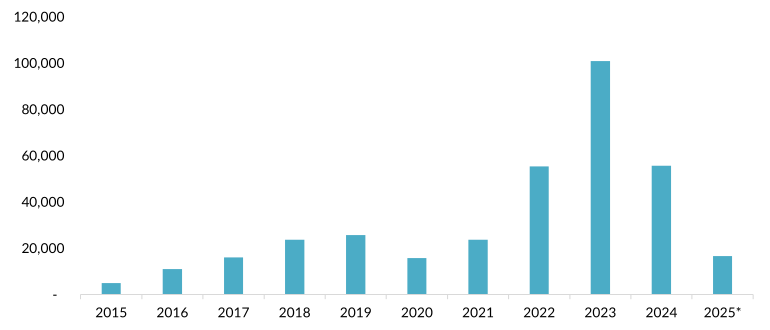
* Data for 2025 cover the first half of the year.
Source: EU Agency for Asylum (EUAA), “Asylum Applications Down by 23% in the First Half of 2025,” press release, September 8, 2025, available online.
Meanwhile, Turkish asylum seekers have been less likely to have their applications approved. The asylum recognition rate for Turkish nationals fell from about 54 percent in 2019 to 12 percent in the first half of 2025 (see Figure 3). Even as Turkey’s internal conflict has been declared over, requests for asylum have remained high but approvals fell to record lows.
Figure 3. Decisions on EU Asylum Applications Filed by Turkish Nationals, by Outcome, 2015-25*
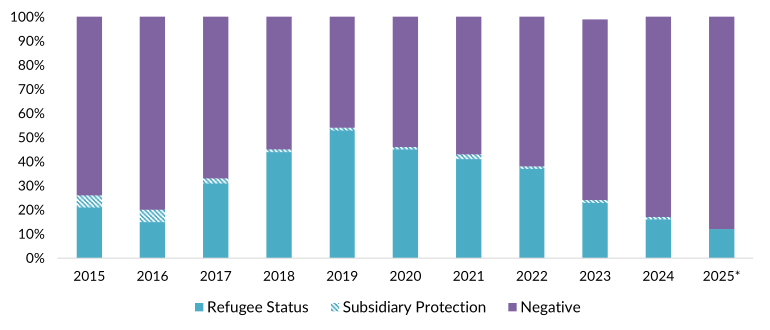
* Data for 2025 cover the first half of the year.
Source: EUAA, Latest Asylum Trends: Mid-Year Review 2025 (Valetta, Malta: 2025), available online.
In Germany, the response has been especially stark. The country doubled returns of Turkish nationals between 2022 and 2024, from 515 to 1,087, making Turkey the top country of origin for returns from Germany; another 502 Turks were returned in the first quarter of 2025. Refugee advocates have argued against returning Kurdish applicants, claiming many are dissidents subject to persecution.
Sweden, home to as many as 100,000 Kurds of all national origins, provides another example of shifting asylum trends. Pushed by Turkey as a requirement for Sweden to join NATO in 2024, the Swedish government took a hardline position against certain Turkish dissidents. According to media reports, the Swedish Migration Agency quietly modified its asylum processes under pressure from the Turkish government, delaying or rejecting asylum or residence applications from individuals linked to groups that Ankara regards as terrorists, including alleged PKK sympathizers. Leaked documents showed that Turkish asylum seekers were subjected to extra checks by Sweden’s Säpo security service and had their asylum cases forwarded to Sweden’s Ministry of Foreign Affairs in order to maintain diplomatic relations with Turkey. Following NATO accession, Sweden’s government closed its public radio’s Kurdish-language service. The government described the closure, alongside those of services in Russian and Tigrinya languages, as a budgetary measure and denied that there was a connection to its NATO efforts. Still, many Kurds interpreted it as a concession to Turkey’s sensitivities.
A New Approach to Syrians
Meanwhile, trends of Syrians seeking protection in the European Union have changed sharply. For a decade, Syrians were the largest national-origin group requesting asylum in the bloc, but this changed in 2025 amid the power transition in Syria, when Syrian asylum applications fell to third place, after those from Venezuelans and Afghans (see Figure 4). Kurds account for a smaller share of Syrian asylum seekers than those coming from Turkey, but are nonetheless sizable: About one-third of Syrians who applied for asylum in Germany from 2015 through 2024 were believed to be Kurdish.
Figure 4. Asylum Applications by Syrian Nationals in the European Union, 2015-25*
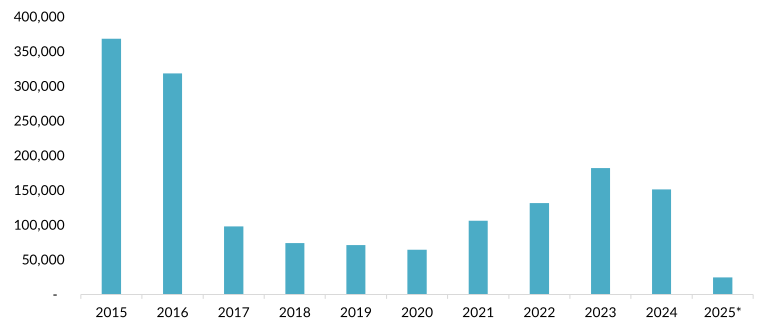
* Data for 2025 cover the first half of the year.
Source: EUAA, “Asylum Applications Down by 23% in the First Half of 2025.”
EU Member States changed policies towards Syrians after Assad’s overthrow, and guidance from the EU Agency for Asylum (EUAA) now considers opponents of the former regime no longer at risk of persecution. Member States including Austria and Germany began returning individuals to Syria in 2025.
Still, long waits for resolving asylum claims persist. As of mid-2025, 918,000 asylum applications were awaiting a first-instance decision, among the largest backlogs on record. Among these cases were nearly 110,000 Syrians and about 37,000 Turkish nationals.
Challenges Ahead: Rights, Repatriation, and Reconciliation
Despite the promising ceasefire in Turkey and regime change in Syria, major challenges remain for Kurdish populations. In Turkey, Kurds continue to face entrenched discrimination and periodic hostility. Decades-old state policies that marginalized the Kurdish identity have not been fully reversed. The government has continued to limit Kurdish language education and prosecute expressions of Kurdish dissent under terrorism laws.
In Syria, meanwhile, after the fall of Assad’s regime and a tenuous ceasefire between government forces and the SDF, many Kurds live in fear, including in the northern autonomous area. More generally since Assad’s overthrow, human-rights groups have documented arbitrary arrests, looting, and violence against Kurdish families and landowners. Additionally, 2025 violence targeting Alawites and Druze demonstrates that Syria remains a particularly dangerous place for minority groups in general. Many civilians have also been traumatized by years of war: UN protection experts have described widespread psychosocial distress and warned that persistent fear and uncertainty have driven some Kurds to flee their homes. Meanwhile, Syria’s health system, including for mental-health care, lies in ruins: Roughly 60 percent of hospitals have been destroyed and many doctors have fled.
Research has highlighted severe mental-health issues among Syrian and Turkish Kurdish asylum seekers, who have been found to have extremely high rates of post-traumatic stress disorder (PTSD), depression, and anxiety, even years after residence outside their home countries. Among migrants from all four Kurdish-origin countries in European and other host nations, 37 percent were found to have PTSD, 36 percent depression, and 28 percent experiencing anxiety, according to a systematic review published in 2025. These problems reflect trauma from persecution and war, which are often compounded by post-migration stressors. The 2025 review led by Darya Rostam Ahmed found roughly 81 percent of Kurdish migrants had fled war or political oppression, and many later reported experiencing discrimination, isolation, family separation, and economic hardship in host countries.
Returnees have emphasized these challenges and many Syrians abroad have expressed fear of being returned. While some governments have begun returning to Syria individuals who were denied asylum, critics have warned that hasty repatriations risk deepening profound psychological wounds.
Kurds in Turkey and Syria face a critical crossroads. The PKK’s ceasefire and the end of the Assad regime have created space for peace and political dialogue, yet core tensions persist. In Turkey, the issue now centers on politics and whether Ankara will allow a space for Kurdish identity. In Syria, Kurds appear intent on safeguarding the self-rule they largely gained during wartime and want to negotiate their future status, including for those outside Kurdish-administered areas. Meanwhile, authorities in Europe have signaled that the conflict is ending. The future for Kurds in the region and those abroad will depend on whether all sides pursue genuine reconciliation and protect human rights or devolve into new rounds of fighting.
Sources
Adamson, Fiona and Veysi Dag. 2023. Integration of Kurdish Refugees in Europe: A Diasporic Perspective. MigrAtion Governance and asYlum Crises (MAGYC) policy brief, SOAS University of London, London, July 2023. Available online.
Ahmad, Gulbin, Ahmet Bekisoglu, and Derya Dêlâl Bozkurt. 2025. Rebuilding Syria’s Health System: Will Kurdish Progress Remain? Think Global Health, October 21, 2025. Available online.
Ahmed, Darya Rostam, Sara K. Kamal, Sarah Mahmoud Mesbah, Jehad Feras AlSamhori, and Reinhard Heun. 2025. Systematic Review of Mental Health Problems and Migration Stressors among Kurdish Migrants in Western Host Countries. Discover Mental Health 5 (1): 158. Available online.
Al Jazeera News. 2019. Who Are the Syrian Democratic Forces? Al Jazeera News, October 15, 2019. Available online.
Al Jazeera Staff. 2026. US Envoy Says SDF’s Role in Syria Has “Largely Expired” After ISIL. Al Jazeera News, January 20, 2026. Available online.
Al-Khalidi, Suleiman. 2025. Syria’s Sharaa Rejects Kurdish Demands for Decentralisation. Reuters, April 27, 2025. Available online.
Ashawi, Khalil, Mahmoud Hasano, and Orhan Qereman. 2026. Last Kurdish Fighters Leave Syria's Aleppo City After Days of Clashes. Reuters, January 10, 2026. Available online.
BBC News. 2017. Who Are the Kurds? BBC News, October 15, 2019. Available online.
BIA News Desk. 2025. “No Excuse Left Not to Build a Democratic Turkey” After PKK Lays Down Arms, Says Pro-Kurdish Leader. Bianet, May 12, 2025. Available online.
Butler, Daren. 2025. In Turkey’s Kurdish Heartland, Distrust Erodes Peace Process Hopes. Reuters, March 31, 2025. Available online.
Butler, Daren and Ece Toksabay. 2025. Kurdish PKK Ends 40-Year Turkey Insurgency, Bringing Hope of Regional Stability. Reuters, May 12, 2025. Available online.
Bosen, Ralf. 2024. Germany's Syrian community — Facts and Figures. Deutsche Welle. October 12, 2024. Available online.
Branam, Leah S., Ismail Yigit, Sipal Haji, Jennifer Clark, and Jessica M. Perkins. 2023. Kurdish Refugee Beliefs about Mental Health and Help-Seeking: A Community-Engaged Research Study in Tennessee. International Journal of Environmental Research and Public Health 20 (2): 1224. Available online.
Bryant, Miranda. 2024. “Now We Are Not Safe:” Sweden’s Kurds Fear Nato Deal Has Sold Them Out. The Guardian, February 7, 2024. Available online.
EU Agency for Asylum (EUAA). 2024. Latest Asylum Trends: 2023. Valetta, Malta: EUAA. Available online.
---. 2025. Asylum Applications Down by 23% in the First Half of 2025. Press release, September 8, 2025. Available online.
---. 2025. Latest Asylum Trends - Annual Analysis. March 3, 2025. Available online.
---. 2025. Latest Asylum Trends: Mid-Year Review 2025. Valetta, Malta: EUAA. Available online.
---. 2025. Syria: Updated EUAA Country Guidance Outlines Changing International Protection Needs. Press release, December 3, 2025. Available online.
Global Protection Cluster. 2025. Protection Landscape in Syria: A Snapshot, March 2025. N.p.: Global Protection Cluster. Available online.
Human Rights Watch (HRW). 1996. Syria: The Silenced Kurds. New York: HRW. Available online.
International Crisis Group. 2014. Flight of Icarus? The PYD’s Precarious Rise in Syria. Erbil/London: International Crisis Group. Available online.
International Rescue Committee (IRC). 2025. Syrians on the Move: Regional Refugee Intentions Briefing. New York: IRC. Available online.
Kaos GL. 2024. HRFT’s Report on Discriminatory, Racist, LGBTI+ Phobic and Hateful Attacks. Kaos GL, October 14, 2024. Available online.
McDowall, David. 2004. A Modern History of the Kurds. London: I.B. Tauris.
Radio Sweden. 2024. Three Language Services at Radio Sweden to Close in Savings Drive. January 31, 2024. Available online.
Turkish Ministry of Foreign Affairs. 2024. Interview of H.E. Hakan Fidan, Minister of Foreign Affairs, Al-Jazeera English, 18 December 2024. December 18, 2024. Available online.
Turkish Minute. 2025. Deportations from Germany to Turkey Double as Migration Hits Record High. Turkish Minute, May 23, 2025. Available online.
---. 2025. PKK’s Disbanding Welcomed Globally with Cautious Optimism, Hopes for Lasting Peace. Turkish Minute, May 12, 2025. Available online.
Williams, Jessie. 2026. Fear and Uncertainty for Yazidis and Kurds in Syria amid Government Advances. The New Humanitarian, January 26, 2026. Available online.
Yussef, Aras. 2025. In the New Syria, Afrin’s Kurds Are Forgotten. Kurdish Peace Institute, July 15, 2025. Available online.