Immigration Systems in Labor-Needy Japan and South Korea Have Evolved—but Remain Restrictive
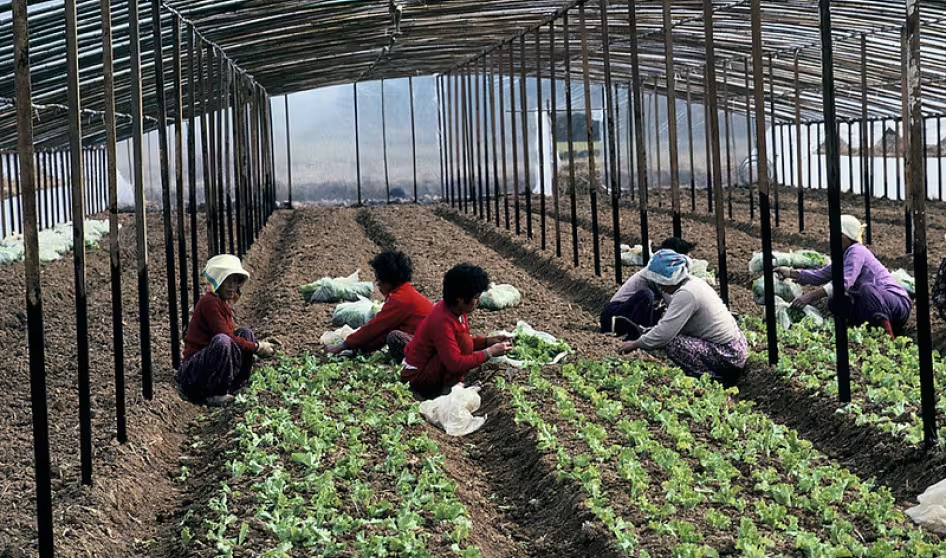
People harvesting crops in South Korea. (Photo: Curt Carnemark/World Bank)
Highlights
Japan and South Korea have quietly expanded immigration through complex, tiered visa systems to meet labor needs while keeping formal pathways to permanent settlement narrow.
- Despite severe demographic pressures, immigrants make up less than 4 percent of the population in Japan and just under 5 percent in South Korea.
- At the same time, both countries' foreign-born populations have grown dramatically, with South Korea's rising more than 50-fold since 1990.
- Both countries have built multi-tiered immigration systems to meet labor needs without broadly liberalizing immigration, institutionalizing hierarchies of rights tied to migrants' perceived economic utility.
Despite severe labor shortages and demographic crises, Japan and South Korea stand out among the world’s liberal democracies for their restrictive immigration policies and low immigration. Over the past few decades, economic pressures and a mainstream political consensus in favor of limited immigration have led to a diverse but hierarchical legal landscape in which many immigrants’ access to rights and long-term residency is tied to their perceived utility towards meeting national goals. The systems have continued to gradually evolve and, despite apparent tensions, are unlikely to be dramatically overhauled in the near future.
The number of immigrants in Japan rose from 851,000 in 1985 to more than 3.4 million in 2023, with the largest numbers coming from China, the Korean peninsula, Vietnam, the Philippines, and Brazil. South Korea’s foreign population grew more than 50-fold in a little over three decades, from fewer than 50,000 in 1990 to approximately 2.5 million in 2023, with the largest numbers coming from China, Vietnam, Thailand, and the Philippines. Despite this sizeable growth, immigrants make up less than 4 percent of the total population in Japan and just under 5 percent in South Korea. (Statistics for both countries include both the foreign born and native-born descendants of immigrants who hold foreign nationality.)
Immigrants’ prospects for permanent settlement are dim. In 2023, more than half of all registered foreign nationals in both countries held temporary visas that could be renewed only a limited number of times. Of these immigrants, approximately 25 percent in both countries held visas that explicitly barred settlement. While immigrants with long-term residence are eligible for generous rights, their access to citizenship varies depending on visa status. And the native-born descendants of immigrants—regardless of how many generations removed from their immigrant ancestor—must undergo the formal process of naturalization to gain citizenship.
This article discusses the multi-tiered migration regimes in Japan and South Korea, which are simultaneously open for some immigrants and restrictive for others.
Once-Closed Immigration Systems Crack Open
Immigration management patterns in Japan and South Korea reflect their intertwined migration histories, on the one hand, and a developmental approach to migration control, on the other.
Japan’s colonization of Korea (1910-45) and Taiwan (1895-1945) generated large-scale migration between the colonies, the Japanese metropole, and imperial frontiers in Manchuria and the Russian Far East. By the end of World War II in 1945, 15 percent of the entire population of the Korean peninsula was residing elsewhere, including approximately 2 million people who had migrated to Japan as laborers, students, or soldiers, many through forced conscription that began in the 1930s. While Japan repatriated approximately two-thirds of colonial-era immigrants to the Korean peninsula and Taiwan during the U.S. occupation (1945-52), Korean and Taiwanese colonial-era immigrants and their descendants remained by far the largest foreign-origin communities in Japan until the 1990s, when numbers from China, South America, South and Southeast Asia, and other origins increased (see Figure 1).
Figure 1. Immigrants in Japan, by Nationality, 1985-2023
In contrast to the policies of European states that opened borders to former colonial subjects during decolonization, post-imperial Japan reclassified former colonial subjects as “aliens” and offered citizenship via the principle of patrilineal jus sanguinis (by descent) rather than jus soli (by place of birth). The government also tightened its borders with the 1951 Immigration Control Act, which was modeled after the 1924 U.S. Immigration Act (also known as the Johnson-Reed Act) setting specific quotas based on country of origin. The basic provisions of this law and the 1950 Nationality Act, setting rules for citizenship acquisition, remained unchanged for decades. Largely in response to efforts to repatriate Japanese settlers left behind in northern China in the chaos of 1945—known as “left-behind compatriots,” most were initially considered denaturalized Japanese citizens—the Nationality Act was revised in 1984 to retroactively eliminate gender discrimination for determining citizenship via descent. In 1990, the Immigration Control Act was revised to reorganize and expand visa categories from 18 to 27, formally instituting several “backdoors” for labor migration under various guises.
Postcolonial migration policies in South Korea, meanwhile, were aimed primarily at emigration until the 1990s. More than 1.5 million Koreans returned after Japan’s defeat in World War II, and then thousands of refugees fled the North amid the division of the Korean peninsula in 1945 and the subsequent outbreak of the Korean War (1950-53). South Korea sought to control overpopulation through policies that sent thousands of students, nurses, and other workers to Japan, Germany, Australia, the Middle East, and the Americas from the 1960s through 1980s. The only significant immigration during this time came from North Korea. But because South Korea officially regards North Korea as part of its shared territory, North Koreans are not classified as immigrants.
Figure 2. Immigrants in South Korea, by Origin, 2000-23
Multi-Tiered Migration Regimes
The “economic miracles” witnessed in Japan and South Korea from the 1960s to the 1980s made both countries attractive destinations for migrant workers. Yet migration policies remained largely unchanged, making legal immigration extremely difficult. This dynamic, combined with growing labor demands and the rise of labor recruiters and intermediaries throughout Asia, quickly gave rise to swelling unauthorized migrant worker populations in both countries. Amid plummeting fertility rates, rapidly aging populations, and mounting labor shortages, the countries could no longer afford to keep their borders closed.
Rather than broadly liberalize immigration, however, Japan and South Korea applied a strategic, goal-oriented approach to directly recruit specific groups—temporary workers, co-ethnic immigrants (those with Japanese or Korean ethnicity born abroad), international students and professionals, and foreign-born spouses (also known as marriage migrants)—through visa categories that provide differential access to rights and benefits. By allocating discrete institutionalized rights for subcategories of migrants according to their perceived socioeconomic value, Tokyo and Seoul institutionalized noncitizen hierarchies on which to build multi-tier immigration regimes. The unprecedented disruptions of the COVID-19 pandemic led to the speedy development and implementation of many exceptional statuses in order to relieve employers who no longer needed contracted labor, make it easier for immigrants to find work, and provide temporary work authorizations for migrants unable to return to their origin countries. But recent years have marked the entrenchment and expansion of the logic of diversified and conditionalized statuses.
Figure 3. Noncitizens in Japan and South Korea, by Visa Category, 2023
From Trainees to Guestworkers
South Korea and Japan maintained closed-door policies to unskilled immigration until 2004 and 2019, respectively. To meet labor demands, both countries instead instituted unregulated “industrial trainee” programs—Japan in 1981 and Korea in 1991—that granted foreign trainees one-year visas to acquire technical skills. Trainees were mostly from other Asian countries including China, Vietnam, and, in Japan’s case, South Korea. From the outset, these programs, which were concentrated in the manufacturing and construction industries, were plagued by exploitative practices and human-rights violations, and resulted in growing populations of unauthorized migrant workers unprotected by labor laws.
In South Korea, many civil-society groups that had been central to the democratization movement through the late 1980s—including labor, religious, human-rights, and women’s-rights organizations—established themselves as advocates for migrant workers. With unprecedented access to the upper echelons of government under Presidents Kim Dae-jung (1998-2003) and Roh Moo-hyun (2003-08), the migrant-rights movement succeeded in providing legal status to many workers through the 2004 establishment of the Employment Permit System (EPS), which was South Korea’s first formal foreign-worker program. EPS regularized immigrant workers and guaranteed them the same labor rights and protections as native Koreans, including pensions and health insurance.
South Korea subsequently abolished the industrial trainee system in 2007. While the E-9 Nonprofessional Employment visa associated with the EPS has an extended three-year duration with the possibility for a single three-year renewal, it does not provide a pathway to permanent settlement or citizenship. In 2023, E-9 visa holders made up approximately 22 percent of all immigrants eligible to work in South Korea (see Figure 4).
Figure 4. Immigrants Eligible for Employment in South Korea, by Category, 2010-23
Japan, by contrast, made incremental reforms to its industrial trainee system by extending the length of trainee visas and affirming labor protections and rights, leading to the 1993 establishment of the Technical Intern and Training Program (TITP). While the official purpose of the TITP is for “human resource development” and foreign assistance, the program remains the primary unofficial pathway for recruiting unskilled and semi-skilled foreign labor despite widespread allegations of exploitation, poor working conditions, and other harms. Although Japan eventually launched a formal (“specified skilled worker”) program in 2019 to recruit skilled and semi-skilled migrants in agriculture, construction, shipbuilding, hospitality, and nursing, the move was accompanied by the expansion—and not the dissolution—of TITP. In June 2024, the Justice Ministry publicized preliminary sketches of a new Training and Employment program to be implemented by 2027, in conjunction with a gradual phaseout of the much-criticized TITP. Reflecting broader trends in Japanese visa policy, the new program will add additional language and technical skills credentialing and testing requirements over the course of migrants’ stay, in conjunction with increased quotas and broader but still conditional access to rights such as the freedom to change employers. In contrast to the generally incremental nature of Japanese policy changes, the new program represents a significant shift; whereas TITP is formally described as a training program to disseminate technical knowledge to developing nations, the Training and Employment program is explicitly a labor immigration scheme to recruit a steady supply of guestworkers while offering the most motivated and high-performing immigrants opportunities to achieve residency and permanent settlement.
Figure 5. Immigrants Eligible for Employment in Japan, by Category, 2010-23
Co-ethnic Immigrants
A second major pathway for informally recruiting unskilled migrant labor came in the form of programs specifically for co-ethnic immigrants. Japan’s 1990 revision to the Immigration Control Act introduced a long-term resident (teijūsha) visa that provided unrestricted entrance and employment rights in Japan available to ethnic Japanese immigrants and their descendants (until the third generation), who are popularly called Nikkei. This status is one of only four permitting unrestricted economic activities; the others are for special permanent residents (limited to colonial-era immigrants and their descendants), permanent residents, and spouses or children of a Japanese national or permanent resident (see Table 1). The long-term resident visa thus allows for permanent settlement, unlike TITP which is contingent on continued employment by the sponsoring company. While the stated purpose of the visa was to invite Nikkei to learn the Japanese language and cultural heritage and also visit relatives, most holders were Brazilian and Peruvian nationals recruited to work in the construction and manufacturing sectors. Just one year after this visa’s creation, Brazilians (the vast majority of whom were Nikkei) became the third-largest immigrant population in Japan, following Koreans and Chinese.
Table 1. Major Employment and Residential Visa Categories in Japan, 2025
|
Visa Category |
Year Established |
Eligibility |
Employment Restrictions |
Associated Rights |
Duration & Renewals Permitted |
|---|---|---|---|---|---|
| Long-Term Resident |
1990 |
Individuals with special familial or humanitarian circumstances; |
None |
Right to work and reside; sponsorship of family allowed; public benefits access; ability to leave Japan for 90 days (or up to five years or until expiration of status with permit application) at a time without losing status |
Varies from 1-5 years; |
| Special Permanent Resident |
1991 |
Immigrants from former Japanese colonies (primarily Korea and Taiwan), including those coerced into migrating, and their descendants |
None |
Residency without immigration complications; public benefits access; ability to leave Japan for two years (or up to six years with permit application) at a time without losing status |
Indefinite; |
| Technical Intern and Training Program (TITP) |
1993 |
Individuals from developing countries in training programs |
Restricted to limited types of work at a specific workplace |
Limited ability to change employers; no sponsorship of family allowed |
5 years; |
| Economic Partnership Agreement (EPA) Nursing Workers (subcategory of Designated Activities) |
2008 |
Nurses and caregivers from countries with bilateral Economic Partnership Agreements |
Employment restricted to health-care institutions |
On-the-job training; residency rights upon employment |
1 year initially, renewable up to 3 years during examination phase; |
| Highly Skilled Foreign Professional (subcategory of Designated Activities) |
2012 |
Professionals recognized for specific achievements |
None |
Preferential rights for residency, family, and long-term stay |
1-5 years; |
| Highly Skilled Professional |
2015 |
Points-based system for highly qualified workers with advanced education or skills |
None |
Accelerated permanent residency for those with the most points (1 year); family accompaniment; ability to sponsor foreign domestic workers; expedited processing of documents |
1–5 years; |
| Fourth Generation Nikkei (subcategory of Designated Activities) |
2018 |
Great-grandchildren of Japanese emigrants from ages 18 to 35 |
Work must involve "language and cultural activities" and cannot be in adult entertainment sectors; language skills evaluated at initial application and during renewals |
Right to work; Japanese language training; access to government-sponsored network of "supporters;" no sponsorship of family allowed |
1 year; |
| Specified Skilled Worker |
2019 |
Foreign workers with skills in 14 specified sectors (including construction and hospitality); some TITP workers eligible for simplified transfer |
Work restricted to designated fields; flexibility to move between employers but must remain within credentialled field |
Can bring family (Type 2 only); |
Type 1: Up to 5 years total; |
| J-SKIP (Special Highly Skilled Professionals; subcategory of Designated Activities) |
2023 |
Workers in (a) advanced academic research, (b) specialized/technical, or (c) business activities |
(a) and (b) must have either at least a master’s degree or 10 years work experience and annual income of at least 20 million yen (approx. U.S. $130,000); (c) must have at least 5 years work experience and an annual income of at least 40 million yen (approx. U.S. $260,000) |
Broad rights, including family sponsorship, fast track to permanent residency, and expedited processing of documentation |
1-5 years; |
| Training and Employment System |
Announced in 2024, to be in place by 2027 |
Workers transitioning to specified skilled status; TITP workers will be eligible for transfer if they pass skills and language exams |
Broad but defined range of fields |
Not yet finalized as of writing, but likely to feature limited ability to change employers with no sponsorship of family allowed |
1–3 years; |
South Korea did not create a visa specifically for ethnic Korean immigrants until 1999, but those from China (Joseonjok) were allocated the largest quotas within the industrial trainee system and, later, the EPS. Unlike ethnic Japanese immigrants who can obtain long-term residence in Japan, however, Chinese of Korean descent were subjected to the same restrictions as other industrial trainees. This changed with the creation of two visas specifically for co-ethnic immigrants in 1999 and 2007: the Overseas Korean visa, which provides generous benefits, and the H-2 Working Visit visa, created specifically for ethnic Koreans from China and the former Soviet Union to work in the service and construction industries (see Table 2). Chinese of Korean descent comprise the largest foreign resident community in South Korea by far, having grown more than 19-fold from slightly more than 32,000 in 2000 to more than 627,000 in 2023.
Table 2. Major Employment and Residential Visa Categories in South Korea, 2025
|
Visa Category |
Year Established |
Eligibility |
Employment Restrictions |
Associated Rights |
Duration & Renewals Permitted |
|---|---|---|---|---|---|
| F-4 Overseas Korean |
1999 |
Emigrants with documentary evidence of household registration in Korea |
No restrictions |
Property rights, investment rights, health insurance, pensions, other social welfare benefits, and dual citizenship eligibility |
3 years; |
| F-5 Permanent resident |
2002 |
5-year continuous residency (exceptions for native-born ethnic Chinese hwagyo, F-4 and F-6 visa holders, and foreign investors) |
None |
Property rights, investment rights, health insurance, pensions, other social welfare benefits, and local voting rights |
No renewals necessary (until 2018) |
| E-9 Nonprofessional Employment |
2004 |
Nationals of countries with a memorandum of understanding with South Korea |
Employment restricted to a single industry and maximum of 3 workplace changes in first 3 years |
Protections under South Korean labor laws (including pensions and health insurance) |
3 years; |
| H-2 Working Visit |
2007 |
Ethnic Koreans from China and the former USSR (up to the grandchildren of emigrants) ages 25 years and above |
None |
Protections under South Korean labor laws (including pensions and health insurance) |
3 years; |
| F-6 Marriage Migrant |
2011 |
Spouses of South Korean nationals, caregivers of South Korean citizen children, and divorcees of Korean citizens |
None |
Property rights, investment rights, health insurance, pensions, other social welfare benefits, dual citizenship eligibility, and simplified naturalization |
3 years; |
Unlike countries such as Germany, Ireland, and Italy, which have provided citizenship for documented co-ethnics, Japan and South Korea situate these individuals as a privileged category of foreigners and offer generous benefits and rights but condition naturalization on years of residence, demonstrated economic self-sufficiency, and law-abiding behavior. This policy is also in contrast with Seoul’s treatment of North Korean migrants, who are considered citizens, as well as Tokyo’s attitude towards “left-behind compatriots,” whose denaturalizations were overturned and thus are recognized as citizens independent of other factors.
At the same time, the recruitment of ethnic Japanese and Koreans was justified through a misguided discourse that assumed they would readily assimilate. Accordingly, little preparation was made, especially at the national level, for these immigrants’ schooling, language training, and integration. Many co-ethnic workers who lack sufficient language skills have found themselves occupying a precarious position in the labor market as contract workers who can be affected by even minor bumps. Particularly in Japan, children have tended to face inflexible public schools that give little consideration to the needs of foreign-born, non-native speaking, or multicultural-background students, leading to much lower enrollment, attendance, and graduation rates at the secondary and postsecondary levels than for the general population. Responsibility for integrating co-ethnic Japanese has largely fallen upon local governments. Meanwhile, in the aftermath of the 2008-09 financial crisis, the national government paid thousands of unemployed Nikkeijin to return to their Latin American countries of origin and instituted language and guarantor requirements for fourth-generation Nikkei applicants.
International Students and Professionals
Recent scholarship has increasingly considered international students in Japan and South Korea as numerically and economically significant labor migrants in their own right. Japan has drawn foreign students since the Meiji Restoration in the 1860s, primarily from China and other Asian countries, but in 2024 for the first time more international students were enrolled in South Korean universities than those in Japan. Because international students in both countries can legally work part-time, language schools and smaller universities have become notorious backdoors for students primarily interested in earning money and sending back remittances. Despite widespread abuse of the system and evidence that sizable numbers of students work illegally, both countries have intensified competition to attract international students, with the goals of drawing revenue to education sectors facing demographic and fiscal decline, providing an additional part-time labor force, and generating a pool of internationalized talent that can bridge different business cultures.
Meanwhile, both countries have had mixed results courting highly valued international professionals and the wealthy. Point-based visas offering highly advantageous treatment such as expedited processing and shortened residency requirements for naturalization and permanent residency were introduced in 2010 as the F-2-7 in South Korea and in Japan as the Highly Skilled Professional visa in 2012. However, annual quotas for these programs remain unmet, likely in part because positions tend to offer lower salaries than those in Western Europe or Anglophone countries, concerns about difficult working conditions and slim opportunities for career advancement, and increasing opportunities elsewhere in Asia. South Korea and Japan also introduced “digital nomad” visas in 2024, doubling down on the strategy.
Marriage Migration
Another migration stream prioritized by both countries is what is popularly referred to as marriage migration. Foreign spouses of native citizens have made up one of the fastest-growing immigrant groups in Japan and South Korea since the late 1990s. Faced with fertility rates below the population replacement level of 2.1 children per woman (since 1975 in Japan and since 1984 in South Korea), rapidly aging populations, and shrinking working-age populations, government officials and others began recruiting female immigrants as wives for the growing number of unmarried, aging men. This has been the case largely in rural areas and has been noticeable since the 1980s in Japan and the 1990s in South Korea. South Korea has additionally invested heavily in social integration programs specifically for immigrant spouses and their families, ranging from Korean language and culture classes to employment training, crisis hotlines, and shelters. Immigrant spouses also featured centrally in Korean debates leading to the 2010 passage of a bill allowing multiple nationalities. In both countries, marriage to a native constitutes one of the few pathways to permanent settlement and citizenship.
Half-Open Doors and Proliferating Tracks for Migration
Rather than a single path toward either more open or more closed immigration policies, Japan and South Korea have partially opened their borders through multiple tracks for different migrant subpopulations. The proliferation of visa categories, each with its own set of rights and privileges, has institutionalized noncitizen hierarchies, widening the gap between those eligible for select visa statuses that come with quasi-dual citizenship rights and those with temporary visas that strictly limit employment and residence. As both countries face the triple challenges of rapidly aging populations, low birthrates, and shrinking working-age populations, one can expect the expansion of their multi-tier migration regimes in the future.
Contrary to the widespread public and political backlash against immigration that has energized restrictionist impulses throughout the world, successive Japanese and Korean administrations have continued to gradually increase migration quotas while simultaneously expanding the complexity of visa schemes. As demographic pressures intensify at home and domestic wages continue to grow across Asia’s migrant-sending countries, Japan and Korea will struggle to meet labor needs without increasing both the overall number of migrants and their institutionalized rights. The challenge ahead will lie in being able to thread this fine needle while limiting the polarizing political consequences that have been so impactful elsewhere.
Sources
Choo, Hae Yeon. 2016. Decentering Citizenship: Gender, Labor, and Migrant Rights in South Korea. Stanford, CA: Stanford University Press.
Chung, Erin Aeran. 2010. Immigration and Citizenship in Japan. New York: Cambridge University Press.
---. 2020. Creating Hierarchies of Noncitizens: Race, Gender, and Visa Categories in South Korea. Journal of Ethnic and Migration Studies 46 (12): 2497-514.
---. 2020. Immigrant Incorporation in East Asian Democracies. New York and Cambridge, UK: Cambridge University Press.
---. 2022. The Developmental Migration State in East Asia. In Understanding Global Migration, eds. James F. Hollifield and Neil Foley. Stanford, CA: Stanford University Press.
---. 2022. The Side Doors of Immigration: Multi-Tier Migration Regimes in Japan and South Korea. Third World Quarterly 43 (7): 1570-86.
Chung, Erin Aeran, Darcie Draudt, and Yunchen Tian. 2023. The Developmental Migration State. Journal of Ethnic and Migration Studies 50 (3): 637-56.
Chung, Erin Aeran and Daisy Kim. 2012. Citizenship and Marriage in a Globalizing World: Multicultural Families and Monocultural Nationality Laws in Korea and Japan. Indiana Journal of Global Legal Studies 19 (1): 195-219. Available online.
Kim, Jaeeun. 2016. Contested Embrace: Transborder Membership Politics in Twentieth-Century Korea. Stanford, CA: Stanford University Press.
Kim, Nora Hui-Jung. 2008. Korean Immigration Policy Changes and the Political Liberals’ Dilemma. International Migration Review 42 (3): 576-96.
Liu-Farrer, Gracia. 2011. Making Careers in the Occupational Niche: Chinese Students in Corporate Japan’s Transnational Business. Journal of Ethnic and Migration Studies 37 (5): 785-803.
---. 2020. Immigrant Japan: Mobility and Belonging in an Ethno-Nationalist Society. Ithaca, NY: Cornell University Press.
Liu-Farrer, Gracia and An Huy Tran. 2019. Bridging the Institutional Gaps: International Education as a Migration Industry. International Migration 57 (3): 235–49. Available online.
Morris-Suzuki, Tessa. 2010. Borderline Japan: Frontier Controls, Foreigners and the Nation in the Postwar Era. New York: Cambridge University Press.
Takenoshita, H. 2013. Labour Market Flexibilisation and the Disadvantages of Immigrant Employment: Japanese-Brazilian Immigrants in Japan. Journal of Ethnic and Migration Studies 39 (7): 1177–95.
Tian, Yunchen. 2019. Workers by Any Other Name: Comparing Co-Ethnics and ‘Interns’ as Labour Migrants to Japan. Journal of Ethnic and Migration Studies 45 (9): 1496–1514. Available online.
Tian, Yunchen and Erin Aeran Chung. 2018. Is Japan Becoming a Country of Immigration? Foreign Affairs, August 3, 2018. Available online.
Tsuda, Takeyuki. 2003. Strangers in the Ethnic Homeland: Japanese Brazilian Return Migration in Transnational Perspective. New York: Columbia University Press.
---, ed. 2009. Diasporic Homecomings: Ethnic Return Migration in Comparative Perspective. Stanford, CA: Stanford University Press.