National Center on Immigrant Integration Policy

The National Center on Immigrant Integration Policy serves as a crossroads for policymakers, community and system leaders, and others looking to understand ways to support successful integration of immigrants and their children into U.S. classrooms, workplaces, and civic spaces.
It produces evidence-informed, nonpartisan policy research and data, and provides technical assistance and cross-state learning opportunities for state and local leaders. By engaging with stakeholders across the early childhood, education, workforce, health, and civic sectors, the Center builds a more coherent, knowledge-driven field. It shines a spotlight on integration issues often overlooked in national debates and promotes solutions that can lift the integration trajectories of immigrant families while also fueling the vibrancy of the communities and local economies where they live. For more about the Center, click here.


More Featured Work




- General Inquiries
Showing 111–120 of 375 results
An Early Readout on the Economic Effects of the COVID-19 Crisis: Immigrant Women Have the Highest Unemployment
Immigrant women in the United States faced the steepest job losses in the COVID-19 recession, with unemployment peaking at 18.5 percent in May 2020.

Lessons from the Pandemic: Weaknesses in K-12 Teacher Education Policies Fuel Inequities Facing English Learners
The COVID-19 pandemic has affected nearly every aspect of education, and it is expected that English Learners (ELs) will suffer disproportionate impacts. In this webcast, panelists discuss how weaknesses in existing EL teacher education and professional development policies have played into schools’ uneven response to the pandemic. They also offer lessons for future reform.
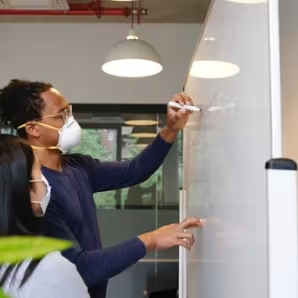
Supporting Immigrant and Refugee Families through Home Visiting: Innovative State and Local Approaches
State and local case studies reveal how community-based programs and equity-focused procurement can improve home visiting for immigrant and refugee families.

Immigrant-Origin Students in U.S. Higher Education: A Data Profile
Immigrant-origin students, who were 28 percent of U.S. college enrollment in 2018, are growing fast and projected to drive U.S. labor force growth through at least 2035.

Navigating the Future of Work: The Role of Immigrant-Origin Workers in the Changing U.S. Economy
Immigrant-origin workers drove 83 percent of U.S. labor force growth from 2010 to 2018 and face similar automation and job-decline risks as their native-born peers.

Centering English Learners in Schools’ Responses to the COVID-19 Pandemic
In this webinar, experts discuss key challenges to meeting English Learners’ needs during the pandemic and the policies and practices that school systems will need to put in place to support them and their families through the public-health and education crisis, as well as when schooling returns to normal.

Educating English Learners during the COVID-19 Pandemic: Policy Ideas for States and School Districts
COVID-19 school closures deepened inequities for the 5 million English Learners, exposing gaps in technology access, teacher training, and equity funding.

Immigration Enforcement and the Mental Health of Latino High School Students
Surveys of Latino high school students in 2018–19 found widespread enforcement fears, with more than half meeting clinical thresholds for anxiety, PTSD, or depression.

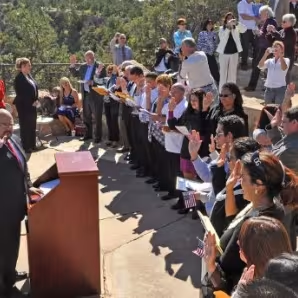
A Bumpy Path to U.S. Citizenship: A Survey of Changing USCIS Practices
Marking the launch of MPI report on USCIS’s evolving procedures for handling citizenship applications, this webinar focuses on the findings from a national survey of naturalization assistance providers. The discussion also examines the increasing obstacles to citizenship, and the effects the pandemic-related shutdown and USCIS financial turmoil could have on the ability of would-be Americans to take the oath of citizenship.
Brain Waste among U.S. Immigrants with Health Degrees: A Multi-State Profile
Some 263,000 immigrants with health degrees are underutilized due to licensing barriers—an untapped U.S. workforce that could help address COVID-19-era health-care shortages.