National Center on Immigrant Integration Policy

The National Center on Immigrant Integration Policy serves as a crossroads for policymakers, community and system leaders, and others looking to understand ways to support successful integration of immigrants and their children into U.S. classrooms, workplaces, and civic spaces.
It produces evidence-informed, nonpartisan policy research and data, and provides technical assistance and cross-state learning opportunities for state and local leaders. By engaging with stakeholders across the early childhood, education, workforce, health, and civic sectors, the Center builds a more coherent, knowledge-driven field. It shines a spotlight on integration issues often overlooked in national debates and promotes solutions that can lift the integration trajectories of immigrant families while also fueling the vibrancy of the communities and local economies where they live. For more about the Center, click here.



More Featured Work




- General Inquiries
Showing 91–100 of 375 results
Narrowing the Skills Gap: Equipping Immigrant-Origin Workers with Postsecondary Credentials
The number of U.S. adults who could benefit from efforts to boost postsecondary credential attainment is strikingly large. Nearly 96 million working-age adults lack a postsecondary credential, 28 million of them of immigrant origin, MPI estimates. This commentary examines how enabling immigrant-origin adults to attain credentials beyond a high school diploma is vital to both building a skilled workforce and closing equity gaps.

Translating Into Success: Key Features of U.S. State & Local Language Access Laws and Policies
MPI researchers examined common features and innovation found in a scan of state and local language access laws and policies in more than 40 states, and offered practical insights local governments can employ as linguistic diversity in their communities grows.
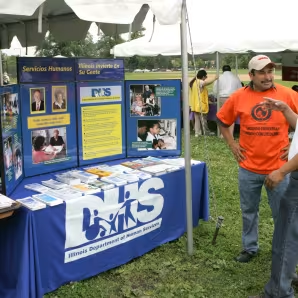
A Framework for Language Access: Key Features of U.S. State and Local Language Access Laws and Policies
This framework maps key features of U.S. state and local language access laws as of 2022, to help governments as they engage in services for residents with limited English proficiency.
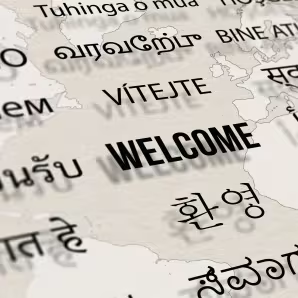
Immigrants’ U.S. Labor Market Disadvantage in the COVID-19 Economy: The Role of Geography and Industries of Employment
Immigrants faced steeper labor losses than U.S.-born workers during the COVID-19 pandemic, driven by concentration in high-risk industries and geographic clusters hit hardest.

Different Statuses, Different Benefits: Determining Federal Assistance for Afghan Evacuees
Afghans evacuated to the United States are entering with a range of legal statuses, with important implications for their ability to access benefits and services that will help them settle into their new communities. This commentary outlines the different statuses and resulting consequences for eligibility for assistance, based on whether the arrivals are recognized as refugees, Special Immigrant Visa (SIV) recipients, or parolees.

Leaving Money on the Table: The Persistence of Brain Waste among College-Educated Immigrants
As of 2019, 2 million college-educated immigrants were underemployed in the United States, with race, English proficiency, and legal status the key predictors of this brain waste.

Immigrant and Other U.S. Workers a Year into the Pandemic: A Focus on Top Immigrant States
A year into the pandemic, immigrant workers, especially women, faced steeper job losses than the U.S. born, with recovery patterns varying sharply by state and industry.

Rebuilding the U.S. Education System for the Nation’s English Learners
The $122 billion investment that K-12 schools across the United States are receiving from the federal government to address the disproportionate impacts of COVID-19 on the nation's most vulnerable students represents a key opportunity to help reset the trajectory of education for English Learners (ELs). As states submit their plans for using the funds, community based organizations can be key partners, as this commentary explains.
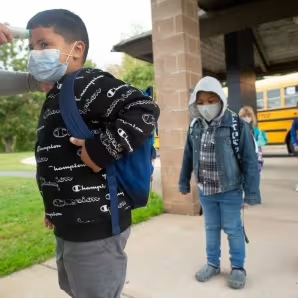
A Solvable Challenge: Improving Asylee Access to Health and Other Benefits
While asylees are eligible for many of the same public benefits and services as resettled refugees, including health care and employment assistance, there is no system to inform them of their eligibility and to help connect them to resources. MPI estimates that fewer than 20 percent of those granted asylum in recent years received Office of Refugee Resettlement benefits during their first year. The U.S. government could address this gap with a few simple measures.

Ending the Invisibility of Dual Language Learners in Early Childhood Systems: A Framework for DLL Identification
MPI proposes a four-step framework to identify 7.4 million Dual Language Learners (DLLs) in early childhood systems, requiring aligned data and well-trained educators.