U.S. Immigration Policy Program
The U.S. Immigration Policy Program provides thought leadership on ways to improve the U.S. immigration system so that it works most effectively in the national interest. To that end, its work focuses on immigration pathways to the United States and immigration enforcement policies and their impacts. It examines the complex demographic, economic, social, political, foreign policy, and other forces that shape U.S. immigration.
Program staff produce data and analyses of immigration trends and the characteristics of U.S. immigrant populations, including unauthorized immigrants. And they conduct original research on the impacts of policy change and the experiences of immigrant populations in diverse parts of the country. This work is frequently informed by private convenings of policymakers and key stakeholders. For more, click here.
The Latest Research
U.S. Deportations and “Self-Deportations” in the First 18 Months of the Second Trump Term
Filling a gap amid a slowdown in official data reporting from the federal government, this analysis offers a window into deportation and "self…

Featured
Physicians in an Era of Changing Immigration Policy: The Case of Nephrology
The care of kidney disease in the United States relies heavily on international medical graduates (IMGs). Recent policy changes could deepen…

Temporary Visa Holders in the United States
The number of U.S. temporary visas plummeted during the COVID-19 pandemic, rebounded, and then fell again in fiscal year (FY) 2025. Preliminary data…

Following Years of High Border Arrivals, the U.S. Unauthorized Immigrant Population Hits New Peak
MPI estimates the U.S. unauthorized immigrant population reached a new peak of 15.8 million as of mid-2024, after holding steady at around 11 million…

More Featured Work
From Counterterrorism to Immigration Enforcement: 25 Years On, Post-9/11 U.S. Changes Have Been Repointed
Post-9/11 national security tools have been repurposed for immigration, expanding the U.S. government’s capacity for surveillance, data sharing, and…

Attacked as "De Facto Amnesty," U.S. Temporary Protected Status Is Abruptly Eroded
The Trump administration moved to terminate most of the 17 Temporary Protected Status (TPS) designations in place when its second term began,…

Though Rare, Birth Tourism to the United States Sparks Outsized Concern
While rare, birth tourism has become a central but contested justification in the Trump administration's push to end the guarantee of birthright…

Key Statistics
Learn more about immigrants and immigration to the United States
14.8%
The immigrant share of the total U.S. population
Learn how this share has evolved (opens in a new tab)50.2 million
The number of immigrants in the United States
Explore Data Profiles by State (opens in a new tab)18.4%
The share of workers in the U.S. civilian labor force who are immigrants
Get the data at U.S. and state levels (opens in a new tab)
Showing 111–120 of 824 results
Meeting Global Skills and Talent Needs in Changing Labor Markets
The discussion focused on the extent to which labor market needs should shape future immigration policy decisions, and how countries are adjusting—and could adjust—their immigration systems to meet human capital and competitiveness needs.

A Path to Meeting the Medical and Mental Health Needs of Unaccompanied Children in U.S. Communities
Unaccompanied children in U.S. communities carry high burdens of trauma and illness, yet fragmented systems and access barriers leave major health needs unmet.

A Post-Title 42 Vision for Migration Management Comes into Focus
Facing a dramatically different reality arriving at the U.S.-Mexico border with the end of a pandemic-era policy that resulted in more than 3 million expulsions, the Biden administration unveiled a policy vision that marries expanded legal pathways with stiff consequences for those seeking to enter without authorization. The strategy can succeed, but speedier while still fair border asylum decisionmaking must be an essential component, this commentary argues.
Federal Judges Step into the Void to Set U.S. Immigration Policy
With Congress overwhelmingly silent on immigration, federal courts have become de facto policymakers, halting or allowing executive actions, managing backlogs, and more.
SNAP Access and Participation in U.S.-Born and Immigrant Households: A Data Profile
Post-1996 federal welfare rules bar many lawfully present immigrants from SNAP. In 2019, many of the 13 million people in low-income immigrant households faced limited or no access to food assistance.

Revamping Asylum at the U.S.-Mexico Border: A Workable Rescue?
The border asylum proposed rule the Biden administration unveiled in February represents a bid to save the U.S. asylum system, not shut it down, as some contend. Whether it can succeed, however, depends on how it is implemented and on other steps that are beyond the bounds of the proposed rule, as this commentary explains.
Imminent End of Formal U.S. Pandemic Emergencies Marks New Era in Immigration Realm
The end of U.S. pandemic emergency declarations will shrink public benefits and reduce health-care access for U.S. residents, with immigrants bearing a disproportionate share of the fallout.
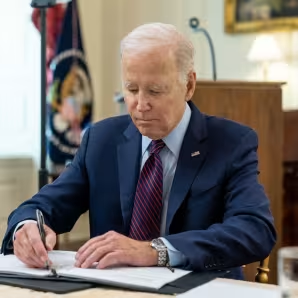
Unblocking the U.S. Immigration System: Executive Actions to Facilitate the Migration of Needed Workers
Without congressional action, U.S. federal agencies can take targeted steps to cut processing backlogs and keep needed workers authorized and productive in the U.S. economy.

Biden at the Two-Year Mark: Significant Immigration Actions Eclipsed by Record Border Numbers
Two years in, the Biden administration set a record pace of executive immigration actions, but high border encounters, court setbacks, and congressional inaction left its agenda unfinished.

Four Strategies to Improve Community Services for Unaccompanied Children in the United States
Coordination, school-based hubs, interdisciplinary care, and a skilled workforce are four key strategies to improve post-release services for unaccompanied children.


- General Inquiries
- Media Inquiries
-
Michelle Mittelstadt
202 266 1910 [email protected]