U.S. Immigration Policy Program

The U.S. Immigration Policy Program provides thought leadership on ways to improve the U.S. immigration system so that it works most effectively in the national interest. To that end, its work focuses on immigration pathways to the United States and immigration enforcement policies and their impacts. It examines the complex demographic, economic, social, political, foreign policy, and other forces that shape U.S. immigration.
Program staff produce data and analyses of immigration trends and the characteristics of U.S. immigrant populations, including unauthorized immigrants. And they conduct original research on the impacts of policy change and the experiences of immigrant populations in diverse parts of the country. This work is frequently informed by private convenings of policymakers and key stakeholders. For more, click here.
The Latest Research
U.S. Deportations and “Self-Deportations” in the First 18 Months of the Second Trump Term
Filling a gap amid a slowdown in official data reporting from the federal government, this analysis offers a window into deportation and "self…

Featured
Physicians in an Era of Changing Immigration Policy: The Case of Nephrology
The care of kidney disease in the United States relies heavily on international medical graduates (IMGs). Recent policy changes could deepen…

Temporary Visa Holders in the United States
The number of U.S. temporary visas plummeted during the COVID-19 pandemic, rebounded, and then fell again in fiscal year (FY) 2025. Preliminary data…

Following Years of High Border Arrivals, the U.S. Unauthorized Immigrant Population Hits New Peak
MPI estimates the U.S. unauthorized immigrant population reached a new peak of 15.8 million as of mid-2024, after holding steady at around 11 million…

More Featured Work
From Counterterrorism to Immigration Enforcement: 25 Years On, Post-9/11 U.S. Changes Have Been Repointed
Post-9/11 national security tools have been repurposed for immigration, expanding the U.S. government’s capacity for surveillance, data sharing, and…

Attacked as "De Facto Amnesty," U.S. Temporary Protected Status Is Abruptly Eroded
The Trump administration moved to terminate most of the 17 Temporary Protected Status (TPS) designations in place when its second term began,…

Though Rare, Birth Tourism to the United States Sparks Outsized Concern
While rare, birth tourism has become a central but contested justification in the Trump administration's push to end the guarantee of birthright…

Key Statistics
Learn more about immigrants and immigration to the United States
14.8%
The immigrant share of the total U.S. population
Learn how this share has evolved (opens in a new tab)50.2 million
The number of immigrants in the United States
Explore Data Profiles by State (opens in a new tab)18.4%
The share of workers in the U.S. civilian labor force who are immigrants
Get the data at U.S. and state levels (opens in a new tab)
Showing 131–140 of 824 results
One Year On: The Situation for At-Risk Afghans in Afghanistan and Abroad
Marking the one-year withdrawal of U.S. troops from Afghanistan and the fall of Kabul to the Taliban, experts reflected on the humanitarian challenges in Afghanistan, the region, and how to ensure at-risk Afghans can reach safety.
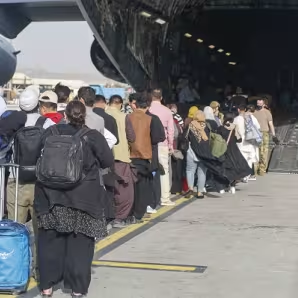
Welcoming Afghans and Ukrainians to the United States: A Case in Similarities and Contrasts
The United States used humanitarian parole to admit displaced Afghans and Ukrainians. But without congressional action, both groups face uncertain futures and no pathway to permanent residence.
Changing the Playbook: Immigrants and the COVID-19 Response in Two U.S. Communities
Immigrants in Nashville and the San Francisco Bay area served in essential COVID-19 roles while community groups bridged health gaps and pushed for foreign-born access to pandemic relief.

The Missing Link: Connecting Eligible Asylees and Asylum Seekers with Benefits and Services
Asylees are eligible for many U.S. refugee-equivalent benefits but lack systems to connect them. Weak outreach and fragmented data leave many underserved.

At Its 10th Anniversary, DACA Faces a Tenuous Future Despite Societal Benefits
Ten years on, the Deferred Action for Childhood Arrivals program (DACA) has proven transformative for hundreds of thousands of Dreamers and the economy. But its future remains uncertain.

The Los Angeles Declaration Could Represent a Big Step for Real Migration Cooperation across the Americas
The Los Angeles Agreement on Migration and Protection signed by leaders from 20 countries across the Western Hemisphere at the 2022 Summit of the Americas marks a significant step forward in creating a common language and a coherent set of ideas for more cooperatively managing migration movements across a region that has seen very significant mobility in recent years, as this commentary explains.

COVID-19’s Effects on U.S. Immigration and Immigrant Communities, Two Years On
COVID-19 slashed U.S. immigration to decade lows, hit immigrant workers hardest, and excluded many from federal relief because of immigration-status rules.

Rise in Maritime Migration to the United States Is a Reminder of Chapters Past
Caribbean maritime migration to the United States has surged to 1990s-level highs, driven by crises in Haiti and Cuba and constrained legal pathways.

Seeking Safety: Regional Protection Options for Central Americans
Speakers offered analysis on regional resettlement and humanitarian channels for Central Americans, along with specific actions the United States and Canada could take.

En Busqueda de Seguridad: Opciones de protección regional para personas de Centroamérica
Con motivo de la publicación de un informe del Instituto de Política Migratoria sobre posibles vías de protección para las personas centroamericanas, este webcast ofrece un análisis sobre las vías humanitarias y de reasentamiento que ya se utilizan en la región así como las oportunidades y los obstáculos para expandir estos programas.

- General Inquiries
- Media Inquiries
-
Michelle Mittelstadt
202 266 1910 [email protected]