U.S. Immigration Policy Program

The U.S. Immigration Policy Program provides thought leadership on ways to improve the U.S. immigration system so that it works most effectively in the national interest. To that end, its work focuses on immigration pathways to the United States and immigration enforcement policies and their impacts. It examines the complex demographic, economic, social, political, foreign policy, and other forces that shape U.S. immigration.
Program staff produce data and analyses of immigration trends and the characteristics of U.S. immigrant populations, including unauthorized immigrants. And they conduct original research on the impacts of policy change and the experiences of immigrant populations in diverse parts of the country. This work is frequently informed by private convenings of policymakers and key stakeholders. For more, click here.
The Latest Research
U.S. Deportations and “Self-Deportations” in the First 18 Months of the Second Trump Term
Filling a gap amid a slowdown in official data reporting from the federal government, this analysis offers a window into deportation and "self…

Featured
Physicians in an Era of Changing Immigration Policy: The Case of Nephrology
The care of kidney disease in the United States relies heavily on international medical graduates (IMGs). Recent policy changes could deepen…

Temporary Visa Holders in the United States
The number of U.S. temporary visas plummeted during the COVID-19 pandemic, rebounded, and then fell again in fiscal year (FY) 2025. Preliminary data…

Following Years of High Border Arrivals, the U.S. Unauthorized Immigrant Population Hits New Peak
MPI estimates the U.S. unauthorized immigrant population reached a new peak of 15.8 million as of mid-2024, after holding steady at around 11 million…

More Featured Work
From Counterterrorism to Immigration Enforcement: 25 Years On, Post-9/11 U.S. Changes Have Been Repointed
Post-9/11 national security tools have been repurposed for immigration, expanding the U.S. government’s capacity for surveillance, data sharing, and…

Attacked as "De Facto Amnesty," U.S. Temporary Protected Status Is Abruptly Eroded
The Trump administration moved to terminate most of the 17 Temporary Protected Status (TPS) designations in place when its second term began,…

Though Rare, Birth Tourism to the United States Sparks Outsized Concern
While rare, birth tourism has become a central but contested justification in the Trump administration's push to end the guarantee of birthright…

Key Statistics
Learn more about immigrants and immigration to the United States
14.8%
The immigrant share of the total U.S. population
Learn how this share has evolved (opens in a new tab)50.2 million
The number of immigrants in the United States
Explore Data Profiles by State (opens in a new tab)18.4%
The share of workers in the U.S. civilian labor force who are immigrants
Get the data at U.S. and state levels (opens in a new tab)
Showing 121–130 of 824 results
The Skills and Economic Outcomes of Immigrant and U.S.-Born College Graduates
Immigrant college graduates match or exceed U.S.-born peers economically, yet the skills of one-fifth of them are underutilized. The gap can be closed with English skills training and credential reform.

After a Slump, Legal Immigration to the United States Is Returning to Pre-Pandemic Levels
U.S. legal immigration is bouncing back to pre-pandemic levels, but massive processing backlogs continue to slow recovery.

A Profile of Low-Income Immigrants in the United States
In 2019, nearly 15 million U.S. immigrants were low income and had higher uninsured rates and lower public benefits use than their U.S.-born counterparts at similar income levels.
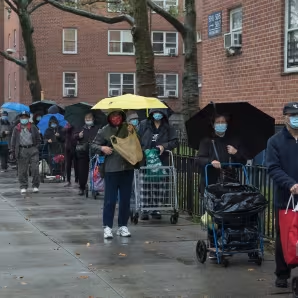
Amid Record Venezuelan Arrivals, Biden Administration Embraces Border Expulsions Policy
Facing record Venezuelan arrivals at the U.S.-Mexico border, the Biden administration paired border expulsions with a limited humanitarian parole program.
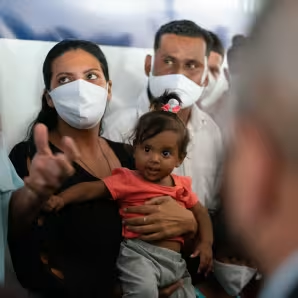
Record-Breaking Migrant Encounters at the U.S.-Mexico Border Overlook the Bigger Story
Headlines focusing on the record-breaking nature of the 2.4 million migrant encounters at the U.S.-Mexico border in fiscal year 2022 overlook the much bigger story: Migrant and asylum seeker flows have rapidly diversified beyond Mexico and northern Central America and as a result, U.S. enforcement policies are misaligned. Today's reality sharply underscores the need for new regional approaches, this commentary argues.
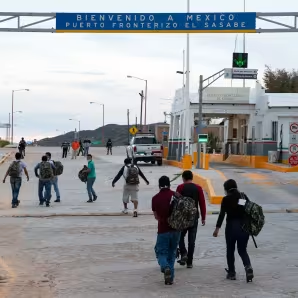
El número récord de encuentros con migrantes en la frontera México-Estados Unidos encubre la historia más importante
Los titulares enfocados en la cifra récord de 2,4 millones de migrantes encontrados en la frontera México-Estados Unidos durante el año fiscal 2022 encubren la historia más importante: Los flujos migratorios se han diversificado rápidamente más allá de México y el norte Centroamérica, y como resultado, las políticas de control migratorio son incongruentes con la realidad de hoy. Esto demuestra la evidente necesitad de nuevos enfoques regionales, argumenta este comentario.
Diverging Pathways: Immigrants’ Legal Status and Access to Postsecondary Credentials
Most of the nearly 24 million U.S. immigrants lacking credentials in 2019 had legal status and Pell Grant eligibility; unauthorized immigrants were barred from federal education support.

Busing and Flights of Migrants by GOP Governors Mark a New Twist in State Intervention on Immigration
Republican governors' busing and flights of migrants to Democratic cities escalated state-versus-state immigration politics and exposed gaps in the U.S. reception system.

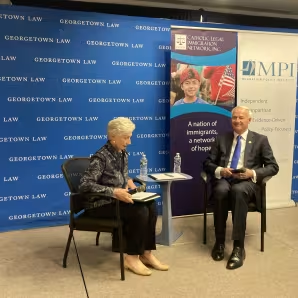
19th Annual Immigration Law and Policy Conference
This conference examined the Biden administration's immigration record, border and asylum policy, litigation trends, and humanitarian protection developments.
The Public-Charge Final Rule Is Far from the Last Word
The Biden administration public-charge final rule undoes deep restrictions imposed during the Trump era, codifying much of the policy in place from 1999 to 2019. Yet confusion and fear over triggering negative immigration consequences will continue to keep many immigrants and their U.S.-born relatives from accessing benefits and services for which they are eligible absent a robust educational campaign, this commentary explains.


- General Inquiries
- Media Inquiries
-
Michelle Mittelstadt
202 266 1910 [email protected]