U.S. Immigration Policy Program
The U.S. Immigration Policy Program provides thought leadership on ways to improve the U.S. immigration system so that it works most effectively in the national interest. To that end, its work focuses on immigration pathways to the United States and immigration enforcement policies and their impacts. It examines the complex demographic, economic, social, political, foreign policy, and other forces that shape U.S. immigration.
Program staff produce data and analyses of immigration trends and the characteristics of U.S. immigrant populations, including unauthorized immigrants. And they conduct original research on the impacts of policy change and the experiences of immigrant populations in diverse parts of the country. This work is frequently informed by private convenings of policymakers and key stakeholders. For more, click here.
The Latest Research
U.S. Deportations and “Self-Deportations” in the First 18 Months of the Second Trump Term
Filling a gap amid a slowdown in official data reporting from the federal government, this analysis offers a window into deportation and "self…

Featured
Physicians in an Era of Changing Immigration Policy: The Case of Nephrology
The care of kidney disease in the United States relies heavily on international medical graduates (IMGs). Recent policy changes could deepen…

Temporary Visa Holders in the United States
The number of U.S. temporary visas plummeted during the COVID-19 pandemic, rebounded, and then fell again in fiscal year (FY) 2025. Preliminary data…

Following Years of High Border Arrivals, the U.S. Unauthorized Immigrant Population Hits New Peak
MPI estimates the U.S. unauthorized immigrant population reached a new peak of 15.8 million as of mid-2024, after holding steady at around 11 million…

More Featured Work
From Counterterrorism to Immigration Enforcement: 25 Years On, Post-9/11 U.S. Changes Have Been Repointed
Post-9/11 national security tools have been repurposed for immigration, expanding the U.S. government’s capacity for surveillance, data sharing, and…

Attacked as "De Facto Amnesty," U.S. Temporary Protected Status Is Abruptly Eroded
The Trump administration moved to terminate most of the 17 Temporary Protected Status (TPS) designations in place when its second term began,…

Though Rare, Birth Tourism to the United States Sparks Outsized Concern
While rare, birth tourism has become a central but contested justification in the Trump administration's push to end the guarantee of birthright…

Key Statistics
Learn more about immigrants and immigration to the United States
14.8%
The immigrant share of the total U.S. population
Learn how this share has evolved (opens in a new tab)50.2 million
The number of immigrants in the United States
Explore Data Profiles by State (opens in a new tab)18.4%
The share of workers in the U.S. civilian labor force who are immigrants
Get the data at U.S. and state levels (opens in a new tab)
Showing 91–100 of 824 results
Shifting Patterns and Policies Reshape Migration to U.S.-Mexico Border in Major Ways in 2023
There is a deeper story behind the U.S. government's fiscal 2023 border encounters numbers than that the year marked a new record high. The pivot from the pandemic-era Title 42 expulsions policy and sharp diversification in nationalities have reshaped migrant arrivals unlike any year before. This commentary goes beyond the headlines to focus on the more enduring—and challenging—realities occuring at the U.S.-Mexico border.

Shared Gains: Immigrant-Origin Students in U.S. Colleges
Immigrant-origin students represent a growing share of U.S. college enrollment, rising from one in five pupils in 2000 to one in three as of 2021—cushioning overall enrollment declines.

Addressing the Next Displacement Crisis in the Making in the Americas
The next major displacement of people in the Americas is in the making, and it is going unnoticed. The response to the steady emigration from Haiti seen since a devastating 2010 earthquake has been largely haphazard and may not stand the test of new spikes as the country unravels further. This commentary suggests a way forward, based on a model used for the Venezuelan displacement crisis.

New York and Other U.S. Cities Struggle with High Costs of Migrant Arrivals
Record migrant arrivals have pushed U.S. cities to spend billions on shelter and services as federal aid falls far short and work authorization lags.

The Power of Refugee Sponsorship: A Sponsor’s Story
An immigration lawyer in a small Minnesota farming town formed one of the first groups to sponsor a refugee family under the new U.S. Welcome Corps program, and this is what she learned.

20th Annual Immigration Law and Policy Conference
Experts examined the Biden administration's immigration actions, border policy, state actions, legal representation, humanitarian parole for Cuban, Haitian, Nicaraguan, and Venezuelan nationals, and other top issues in immigration policy.
A Turning Point for the Unauthorized Immigrant Population in the United States
The unauthorized immigrant population in the United States stood at approximately 11.2 million people in mid-2021, with larger annual growth than at any point since 2015, according to MPI's latest estimates. Even as the Mexican unauthorized immigrant population continued its decade-long decline, there were new entrants from a growing array of other countries.

A Shrinking Number of DACA Participants Face Yet Another Adverse Court Ruling
The DACA program has received another blow to its survival, with a federal court once again ruling that the executive branch exceeded its authority in creating the program. But with litigation likely to continue for years, it is attrition that is actively reducing the program. This commentary examines the shrinking population of DACA holders, as well as those who have been locked out from participating.
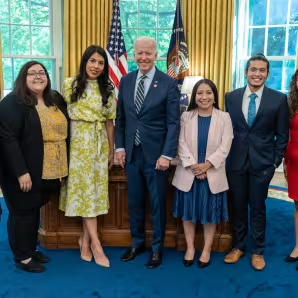
In the Twilight Zone: Record Number of U.S. Immigrants Are in Limbo Statuses
A record 1.9 million migrants were in the United States on temporary statuses in 2023, the result of unprecedented executive actions taken by the Biden administration.
Investing in the Future: Higher Ed Should Give Greater Focus to Growing Immigrant-Origin Student Population
Eighty percent of the increase in U.S. college enrollment between 2000 and 2021 came from U.S.-born students with immigrant parents or first-generation immigrant students. This population, often overlooked, should receive significantly more focus as leaders in higher education and workforce development seek to deliver a skilled workforce for a rapidly changing U.S. labor market, this commentary argues.


- General Inquiries
- Media Inquiries
-
Michelle Mittelstadt
202 266 1910 [email protected]