Four Strategies to Improve Community Services for Unaccompanied Children in the United States

Related Content
Highlights
Coordination, school-based hubs, interdisciplinary care, and a skilled workforce are four key strategies to improve post-release services for unaccompanied children.
- From fiscal years (FY) 2014 through 2022, the federal Office of Refugee Resettlement (ORR) released more than 500,000 unaccompanied children to sponsors. But post-release services remain patchwork, underfunded, and typically limited to 90 days.
- Interagency working groups and service coalitions reduce fragmented care by enabling referrals, information sharing, and continuity between federal shelter staff and local providers.
- Public schools are uniquely positioned as daily contact points; wraparound services, navigation support, and community partnerships can transform them into comprehensive service hubs.
- Recruitment of bilingual, culturally competent staff; ongoing trauma-informed training; and staff care policies are critical to building and retaining an effective frontline workforce.
When unaccompanied migrant children leave federal custody to live with a parent or other sponsor, the transition into U.S. communities can be difficult for both children and their families. While some support is available through a patchwork of programs from local governments, post-release service providers, and other organizations, their resources and capacity vary widely. These organizations also often lack formal mechanisms to coordinate the services unaccompanied children may receive from different providers. Too often, unaccompanied children’s needs are inadequately addressed, negatively affecting their well-being and longer-term development.
Explore the Data: Unaccompanied Children in U.S. Communities
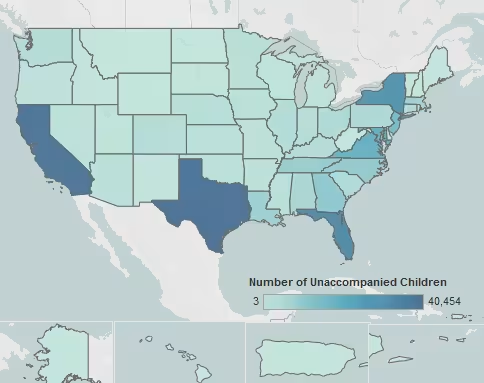
This interactive tool shows the number of unaccompanied minors released to sponsors at U.S., state, and top county levels, as well as the state's share of children released from federal custody annually since 2014.
This issue brief offers promising practices and resources for government agencies, community organizations, and funders seeking to improve supports for unaccompanied children transitioning from federal custody into U.S. communities. The brief focuses on four areas: strengthening coordination among government and community-based organizations to improve continuity of care; leveraging the unique role of public schools to connect children with comprehensive support; taking an interdisciplinary approach to program design so that children and their families can more easily benefit from multiple types of specialized, coordinated services; and developing a workforce of skilled, linguistically and culturally competent service providers. This research results from a collaboration between MPI and the United Nations Children’s Fund (UNICEF) that included three roundtables on supporting unaccompanied children’s transitions into U.S. communities.
Table of Contents
Introduction
Strategy #1. Improving Interagency Coordination and Communication
Strategy #2. Leveraging the Role of Public Schools to Connect Children with Comprehensive Support
Strategy #3. Using Interdisciplinary Approaches to Address Needs Holistically
Strategy #4. Developing a Diverse and Highly Skilled Workforce in Organizations that Serve Unaccompanied Children
Conclusion
About the Human Services Initiative
The Initiative produced work focusing on U.S. federal, state, and local policies on immigration issues affecting children, families, and health and human services.
About the U.S. Immigration Policy Program
The U.S. Immigration Policy Program provides analysis of U.S. immigration pathways, the impacts of enforcement and other policies, and the characteristics of immigrant populations.
About the National Center on Immigrant Integration Policy
The Center is a national hub connecting policymakers, educators, community leaders, and service providers with evidence-informed policy research, technical assistance, and data to advance effective immigrant integration at U.S., state, and local levels.

Related Content