A Path to Meeting the Medical and Mental Health Needs of Unaccompanied Children in U.S. Communities

Related Content
Highlights
Unaccompanied children in U.S. communities carry high burdens of trauma and illness, yet fragmented systems and access barriers leave major health needs unmet.
- Many unaccompanied children arrive with untreated medical conditions and significant trauma histories. Poverty, limited English proficiency, and legal uncertainty compound barriers to medical and mental health care.
- Sponsor households often lack the resources, time, and system knowledge to navigate health services on a child’s behalf, leaving many needs undetected or unaddressed.
- Integrated models that combine medical, mental health, legal, and social services in a single setting—for example, the New Orleans Children’s Health Project—show stronger outcomes for unaccompanied children.
The number of immigrant children traveling to the United States without a parent or legal guardian has increased considerably over the last decade, reaching a historic high in 2022. When these children leave government custody to live with a family member or other sponsor while they await the outcome of their immigration proceedings, many find it difficult to access the services and supports they need to thrive. Medical and mental health services are among the most critical, and having limited access to these services can harm both children and the communities in which they live.
Explore the Data: Unaccompanied Children in U.S. Communities
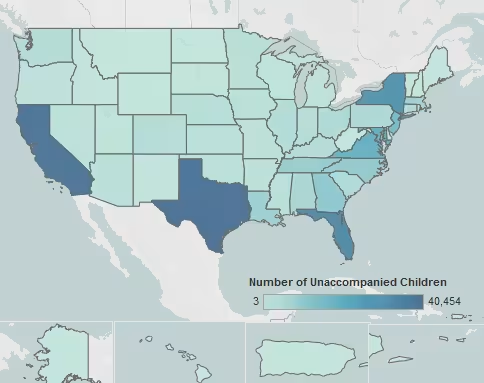
This interactive tool shows the number of unaccompanied minors released to sponsors at U.S., state, and top county levels, as well as the state's share of children released from federal custody annually since 2014.
This report is the culmination of a joint initiative by the American Academy of Pediatrics and MPI to study unaccompanied children’s access to medical and mental health services in U.S. communities. It draws on field visits to three cities (Houston, Los Angeles, and New Orleans) and interviews and focus groups with more than 100 professionals working with this population, as well as unaccompanied children themselves.
This report examines the barriers unaccompanied children face to accessing medical and mental health care—including those related to official policies, the complexities of the U.S. health-care system, and individual and community factors—and highlights promising practices that some regions have adopted to address these barriers. It also presents recommendations for governments, health systems, schools, and communities that, if implemented, would substantially strengthen services for unaccompanied children.
Table of Contents
1 Introduction
2 Unaccompanied Children and the U.S. Health Care System
A. The Health Needs of Unaccompanied Children
B. Medical and Mental Health Services While in Federal Custody
C. Health Care Coverage and Financial Assistance
D. The Importance of Medical and Mental Health Services
3 Barriers to Medical and Mental Health Services
A. ORR Policies and Procedures
B. The U.S. Health Care Infrastructure
C. Individual and Immigration-Related Circumstances
D. Community Factors
4 Promising Practices
A. Communities, Schools, and Local Governments Helping to Smooth Children’s Transition from ORR to a Sponsor
B. Health Care Systems Working to Mitigate Barriers to Access
C. Effective Communication and Trust between Unaccompanied Children, Sponsors, and Communities
5 Recommendations
6 Conclusion
About the Human Services Initiative
The Initiative produced work focusing on U.S. federal, state, and local policies on immigration issues affecting children, families, and health and human services.
About the U.S. Immigration Policy Program
The U.S. Immigration Policy Program provides analysis of U.S. immigration pathways, the impacts of enforcement and other policies, and the characteristics of immigrant populations.
About the National Center on Immigrant Integration Policy
The Center is a national hub connecting policymakers, educators, community leaders, and service providers with evidence-informed policy research, technical assistance, and data to advance effective immigrant integration at U.S., state, and local levels.