U.S. Immigration Policy Program
The U.S. Immigration Policy Program provides thought leadership on ways to improve the U.S. immigration system so that it works most effectively in the national interest. To that end, its work focuses on immigration pathways to the United States and immigration enforcement policies and their impacts. It examines the complex demographic, economic, social, political, foreign policy, and other forces that shape U.S. immigration.
Program staff produce data and analyses of immigration trends and the characteristics of U.S. immigrant populations, including unauthorized immigrants. And they conduct original research on the impacts of policy change and the experiences of immigrant populations in diverse parts of the country. This work is frequently informed by private convenings of policymakers and key stakeholders. For more, click here.
The Latest Research
U.S. Deportations and “Self-Deportations” in the First 18 Months of the Second Trump Term
Filling a gap amid a slowdown in official data reporting from the federal government, this analysis offers a window into deportation and "self…

Featured
Physicians in an Era of Changing Immigration Policy: The Case of Nephrology
The care of kidney disease in the United States relies heavily on international medical graduates (IMGs). Recent policy changes could deepen…

Temporary Visa Holders in the United States
The number of U.S. temporary visas plummeted during the COVID-19 pandemic, rebounded, and then fell again in fiscal year (FY) 2025. Preliminary data…

Following Years of High Border Arrivals, the U.S. Unauthorized Immigrant Population Hits New Peak
MPI estimates the U.S. unauthorized immigrant population reached a new peak of 15.8 million as of mid-2024, after holding steady at around 11 million…

More Featured Work
From Counterterrorism to Immigration Enforcement: 25 Years On, Post-9/11 U.S. Changes Have Been Repointed
Post-9/11 national security tools have been repurposed for immigration, expanding the U.S. government’s capacity for surveillance, data sharing, and…

Attacked as "De Facto Amnesty," U.S. Temporary Protected Status Is Abruptly Eroded
The Trump administration moved to terminate most of the 17 Temporary Protected Status (TPS) designations in place when its second term began,…

Though Rare, Birth Tourism to the United States Sparks Outsized Concern
While rare, birth tourism has become a central but contested justification in the Trump administration's push to end the guarantee of birthright…

Key Statistics
Learn more about immigrants and immigration to the United States
14.8%
The immigrant share of the total U.S. population
Learn how this share has evolved (opens in a new tab)50.2 million
The number of immigrants in the United States
Explore Data Profiles by State (opens in a new tab)18.4%
The share of workers in the U.S. civilian labor force who are immigrants
Get the data at U.S. and state levels (opens in a new tab)
Showing 101–110 of 824 results
Straining under the Backlog: Fixing a U.S. Immigration Court System in Crisis
As the U.S. immigration court system struggled with record case backlogs in 2023, this discussion examined the factors that have driven the system to the point of crisis and possible fixes.

At the Breaking Point: Rethinking the U.S. Immigration Court System
By 2023, the U.S. immigration court backlog surpassed 3 million cases. Incremental fixes have failed—fundamental redesign of the system is essential.

Canada's New Tech Talent Strategy Takes Aim at High-Skilled Immigrants in the United States
Canada’s Tech Talent Strategy is highly unusual for its explicit targeting of visa holders in another country. Opening a dedicated stream specifically for high-skilled immigrants in the United States who hold an H-1B visa is the latest salvo in a growing global competition for talent—one in which some countries are racing ahead of the United States in terms of policy dynamism, as this commentary explores.

Activism on Immigration by U.S. States Is Back, with New Tactics and Different Targets
Immigration activism is back—more polarized than ever—with some states expanding immigrant rights while others enact sweeping enforcement laws and deploy National Guard troops.
U.S. Border Asylum Policy Enters New Territory Post-Title 42
The end of the Title 42 expulsions policy ushered in sweeping border asylum restrictions, but capacity limits, record court backlogs, and litigation have left U.S. border policy on uncertain ground.

The U.S.-Mexico Border Becomes More High-Tech
MPI analysts who toured the U.S.-Mexico border discuss the increasingly sophisticated U.S. Customs and Border Protection operations to address asylum seekers and other migrants arriving at official ports of entry.
Understanding Poverty Declines among Immigrants and Their Children in the United States
Immigrant poverty in the United States fell 36 percent between 2009 and 2021, driven by economic recovery, a wider safety net, and pandemic aid that reached many noncitizen families.

Regional Processing Centers: Can This Key Component of the Post-Title 42 U.S. Strategy Work?
Amid a potentially dramatic rethink in the U.S. approach to management of migration from the Western Hemisphere, the creation of Regional Processing Centers (now known as Safe Mobility Offices, or SMOs) across Latin America will be central to the post-Title 42 strategy, as this commentary explains.
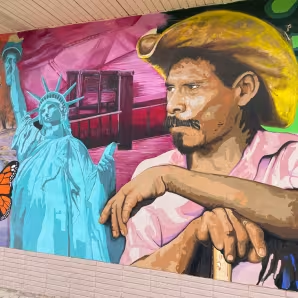
Roxham Road Meets a Dead End? U.S.-Canada Safe Third Country Agreement Is Revised
The revised U.S.-Canada Safe Third Country Agreement closed the Roxham Road loophole but raises serious safety concerns and signals a broader U.S. shift toward externalizing asylum responsibility.
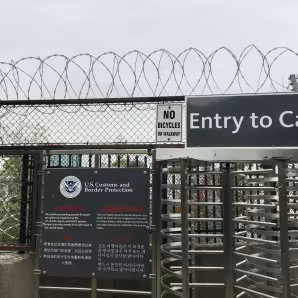
A Complex Picture: Diversifying Migration Flows & Policies at the U.S.-Mexico Border
What is driving the increasingly diverse flows to the U.S.-Mexico border, and how are officials responding on the ground?

- General Inquiries
- Media Inquiries
-
Michelle Mittelstadt
202 266 1910 [email protected]