U.S. Immigration Policy Program

The U.S. Immigration Policy Program provides thought leadership on ways to improve the U.S. immigration system so that it works most effectively in the national interest. To that end, its work focuses on immigration pathways to the United States and immigration enforcement policies and their impacts. It examines the complex demographic, economic, social, political, foreign policy, and other forces that shape U.S. immigration.
Program staff produce data and analyses of immigration trends and the characteristics of U.S. immigrant populations, including unauthorized immigrants. And they conduct original research on the impacts of policy change and the experiences of immigrant populations in diverse parts of the country. This work is frequently informed by private convenings of policymakers and key stakeholders. For more, click here.
The Latest Research
U.S. Deportations and “Self-Deportations” in the First 18 Months of the Second Trump Term
Filling a gap amid a slowdown in official data reporting from the federal government, this analysis offers a window into deportation and "self…

Featured
Physicians in an Era of Changing Immigration Policy: The Case of Nephrology
The care of kidney disease in the United States relies heavily on international medical graduates (IMGs). Recent policy changes could deepen…

Temporary Visa Holders in the United States
The number of U.S. temporary visas plummeted during the COVID-19 pandemic, rebounded, and then fell again in fiscal year (FY) 2025. Preliminary data…

Following Years of High Border Arrivals, the U.S. Unauthorized Immigrant Population Hits New Peak
MPI estimates the U.S. unauthorized immigrant population reached a new peak of 15.8 million as of mid-2024, after holding steady at around 11 million…

More Featured Work
From Counterterrorism to Immigration Enforcement: 25 Years On, Post-9/11 U.S. Changes Have Been Repointed
Post-9/11 national security tools have been repurposed for immigration, expanding the U.S. government’s capacity for surveillance, data sharing, and…

Attacked as "De Facto Amnesty," U.S. Temporary Protected Status Is Abruptly Eroded
The Trump administration moved to terminate most of the 17 Temporary Protected Status (TPS) designations in place when its second term began,…

Though Rare, Birth Tourism to the United States Sparks Outsized Concern
While rare, birth tourism has become a central but contested justification in the Trump administration's push to end the guarantee of birthright…

Key Statistics
Learn more about immigrants and immigration to the United States
14.8%
The immigrant share of the total U.S. population
Learn how this share has evolved (opens in a new tab)50.2 million
The number of immigrants in the United States
Explore Data Profiles by State (opens in a new tab)18.4%
The share of workers in the U.S. civilian labor force who are immigrants
Get the data at U.S. and state levels (opens in a new tab)
Showing 481–490 of 824 results
A Detailed Look at the Unauthorized Immigrant Population Nationally and by State
A discussion on detailed new MPI national and state estimates of the unauthorized immigrant population and key sociodemographic characteristics, as well as upcoming policy and political developments at executive and legislative levels.

Immigration Not Decisive in the Midterms, But Results Critical to the Congressional Debate
Republican gains in 2014 U.S. midterm elections did nor resolve questions around immigration.
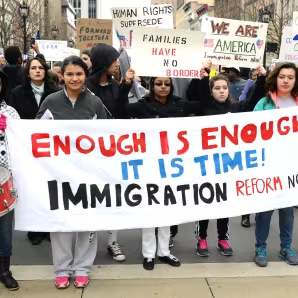
The Global Boom in Investor Immigration: What Are the Lessons for Policymakers?
A discussion on the extraordinary boom in investor immigration. From the rapidly expanding EB-5 visa in the United States to Malta’s controversial “cash for citizenship” policy and a host of programs across Europe and the Caribbean, governments are increasingly offering residence rights or citizenship to wealthy individuals in return for a significant economic investment.

Ebola Outbreak Rekindles Debate on Restricting Admissions to the United States on Health Grounds
The Ebola crisis has revived scrutiny of U.S. health-based immigration controls in a mass-travel era.

11th Annual Immigration Law and Policy Conference
This annual conference offered timely policy and legal analysis and discussion on key immigration topics featuring panels with government officials, researchers, advocates, and other immigration experts

The U.S. Deportation System: Trends from a Decade of Data
MPI researchers discuss the findings from a MPI report that examines the 3.7 million deportations that have occurred in the United States since establishment of the Department of Homeland Security in 2003, as well as lessons that can be learned for future policy and possible administrative action.

Deportation and Discretion: Reviewing the Record and Options for Change
All but 9 percent of the 3.7 million U.S. deportations carried out by DHS from 2003 to 2013 were of Mexicans or northern Central Americans, and disproportionately were of men.

Confronting the Unaccompanied Children Immigration Crisis: Perspectives from Central America, Mexico, and the United States
A discussion on possible medium- and long-term solutions to the flows of unaccompanied children migrating from Central America to the United States.

Unaccompanied Minors Crisis Has Receded from Headlines But Major Issues Remain
While 2014’s U.S. child migrant surge faded fast, court backlogs, due-process battles, and immigration politics continue to play out.
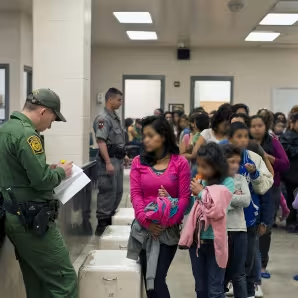
U.S. Customs and Border Protection Commissioner Discusses His Vision for the Agency
U.S. Customs and Border Protection Commissioner R. Gil Kerlikowske outlined his vision and discussed his priorities for the agency as part of MPI's Leadership Visions series.

- General Inquiries
- Media Inquiries
-
Michelle Mittelstadt
202 266 1910 [email protected]