U.S. Immigration Policy Program
The U.S. Immigration Policy Program provides thought leadership on ways to improve the U.S. immigration system so that it works most effectively in the national interest. To that end, its work focuses on immigration pathways to the United States and immigration enforcement policies and their impacts. It examines the complex demographic, economic, social, political, foreign policy, and other forces that shape U.S. immigration.
Program staff produce data and analyses of immigration trends and the characteristics of U.S. immigrant populations, including unauthorized immigrants. And they conduct original research on the impacts of policy change and the experiences of immigrant populations in diverse parts of the country. This work is frequently informed by private convenings of policymakers and key stakeholders. For more, click here.
The Latest Research
U.S. Deportations and “Self-Deportations” in the First 18 Months of the Second Trump Term
Filling a gap amid a slowdown in official data reporting from the federal government, this analysis offers a window into deportation and "self…

Featured
Physicians in an Era of Changing Immigration Policy: The Case of Nephrology
The care of kidney disease in the United States relies heavily on international medical graduates (IMGs). Recent policy changes could deepen…

Temporary Visa Holders in the United States
The number of U.S. temporary visas plummeted during the COVID-19 pandemic, rebounded, and then fell again in fiscal year (FY) 2025. Preliminary data…

Following Years of High Border Arrivals, the U.S. Unauthorized Immigrant Population Hits New Peak
MPI estimates the U.S. unauthorized immigrant population reached a new peak of 15.8 million as of mid-2024, after holding steady at around 11 million…

More Featured Work
From Counterterrorism to Immigration Enforcement: 25 Years On, Post-9/11 U.S. Changes Have Been Repointed
Post-9/11 national security tools have been repurposed for immigration, expanding the U.S. government’s capacity for surveillance, data sharing, and…

Attacked as "De Facto Amnesty," U.S. Temporary Protected Status Is Abruptly Eroded
The Trump administration moved to terminate most of the 17 Temporary Protected Status (TPS) designations in place when its second term began,…

Though Rare, Birth Tourism to the United States Sparks Outsized Concern
While rare, birth tourism has become a central but contested justification in the Trump administration's push to end the guarantee of birthright…

Key Statistics
Learn more about immigrants and immigration to the United States
14.8%
The immigrant share of the total U.S. population
Learn how this share has evolved (opens in a new tab)50.2 million
The number of immigrants in the United States
Explore Data Profiles by State (opens in a new tab)18.4%
The share of workers in the U.S. civilian labor force who are immigrants
Get the data at U.S. and state levels (opens in a new tab)
Showing 491–500 of 824 results
Realizing the DACA and DREAM Promise: Actions to Support Educational Attainment of Potentially Eligible Immigrant Youth
A report release and expert discussion on the eligible population and educational requirements of the DACA program and prior DREAM Act policy proposals, along with recommendations for overcoming the education-success challenges that key subgroups of DACA-DREAM youth face.

Extending New Relief to Unauthorized Immigrants: Estimating the Impacts of Possible Executive Actions
MPI experts unveil the findings of new research that provides estimates of the numbers of unauthorized immigrants who may benefit from potential approaches to administrative relief.
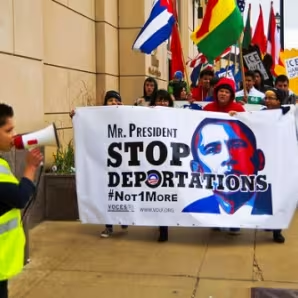
Executive Action for Unauthorized Immigrants: Estimates of the Populations that Could Receive Relief
Executive action on deferred action and enforcement priorities contemplated by the Obama administration could shield 1.3 million to 4.3 million unauthorized immigrants, MPI estimates.
Diploma, Please: Promoting Educational Attainment for DACA- and Potential DREAM Act-Eligible Youth
This report examines how state policies, school supports, and affordability shape education outcomes for DACA- and potential DREAM Act-eligible youth.

The Stalemate over Unaccompanied Minors Holds Far-Reaching Implications for Broader U.S. Immigration Debates
Congress's fight over funding for unaccompanied Central American minors could reshape U.S. immigration politics.
Giving Cities and Regions a Greater Voice in Immigration Policy
MPI researchers and representatives from London and Detroit discuss the policies and strategies used—both at national and local levels—to attract immigrants into local economies and the challenges faced in doing so.

Giving Cities and Regions a Greater Voice in Immigration Policy
MPI researchers and representatives from London and Detroit discuss the policies and strategies used—at national and local levels—to attract immigrants into local economies.

Deferred Action for Childhood Arrivals (DACA) at Two: New MPI Findings as Renewal Approaches
A discussion of MPI's estimates on the size of the DACA population nationally and for 25 key states, as well as application rates and analysis of the program’s challenges and achievements.

DACA at the Two-Year Mark: A National and State Profile of Youth Eligible and Applying for Deferred Action
By July 2014, 55 percent of immediately eligible DACA youth had applied. But cost barriers, education gaps, and limited outreach kept hundreds of thousands from enrolling.

Unaccompanied Minors: A Crisis with Deep Roots and No Simple Solutions
This telebriefing by Doris Meissner and Marc Rosenblum of MPI examines factors behind the flow of unaccompanied children from Central America and Mexico to the United States, which has surged 90 percent since last year. The talk also previews a policy brief on unaccompanied minors that MPI will release in July.

- General Inquiries
- Media Inquiries
-
Michelle Mittelstadt
202 266 1910 [email protected]