U.S. Immigration Policy Program
The U.S. Immigration Policy Program provides thought leadership on ways to improve the U.S. immigration system so that it works most effectively in the national interest. To that end, its work focuses on immigration pathways to the United States and immigration enforcement policies and their impacts. It examines the complex demographic, economic, social, political, foreign policy, and other forces that shape U.S. immigration.
Program staff produce data and analyses of immigration trends and the characteristics of U.S. immigrant populations, including unauthorized immigrants. And they conduct original research on the impacts of policy change and the experiences of immigrant populations in diverse parts of the country. This work is frequently informed by private convenings of policymakers and key stakeholders. For more, click here.
The Latest Research
U.S. Deportations and “Self-Deportations” in the First 18 Months of the Second Trump Term
Filling a gap amid a slowdown in official data reporting from the federal government, this analysis offers a window into deportation and "self…

Featured
Physicians in an Era of Changing Immigration Policy: The Case of Nephrology
The care of kidney disease in the United States relies heavily on international medical graduates (IMGs). Recent policy changes could deepen…

Temporary Visa Holders in the United States
The number of U.S. temporary visas plummeted during the COVID-19 pandemic, rebounded, and then fell again in fiscal year (FY) 2025. Preliminary data…

Following Years of High Border Arrivals, the U.S. Unauthorized Immigrant Population Hits New Peak
MPI estimates the U.S. unauthorized immigrant population reached a new peak of 15.8 million as of mid-2024, after holding steady at around 11 million…

More Featured Work
From Counterterrorism to Immigration Enforcement: 25 Years On, Post-9/11 U.S. Changes Have Been Repointed
Post-9/11 national security tools have been repurposed for immigration, expanding the U.S. government’s capacity for surveillance, data sharing, and…

Attacked as "De Facto Amnesty," U.S. Temporary Protected Status Is Abruptly Eroded
The Trump administration moved to terminate most of the 17 Temporary Protected Status (TPS) designations in place when its second term began,…

Though Rare, Birth Tourism to the United States Sparks Outsized Concern
While rare, birth tourism has become a central but contested justification in the Trump administration's push to end the guarantee of birthright…

Key Statistics
Learn more about immigrants and immigration to the United States
14.8%
The immigrant share of the total U.S. population
Learn how this share has evolved (opens in a new tab)50.2 million
The number of immigrants in the United States
Explore Data Profiles by State (opens in a new tab)18.4%
The share of workers in the U.S. civilian labor force who are immigrants
Get the data at U.S. and state levels (opens in a new tab)
Showing 471–480 of 824 results
The Integration Outcomes of U.S. Refugees: Successes and Challenges
U.S. refugees become self-sufficient over time, but growing diversity and low literacy among recent arrivals strain a system with flat funding and focus on rapid employment.
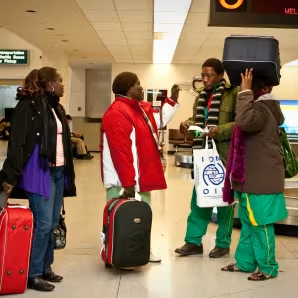
In Historic Shift, New Migration Flows from Mexico Fall Below Those from China and India
China and India surpassed Mexico as leading recent sources of U.S. immigrants in 2013, signaling lasting shifts in flows and demographics.

Recent Court Decisions Put a Sharp Spotlight on U.S. H-2B Temporary Worker Visa Program
A legal battle over H-2B visa regulations has exposed a dispute about agency authority and the program's failure to protect workers.

Unaccompanied Child Migration to the United States: The Tension between Protection and Prevention
U.S. enforcement responses to the 2014 Central American child migration surge cut flows rapidly but left adjudication failures and the root causes of this migration unresolved.
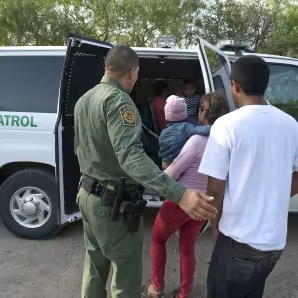
Child and Family Migration to the United States: Continuing Flows and Evolving Responses
A webinar examining the shifting pattern of Central American migration between 2011 and 2014 and expectations for 2015, why inflows in this period present a particularly acute policy challenge, and how states, localities, the U.S. government, and other countries in the region are responding to the crisis.
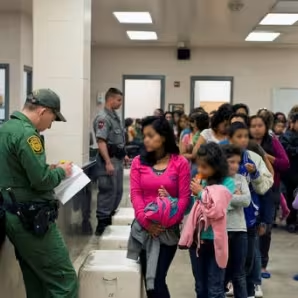
All Eyes on U.S. Federal Courts as Deferred Action Programs Halted
A court injunction halted DAPA and expanded DACA, leaving deportation relief for up to 5.2 million unauthorized immigrants uncertain.
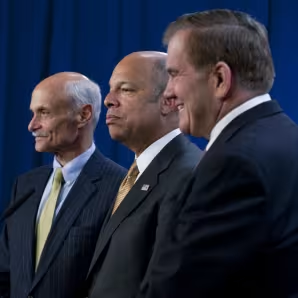
As Implementation Nears, U.S. Deferred Action Programs Encounter Legal, Political Tests
With up to 5.2 million unauthorized immigrants potentially eligible, 26 states and Congress are seeking to block DACA and DAPA before they take effect.
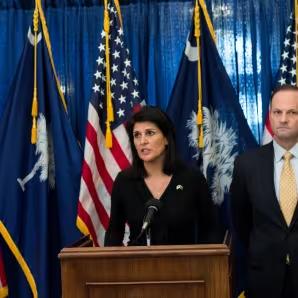
The County-Level View of Unauthorized Immigrants and Implications for Executive Action Implementation
A webinar showcasing MPI's profiles of unauthorized immigrants in the 94 U.S. counties with the largest populations potentially eligible for DACA or DAPA, and the implications of the data for implementation of the DACA and DAPA programs.

Normalization of Relations with Cuba May Portend Changes to U.S. Immigration Policy
The December 2014 U.S.-Cuba normalization deal put uniquely favorable Cuban immigration policies on uncertain footing, but permanent changes require Congress.
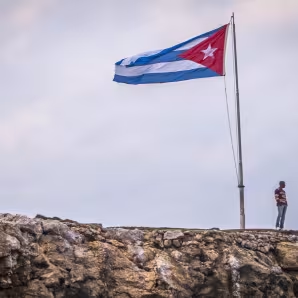
Digging Deeper Into Executive Action: A Further Examination of the Impacts
A discussion of some of the less examined aspects of President Obama's executive actions on immigration, with respect to immigration enforcement, legal immigration, and immigrant integration.


- General Inquiries
- Media Inquiries
-
Michelle Mittelstadt
202 266 1910 [email protected]