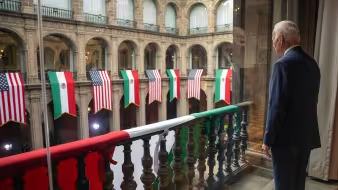
A Complex Picture: Diversifying Migration Flows & Policies at the U.S.-Mexico Border
Part of The World of Migration
This transcript was generated using AI and may contain inaccuracies. If you notice an error, feel free to email [email protected].
CHAPTERS
[00:00:00]: Why the U.S.-Mexico border looks nothing like it did a few years ago
[00:04:30]: Why different nationalities cross at different parts of the border
[00:07:22]: How nationality-specific policies are reshaping who gets processed and how
[00:10:29]: How CBP built a processing system for record arrivals; how it works
[00:21:29]: What the encampments on the Mexican side of the border look like
TRANSCRIPT
[00:00:03.03]
Welcome to the World of Migration, a podcast of the Migration Policy Institute that is dedicated to discussing varied aspects of international migration with some of the most interesting thinkers on migration, whether inside or beyond MPI. My name is Andrew Selee, I'm the President of the Migration Policy Institute and I'm really delighted today to speak with two of my colleagues who are working on a fascinating MPI project assessing operations and policies used by the U.S. Government at the U.S.-Mexico border. Our Policy Analysts, Ariel Ruiz Soto and research assistant Colleen Putzel-Kavanaugh recently came back from a tour of the nearly 2,000 mile U.S.-Mexico border. They went from San Diego, California to Brownsville, Texas, stopping in 13 cities on both sides of the border, interviewing U.S. Customs and Border Protection officials in six of the nine Border Patrol sectors, and visiting nine processing facilities where CBP handles migrants encountered arriving at the U.S.-Mexico border without authorization to enter. From being next to the fence that walls off the border in San Diego, to visiting soft sided tent processing facilities in nearly every sector, to traveling by boat on the Colorado river, they witnessed CBP operations from many angles beyond interviews with U.S. and Mexican government officials.
[00:01:17.17]
They also spoke with NGO leaders and witnessed the processing of a number of immigrant families and individuals in non-governmental settings. We at MPI go out of our way to do field research as often as we can so that we can gain the most detailed understanding possible of the policies and operations that undergird immigration systems. We want to make sure that we understand how policies actually operate on the ground. I was along for one part of the border tour with Ariel and Colleen and I'm really interested to dive into this conversation as we all learned so much and the experiences were so varied in each place that we revisited. So Ariel and Colleen, thanks for coming on the podcast. I'm really looking forward to our conversation.
[00:01:54.07]
Great to be with you, Andrew.
[00:01:55.12]
Thanks for having us. Looking forward to our conversation.
[00:01:58.03]
Well, looking forward to it. And you know, I've been on the border many times and one of the things that's really important to underscore is how different the U.S.-Mexico border is today than it was just even a few years ago. I mean, the overwhelming number of Mexican immigrants who came 50 or more years ago is almost exclusively Mexican and I used to live in both Tijuana and San Diego. So I mean, my times living at the border in the 1990s was almost entirely Mexicans coming across the border. And then there was a period a few years ago when it was a mixture of Mexican nationals and people from northern Central American countries. And now it's been replaced by a vast mix of nationalities coming to the U.S.-Mexico border. You know, beyond the growing numbers of Venezuelans, Colombians, Brazilians and Haitians, people arriving at the border these days are coming from all over the world. India, Sub-Saharan Africa, Russia, China, and dozens of other countries. So I guess a great place to kick this conversation off, Ariel and Colleen, is to ask you the question, what's driving the great diversification of nationalities arriving at the U.S.-Mexico border?
[00:02:56.20]
And Ariel, why don't we go to you on this one?
[00:02:58.22]
Sure. I mean, one of the key things that we saw when we were at the border has been just the expansion of different nationalities that are coming through, but not just in terms of how they're arriving, but also in the composition that they're coming to the United States. And it's clear that as more of these nationalities, including China most recently at Brownsville, and for example, Russians over in San Diego, that there's more and more driving factors here that are pushing migrants to go to certain, certain parts of the border and others as well. In the lead up to this year and the year before, we saw, for example, that in 2019, there has been, there had been a lot of migration from Central America, but today we find ourselves in a much more hemisphere migration that includes migrants coming from other parts as well. In South America. This is really a result of multiple factors, including more socioeconomic forces leading to the or past the pandemic, but also more of those forces and political pressures that have been developing over time. Part of this has also been a drive to come to the United States because of economic conditions that have been a long standing incentive for migrants to come to the United States.
[00:04:13.11]
And in this case, what we're seeing today is that all these factors are intersecting in a very important way that really makes more of this migration more hemispheric, but also places more new challenges. And really the realities that we are seeing today, as you mentioned, have changed so much just within the last couple of years.
[00:04:30.17]
Thank you, Ariel. I mean, it really is quite phenomenal to see. I mean, we all know the numbers, but it is quite phenomenal when you see it on the ground. And the number of different nationalities. I mean, Colleen, tell us, you know, nationals from different countries go to different places. How does that happen? Why?
[00:04:46.07]
Yeah, so this is a phenomenon that we've been following closely, even just from the Customs and Border Protection monthly numbers that are released, but it was also highly visible on the ground. And so, like Ariel said, we've seen Russians most prominently encountered in San Diego, whereas in Brownsville, it's more normally Mexican or Central American flows. And then in Laredo, we've seen larger shares of Haitians. But most importantly, these trends aren't static, and so they change over time. We have recently in Tucson seen a higher number of Central Americans or South Americans enter there. And because these tend to change, there are likely a lot of different reasons why these patterns occur. In part, it could be smuggling organizations. They may be sort of dictating where the flows go, depending on the nationality. There's also the increase in technology. Most migrants are coming to the U.S.-Mexico border with some sort of cell phone. And so they may be able to see different routes that people before them have taken. Word of mouth is very prolific, and it's a powerful multiplier in different trends. Finally, there may just be other outside forces, such as flights. If someone is flying from Russia, they may more likely end up in one part of Mexico than the other.
[00:05:59.04]
Or if they're coming from another country, they may end up in another area of Mexico. And so some of those outside forces are dictating the flows, too.
[00:06:06.17]
And just a quick point to add there, Andrew, it's notable, too, that Mexican policies and Mexican enforcement has also in some ways been a result or helped have these results of different flows to different countries and parts of the different parts of the different Mexico border as well. So that's one key component that we think could shift and unlikely will after different policies come into place in the next coming months.
[00:06:29.14]
That's right. And of course, U.S. policies as they shift, right? I mean, because one of the things—and we'll get into this in a minute, but one of the things I know you saw is, you know, as you go across the border, not only do the trends change in the nationalities, but also policies are applied somewhat differently from place to place for a variety of reasons. So which creates all sorts of incentives, you know, so policies on both sides probably make a lot of difference. Tell us, you know, Ariel, let me go back to you on this. I mean, the U.S. government has articulated a number of policies to deal with the arrivals of particular nationalities, right? I mean, this has been, I think this is probably the first time we've seen this at the U.S.-Mexico border, certainly not in U.S. Immigration policy, but it's probably the first time we've seen it to this extent at the border, a sort of a policy specific to different nationalities. You know, how do you see processing differing by nationality also maybe by, you know, different kinds of groups of migrants who are at the border. What differences did you see?
[00:07:22.12]
Well, policy here plays an important role in how migrants perceive the opportunity to come into the United States and how much likely they like to try to come into the United States. One of the biggest factors that changed, especially in October of last of 2022, was that there was a Title 42 expansion to include Venezuelan nationals who would be then expelled to Mexico, given the criteria of a public health order that is ongoing in the United States. Certainly we saw a decrease in Venezuelan migration after that, and it's clear that that may continue going forward. Also in January, we saw the Biden administration expand the title 42 to other nationalities as well, including Cubans, Haitians and Venezuelans. In total today, there are eight nationalities that the United States expels to Mexico, including Mexicans, of course, Guatemalans, Hondurans, Salvadorans, Venezuelans, Cubans, Haitians, as well as Nicaraguans who come to the border and now are being expelled to Mexico. That has had a significant deterrent in the migration flows that we've seen, at least until today, and also made migrants adapt their routes and their policies, for example, to try to evade migration authorities in Mexico as well as in the United States.
[00:08:40.21]
Then there are also sponsorship programs that we talked and we saw last year about Ukrainians. And this year we're seeing similar programs that are trying to make more orderly migration from Mexico of this nationality, especially from Cuba, Nicaragua, Haiti and Venezuela. And so in this particular case, we've seen that that has had some effects in trying to deter some of the irregular flows, to make them regular flows. But it does vary by location. And we're continuing to see that the closer or the lack of predictability in these policies has made micro immigrants try to understand how better to arrive at the U.S.-Mexico border, and for many in all reality is trying to understand where they can make when they may be able to enter the United States without authorization after they have been waiting in Mexico for several months.
[00:09:27.07]
Yeah, I mean, it's something I know you and I and Doris and other people have said along the way is that unpredictability often encourages people to try and make an irregular journey, right? If they don't know what the rules are, they think the rules might change. That unpredictability often encourages migration. We've seen a lot of that over the last few years. I mean, not just this administration, the prior administration, you know, I mean, but, you know, and it's true in many parts of the world, but it does give people hope that they might if they just wait out a particular policy, they might eventually be able to get in or you know, be there in time for a change. Right. I mean, Colleen, tell us a little bit about how CBP is handling the record number of arrivals. And you know, when I was traveling with you guys, you know, one of the things that is evident is just how big the numbers are. I mean that, that is, you know, it's hard to understate this, that these are numbers just in terms of processing, right? And we talk about the causes and we can talk about the outcomes, but just the sheer numbers and the ability to process those numbers puts a strain on existing resources.
[00:10:26.15]
And so how's that working and what's changed as a result of this?
[00:10:29.24]
Right, Andrew, you're correct. So with these record numbers, migrants who are encountered all have to be processed by Border Patrol. And very quickly Border Patrol found that their stations were overwhelmed, they could not hold the number of people, especially they could not disaggregate them by gender or by family composition. And so what happened was several soft sided facilities were constructed along the U.S.-Mexico border. And just to paint a picture, these are temporary but massive tent-like structures that are meant to efficiently process, hold and then release people within the 72 hour time period that Border Patrol has. And in many ways they're a streamlined operation. Migrants arrive and have an intake, they're disaggregated into pods that are based on their gender and family demographic. And then they are processed with the correct disposition that's assigned to them. And these aren't long term detention facilities. But what we did see visiting many of these structures is that there have been measures to make the stay somewhat more tolerable. So we saw that movies were showing or that light dimmers are there to create a sense of, you know, nighttime so people can go to bed and their outdoor recreation areas.
[00:11:41.07]
But over and over again we heard that the key to keeping these facilities running is that many of the processes have been outsourced to contractors. So food, hygiene, health care and security are all done through contracted organizations. And Border Patrol has a new, fairly new position that's a Border Patrol processing coordinator. And these people have been extremely helpful in processing migrants, determining how their case should be handled. But the ultimate adjudication of course is done by an officer. And this has helped to get more Border Patrol agents back out into the field while still providing a space that can meet the record numbers and meet the need of people while they're in the custody of the facilities. And in some of these centers, ICE is actually co-located. And so once the Border Patrol is finished processing, ICE can take over and do the next steps, whether that's issuing an alternative to detention or transferring to detention, whatever the next step is for that individual. And these sort of look towards joint processing centers that would co locate a lot of different government agencies who are all involved at the border. And there seems to be a want to get ORR, HHS, USCIS involved in these processing centers to make the process even more streamlined and not fall entirely on the Border Patrol.
[00:13:03.24]
Yeah, I mean, it's important to emphasize how much there are different functions. Right. I mean, you know, CBP is responsible for what happens immediately when people come in. But ultimately asylum is in the hands and other decisions on relief are in the hands of USCIS. ICE plays a role or certainly with children. I mean, and then of course, a range. We'll talk about this in a minute. But the range of state and local agencies as well, and NGOs. And so there's a lot of, there's a lot of fragmentation that if you could get beyond that, might be interesting. Let me ask you both actually on outcomes. I mean, it seems from what I saw when I was with you, the days that I was with you, that the outcomes, you know, some people were sent back to Mexico with Title 42. That number seems to be going down. They don't usually get to the facilities. Right. I mean, they're sent back directly from, you know, some other facility closer to the border. They're not going into the place where you would spend the night. And then people that are actually coming to the Border Patrol facilities, you know, there's a number of them that will be sent back on an airplane either through Title 42 or through deportation to their country of origin.
[00:14:10.20]
And then other people are being released with a notice to appear. That seemed to be the outcomes we saw was that what you saw in different places and perhaps one of the
[00:14:19.09]
most striking features of how Border Patrol is now processing migrants is that it really varies by sector and it also varies by week or even by day. Sometimes this is determined by larger U.S. Policy that allow. That allow us to try to provide authority for Border Patrol agents to determine in a given week or in a given day who and what will be the preferred outcome for many migrants at the same time, even if there is this intention to try to create disorder processing in this case, there are also different factors that also in this case can be barriers to that. And that one of them is, for example, that some nationalities like Chinese or Russian migrants, who are not able to be returned to their country of origin still have to find ways to try to Border Patrol still has to find ways to try to process them. And that may mean for many of them to be released with the notice to appear. In other cases, it could mean that an NGO has to be involved. But specifically here, and a point to follow up on, Colleen, here is as well, that even the smaller sectors in Border Patrol are likely sometimes the ones that receive the most migrant arrivals.
[00:15:20.12]
For example, we saw this in Del Rio, that many migrants who were arriving there were not able to be processed on site and had to be transferred over to other locations and sectors, including Brownsville, sometimes Laredo as well, to try to process there where the numbers were bigger. And so what we found from this is that, in fact, sometimes the border arrivals only reflect the initial phase of how migrants arrive. And in fact, many of them are likely then transferred to their facilities where they can be processed. And in many cases, for example, Ecuadorians and some Colombians, Guatemalans and also Hondurans be flown back to their country of origin, specifically after they're given a Title 42 expulsion.
[00:15:59.24]
That's decompression, right? I mean, they were calling it decompression. So if you're, if you come into a sector that doesn't have the capacity to process the numbers that are coming through, they'll send them to another sector, right? And they'll be processed there. Or if they're, you know, the, the only airplanes, the only flights, they, if they are going to be sent back, the only flights going to a certain country or in another sector, they send them there as well, Colleen?
[00:16:21.09]
Correct. And what we also were hearing as well was that every country sort of allocates a different number of flights per week. So nationwide, there may be only seven flights per week for Ecuadorians. And so those migrants need to be moved to a certain place, and that flight may go out of only one city along the border. Same with Colombians or other nationalities. And so there is a lot of what they call lateral movement between the different sectors in order to make sure that people can be processed efficiently. But a lot of it does depend on the relationship with the receiving country as well.
[00:16:55.06]
I mean, one of the impressions that I was left with, too, is that for an individual migrant, what happens on their case is a little bit random, because it depends a little bit what sector you land in, how busy it is on a given day, if there are flights available, if there are beds in an ICE facility, you know, I mean, and that can often be the difference between being put on a plane back to your home country or being given a notice to appear and released or being sent to ICE custody to begin expedited removal, right? And sort of those decisions, there are criteria around them, certainly. But because the numbers are so big, I mean, what happens in any individual case is also a little bit the luck of the draw, right? On the capacity to process any of those particular outcomes.
[00:17:37.15]
Right. We heard frequently Border Patrol say, "We can't say no." And so any migrant that crosses into the United States has to be processed. But part of that process does depend on the secondary agencies who are involved. So whether that's ORR or ICE, that disposition, how they're processed is definitely dependent somewhat on down the road and how much capacity there is in these other agencies.
[00:18:03.23]
Let me ask another question on this too, which is, I mean, OFO the Office of Field Operations, which manages ports of entry. I mean, traditionally, it's also part of CBP, but traditionally it's really been an agency was focused on passengers and pedestrians and cargo coming across. And increasingly they're playing a huge role in immigration. I mean, they've always had some role in immigration, but increasingly they were asked originally actually on MPP, on Migrant Protection Protocols were made in Mexico. They were asked to process people, and now they're being asked to process the exceptions to Title 42. And so you saw some of those processes tell us a little bit about the role that OFO plays and the ports of entry, which is different than the Border Patrol, right? I mean, this is, you know, this is the folks in green or the Border Patrol. The folks in blue are the ones at the ports of entry. You know, there are different tracks within CBP and increasingly the folks in blue are playing a pretty big role also in immigration policy.
[00:18:56.13]
Well, so it is an important distinction and also it is a somewhat related in how migrants arrive between ports or at ports. The biggest component of migration processing that we're seeing now at ports of entry is Title 42 exemptions. And to do that, migrants today would have to apply under the CBP One app, outline why they have a specific vulnerability that would give them an opportunity to be exempted from Title 42, and then they would have to schedule an appointment to arrive at a new given port of entry at the U.S.-Mexico border. This has been in many ways problematic because the appointments do not meet the demand that there is on the Mexican side when people get there. But at the same time, the ports of entry do have to have some sort of processing in order for them. We've seen the capacity of the port of the ports of entry to be different from one sector to another. The larger sectors tend to have more capacity, the smaller sectors tend to have less. But there is this idea that by allowing or shifting more of those flows to the ports of entry, that would create additional order.
[00:19:57.13]
And, and one of the things that a lot of ports of people at the ports of Andrew told us, was that they really see this as one of their multifunctions and parts of their mission that they're seeing. You mentioned cargo and pedestrians, but there's also busses, tourists, and everybody else who comes through in legitimate travel that they also have to screen through every day in the millions. And so it's a key idea here to understand how sometimes when there is this shift to focusing on ports of entry, it would entail additional capacity. When there isn't additional capacity, migrants who because of many reasons, get frustrated by what it is in Mexico, then decide to try to enter between ports of entry, and that then makes it a Border Patrol scenario for them to be processed.
[00:20:43.07]
And there are real limitations on capacity at the ports of entry, right? I mean, you saw that. It's, you know, and there are trade offs, right? I mean, if you, you open up spaces, if you use the physical spaces at ports of entry for processing exceptions to Title 42, it means you have less room to process passengers coming or pedestrians coming across, for example, in certain areas. So, I mean, there are all these sort of. And also in terms of people power, right? It requires moving people, officers from one function to another to do it. So the ports of entry are going through a real transition period also in assuming this, Colleen, you saw in Matamoros also the gathering of people on the Mexican side, right? I mean, you saw this in other cities as well. But in Matamoros, it was probably more visible than some of the other some you heard about in other places. But people tend to be in shelters. And Matamoros was really visible, right?
[00:21:29.05]
Absolutely, yeah. So there are a series of encampments in Matamoros that are offset from the bridge area. And one is sort of near kind of a hill. And so there are a lot of tents set up, a lot of temporary structures. Some of them have seem to have been there for quite a while, and that as new arrivals come, they sort of claim an area and stay there. There are some porta potties that were put in, but there's of course, no running water. And so there is water that's been brought in by Doctors Without Borders. But overall, it is definitely representing a humanitarian and a hygiene crisis for a variety of reasons. You have people mainly from Central America, other parts of Mexico, and then perhaps south as well, who are waiting there. And then there's a separate encampment that's actually underneath kind of an old gas station. And that's where the majority of Haitian migrants are staying right now, in tented areas as well. And so none of these areas are secured or overseen by any one particular organization. There are a lot of people involved in perhaps providing aid or bringing in anything, any sort of necessary equipment, such as water, food, maybe donations.
[00:22:46.07]
But they are definitely temporary areas where people are actually being forced to stay for sometimes several weeks to several months at a time, especially for young children, women. It's really not a place for anyone to be staying for a long period of time, but especially vulnerable populations.
[00:23:04.13]
And they're mostly trying to get on the CBP One app to get an exception to Title 42 right now, or wait until the end of Title 42 to get an asylum. An asylum hearing. Right. I mean, they're trying to figure out how they can go through the orderly process. But the draw to the northern border is you can only use the app right now north of Mexico City.
[00:23:21.10]
Exactly. So many people are there because they're trying to get on the app. And so I crossed over into Matamoros around 9, 9:30am and at 10am you could see that people were gathering up on a hill to try to get the best cell phone reception possible. The actual best reception is closest to the port of entry, but migrants are not allowed to get close enough by the Mexican National Guard. And so you could see crowds of people gathering, trying to get kind of to the highest ground that they could to be able to use the application. And it's really quite humbling to see the numbers of people, but then also witness sort of the complications with the app. So waiting screens or others that have been well documented.
[00:24:09.05]
I mean, so this is one of the challenges, I mean, in creating an orderly system, right? Is, I mean, you can create order in one part and then disorder in another part, right? And so, I mean, I think that's the, you know, one of the challenges. They've sort of created an orderly system at ports of entry. It actually does look very orderly from the ones that I was in with you. But, you know, on the other side of the border, there's sort of the disorder there, and it's hard to, you know, you have to figure out how you make these work in tandem. Going back to the U.S. side. I mean, one of the things that you did see in terms of actually creating order was the really active relationship between CBP and a lot of local governments and NGOs. And I don't say it's close because I think, you know, they may have very different opinions about each other, right? And depending on the context. But, but there seems to be a lot of dependence of the U.S. government now on those partnerships with local governments and non governmental organizations. And that certainly seems like a change in the past few years.
[00:24:59.05]
Certainly a change from, you know, when I lived at the border. Is there, you know, tell us a little bit about that.
[00:25:05.02]
So one of the key components that we saw indeed, Andrew, was this even if informal partnership between the U.S. agencies and NGOs and local governments that really made this processing work the way it does. And this type of idea is an important access because it does allow more stability and predictability for migrants. For the same point that Colleen mentioned earlier, to try to understand how migrants can actually see that they're in this temporary facilities for only a short time before they can go into their final estate destination, you're right, there are differences among the agencies and NGOs, but in this particular case, either out of need or because of practical reasons, NGOs have now been a key component that has really amplified the efforts of Border Patrol and ICE to try to give an option for people to one get to the final destination, but also help with processing so that migrants are not waiting in processing facilities for several days. Now the aspect of this too that I think it's important to cover is that Mexican NGOs as well are an important aspect of this, even if the landscape has changed slightly after the arrival of CBP
[00:26:08.20]
One, more Mexican NGOs and local governments are also helping address some of the issues that we're seeing on that side of the border. Allowing migrants to understand what the process will be when they go to the United States and providing some services for legal representation in very particular, particular cases. Being able to see this in person, I think really showed how key this partnership is and again how informal it is at the point. But even that informality on one hand, it gives you greater flexibility and you can able to adapt to different changes in say, day by day. It also comes with some concern that it will not be sustainable over long term. That it's not a durable partnership if policies change, if leadership changes and, or the difference in composition or lack of resources on the Mexican side.
[00:26:57.16]
Yeah, and I'll just add in, if I may, that these are not necessarily new relationships NGOs have always played, especially along the U.S.-Mexico border, have always assisted migrants after their release from ICE or Border Patrol. But I think that what's different is that the new record number of migrants that are being released by CBP has really initiated this, this necessary connection that's formed between NGOs and CBP. And part of this is because cities really want to avoid street releases. It's bad for their optics. But more importantly, it's really not beneficial for migrants, especially if there's inclement weather or what have you. And so I think that part of what this has done is assisted migrants in the next step of their journey. So the majority of people aren't planning to stay in the city that they crossed into. And so these NGOs are really playing a role in helping to facilitate that next step. There's no formal process that exists anywhere that says this is what happens to migrants after they're released. They're just released. But NGOs along the U.S.-Mexico border have sort of taken it upon themselves to create these systems, albeit informal systems, but systems nonetheless that facilitate that onward travel for people to get to their final destination or at least to their next next step.
[00:28:15.20]
That's fascinating. And tell me—we're now at the end of our time, so let's go to a lightning round. But tell me something, you know, something else you haven't said yet that surprised you because, you know, we follow these issues a lot, right? I mean, in a lot of this we sort of knew, at least theoretically. And then you see it at the border and. Yes. Oh yeah, that's how it operates. But, you know, let me start with you, Ariel. I mean, what, you know, tell me something that you didn't expect, that you saw as you went across the border.
[00:28:41.11]
Yeah. One of the most surprising things that I saw, though I expected to see in some ways, was that even when there's this increased processing between Border Patrol and the other agencies that are involved and NGOs, that there's still a very tangible spillover effect that makes lives for migrants and processing for migrants directly very difficult. But also the toll that it takes on Border Patrol officials and other agencies to be able to do this work in this fast paced nature, where changes are coming from one week to another, where predictability is not there fully. And that really takes a toll more than I would have thought on the different components of these operations. On the migrant side, Colleen and I, we saw at times families being separated because they could not prove that they were biological parents of the children they were traveling with. We were able to see migrants being encountered along highways. We were also able to see some interdictions that happen between or near the, near the fencing. And that was difficult to watch, mainly because it shows that even under this best sort of scenario of processing that I think the United States and Mexico, to some regard are trying to get to, there will still be events where they will have limited consequences and difficulties for everybody involved.
[00:30:06.10]
And frankly, Border Patrol told us when they were there that they also don't like separating families, that they don't believe that the current structures or policies that we have in place in the United States are really able to meet the demands that we see. And so trying to put those two things together, it really shifts the focus to me at least on how behind our policies are in the U.S. when your agencies are saying that they could be doing things better if there were different policies. And to see just the different nature of family separation and migrants being even in this subset of facilities being there for hours and is not really the long term solution for this.
[00:30:47.09]
Thank you, Ariel. Colleen, what surprised you?
[00:30:50.02]
Yeah, I think just to build on what Ariel was saying, the opportunity to conduct fieldwork on the ground allowed us this opportunity to see a lot of the unintended consequences that have resulted from policies and the difficulty on both the government agencies, the NGOs working on the ground, and importantly the migrants who are going through these processes as well. And so I think that it kind of sheds new light on how future policy recommendations have to be built with those unintended consequences in mind. As good as a policy may look, what could possibly go wrong with it. And it just gives new light to us as researchers to look at all of the possible outcomes. And so I think that that was very illuminating in looking at some of the unintended consequences or the difficulties faced by all the parties involved.
[00:31:33.10]
Yeah, yeah, because, you know, we. You can sit inside the beltway and design all sorts of things, but it often looks different in terms of what plays out. And even the best design plans have unintended consequences. Right. I mean, in all sorts of ways, not to mention plans that change frequently, as Ariel was referencing, also create a certain unpredictability on the ground. Yeah. Thank you both. I mean, this has been wonderful. You really had a chance to get an up close view of border processing that few people get to see quite as closely. And, you know, we certainly want to thank the Department of Homeland Security and CBP officials, both in Washington along the border, for facilitating, you know, our visits and for their willingness to show us their operations and have candid conversations with us. We also really appreciate all the NGOs that met with us, local governments, local experts in some of the communities on both sides of the border, both on the U.S. side and the Mexican side. I know you had lots and lots of those conversations, some of them planned and some of them, you know, you dropped in on as well along the way or you realize you need to talk to someone.
[00:32:32.06]
You were there and people really were kind to open up and spend a few minutes with you on this and with, you know, Muz Chisti went for part of the trip as well, and I went for part. And so when we were there as well, this is this, you know, trip was part of some research we're doing. It's been a foundation for some important insights in work we're doing on the border. We could continue this conversation for another hour, but this is all we have time for today. So thank you so much for coming on the podcast.
[00:32:58.18]
Thanks for having us andrew
[00:33:02.14]
Ariel Ruiz Soto and Colleen Putzel-Kavanaugh with MPI's U.S. Immigration Policy Program. They are working on an MPI project looking at border management in the United States and several other countries with the aim of providing recommendations to make operations more effective. Thank you for tuning into this episode of the World of Migration. You can find all the episodes for the World of Migration and other MPI podcasts online at migrationpolicy.org/podcasts or find us wherever you get your podcast. Just search for World of Migration and please leave us a review while you're there. This episode was produced by Yoseph Hamid and Michelle Mittelstadt and made possible with the help of Lisa Dixon. Our music is a song called Geography by Bright Idea. My name is Andrew Selee and thanks again for listening.
What is driving the increasingly diverse flows to the U.S.-Mexico border, and how are officials responding on the ground?
How are U.S. border operations and policies evolving at the U.S.-Mexico border to address rising and diversifying flows? And what is driving increasing immigration from across Latin America, the Caribbean, and beyond? MPI President Andrew Selee speaks with two colleagues who traveled from one end of the nearly 2,000-mile boundary to the other, touring U.S. Customs and Border Protection facilities and interviewing U.S. and Mexican officials, NGO leaders, and others.
Latin America and Caribbean Initiative
The Initiative combines rigorous research with direct engagement of governments, institutions, and stakeholders to help build orderly, rights-respecting migration systems across one of the world's most dynamic migration regions.
About the U.S. Immigration Policy Program
The U.S. Immigration Policy Program provides analysis of U.S. immigration pathways, the impacts of enforcement and other policies, and the characteristics of immigrant populations.
- Countries
- United States Mexico
- Speakers
-
Andrew Selee
President, MPI

Ariel G. Ruiz Soto
Senior Policy Analyst

Colleen Putzel-Kavanaugh
Associate Policy Analyst
Related Content