Immigrants’ U.S. Labor Market Disadvantage in the COVID-19 Economy: The Role of Geography and Industries of Employment

Immigrants faced steeper labor losses than U.S.-born workers during the COVID-19 pandemic, driven by concentration in high-risk industries and geographic clusters hit hardest.
While the nation’s economic outlook remains uncertain due to the unpredictable course of the pandemic, most general economic indicators are improving, albeit slowly. The total U.S. unemployment rate fell from a peak of 14.4 percent in April 2020 to 5.7 percent in July 2021. But the sharp job losses and subsequent partial rebound have been spread unevenly across the country, affecting different populations, regions, and economic sectors differently.
During the worst of the pandemic-induced economic downturn, immigrants experienced much higher unemployment rates than U.S.-born workers. But by July 2021, immigrant unemployment had fallen below that of U.S.-born workers. Still, immigrants are not particularly well-positioned to take advantage of the economic recovery, given their concentration in industries and regions of the country with still-elevated unemployment rates.
This issue brief uses monthly data from the U.S. Census Bureau’s Current Population Survey (CPS) to examine the extent of job losses and shifts in employment patterns among immigrant and U.S.-born workers from mid-2019 to mid-2021. In particular, it looks at how foreign- and native-born men and women have fared in different industries and parts of the country.
Data Tool: Mapping Shifting Unemployment by Group
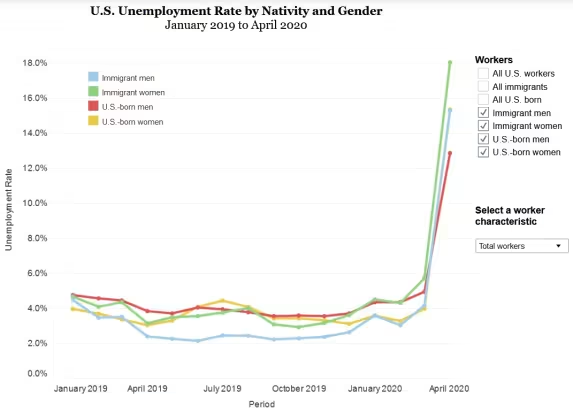
Check out this data tool to explore monthly unemployment rates for immigrants and other U.S. workers before and since the COVID-19 pandemic began. In addition to nativity and gender, this tool allows you to break down trends by race/ethnicity, educational attainment, and industry, and to compare unemployment for different groups over time.
Table of Contents
1 Introduction
2 Changes in the Number of Workers and Their Employment Levels
3 Trends across U.S. Geographic Regions
4 Trends across Major Economic Sectors
5 Conclusion
About the U.S. Immigration Policy Program
The U.S. Immigration Policy Program provides analysis of U.S. immigration pathways, the impacts of enforcement and other policies, and the characteristics of immigrant populations.
About the National Center on Immigrant Integration Policy
The Center is a national hub connecting policymakers, educators, community leaders, and service providers with evidence-informed policy research, technical assistance, and data to advance effective immigrant integration at U.S., state, and local levels.



Related Content