National Center on Immigrant Integration Policy

The National Center on Immigrant Integration Policy serves as a crossroads for policymakers, community and system leaders, and others looking to understand ways to support successful integration of immigrants and their children into U.S. classrooms, workplaces, and civic spaces.
It produces evidence-informed, nonpartisan policy research and data, and provides technical assistance and cross-state learning opportunities for state and local leaders. By engaging with stakeholders across the early childhood, education, workforce, health, and civic sectors, the Center builds a more coherent, knowledge-driven field. It shines a spotlight on integration issues often overlooked in national debates and promotes solutions that can lift the integration trajectories of immigrant families while also fueling the vibrancy of the communities and local economies where they live. For more about the Center, click here.


More Featured Work




- General Inquiries
Showing 211–220 of 375 results
Improving Education for Migrant-Background Students: A Transatlantic Comparison of School Funding
Supplementary school funding is essential for migrant-background students in Europe and North America. But effectiveness hinges on rigorous identification, clear spending rules, and oversight.
Immigrants and WIOA Services: Comparison of Sociodemographic Characteristics of Native- and Foreign-Born Adults in the United States
Immigrants are over-represented among WIOA's target populations but consistently receive far less than their equitable share of adult education and training services.

How Well Are Young Children of Refugees Integrating into the United States?
MPI analysts discuss the results of an analysis, Young Children of Refugees in the United States: Integration Successes and Challenges, comparing young children of refugees to other U.S. children on several key indicators of well-being.

Federal WIOA Plan Requirements Ignore Opportunities to Support Equitable Access for Immigrant/LEP Adults
Federal WIOA state plan guidance omits key data requirements for Limited English Proficient (LEP) adults, undermining equitable access to workforce training services.
Providing a Head Start: Improving Access to Early Childhood Education for Refugees
Head Start–refugee resettlement collaboration can raise young refugee children's early education enrollment substantially, but federal silos keep such success rare.
Young Children of Refugees in the United States: Integration Successes and Challenges
Young children of refugees benefit from strong family structures and parental employment, but two-thirds live in low-income households in the United States and outcomes vary sharply by origin.
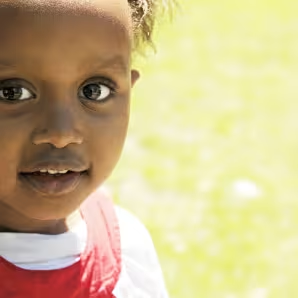
Challenges in Accessing Early Childhood Education and Care for Children in Refugee Families in Massachusetts
Refugee families in Massachusetts face a fragmented multiagency system and declining state funding that together block access to early childhood education and care for young children.
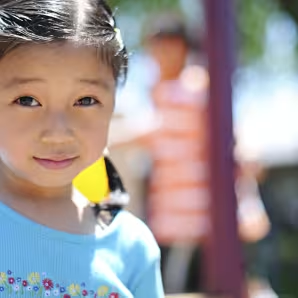
Deferred Action for Unauthorized Immigrant Parents: Analysis of DAPA's Potential Effects on Families and Children
Deferred action for unauthorized immigrant parents could raise family incomes by 10 percent and alleviate documented psychological harms for millions of children, most U.S.-born.

Taking Stock of ESSA’s Potential Impact on Immigrant and English-Learner Students
A webinar examining provisions of the Every Student Succeeds Act (ESSA) related to immigrant and English-learner students’ success.
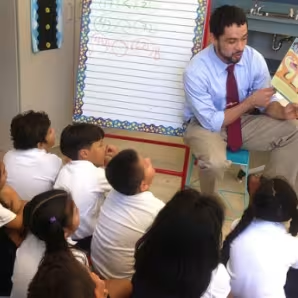
A Profile of Children with Unauthorized Immigrant Parents in the United States
This webinar offers a discussion of the economic, linguistic and educational disadvantage experienced by U.S. children with unauthorized immigrant parents. The researchers discuss their finding that 86 percent of the 5.1 million such children in the United States have a parent who could potentially benefit from the Deferred Action for Parents of Americans and Lawful Permanent Residents (DAPA) program.