National Center on Immigrant Integration Policy

The National Center on Immigrant Integration Policy serves as a crossroads for policymakers, community and system leaders, and others looking to understand ways to support successful integration of immigrants and their children into U.S. classrooms, workplaces, and civic spaces.
It produces evidence-informed, nonpartisan policy research and data, and provides technical assistance and cross-state learning opportunities for state and local leaders. By engaging with stakeholders across the early childhood, education, workforce, health, and civic sectors, the Center builds a more coherent, knowledge-driven field. It shines a spotlight on integration issues often overlooked in national debates and promotes solutions that can lift the integration trajectories of immigrant families while also fueling the vibrancy of the communities and local economies where they live. For more about the Center, click here.


More Featured Work




- General Inquiries
Showing 191–200 of 375 results
Facts about English Learners and the NCLB/ESSA Transition in Select States
State-level data on English Learner demographics and outcomes can equip policymakers and community organizations to navigate federal education shifts.

Reducing Integration Barriers Facing Foreign-Trained Immigrants: Policy and Practice Lessons from Across the United States
Marking the release of an MPI report, researchers and practitioners on this webinar discuss brain waste among college-educated immigrants and initiatives that ease the barriers foreign-educated newcomers confront with regards to credential recognition, employment, and relicensure, as well as recent policy developments and ongoing challenges in the field.

Unlocking Skills: Successful Initiatives for Integrating Foreign-Trained Immigrant Professionals
Effective programs exist to reduce brain waste among foreign-trained professionals in the United States, but rigid licensing laws and employer bias are stubborn system-level barriers.

Doctors as Taxi Drivers: The Costs of Brain Waste among Highly Skilled Immigrants in the United States
A report release and presentation of first-ever U.S. estimates on the actual economic costs of skill underutilization for immigrants, their families, and the U.S. economy, in terms of forgone earnings and unrealized federal, state, and local taxes.
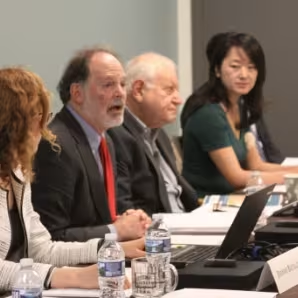
Brain Waste: Researchers Discuss Economic Costs of Skill Underutilization among Highly Skilled Immigrants
What does it cost the U.S. economy when college-educated immigrants cannot find work at their skill level?

New Data Resources Can Help Improve Targeting of State Early Childhood and Parent-Focused Programs
Fact sheets for 30 states reveal wide variation in poverty and education among immigrant parents of young children; these analyses can help guide two-generation program targeting.
Untapped Talent: The Costs of Brain Waste among Highly Skilled Immigrants in the United States
Brain waste affects nearly 2 million college-educated immigrants, costing the United States $39 billion in forgone earnings and $10 billion in lost tax revenues each year.
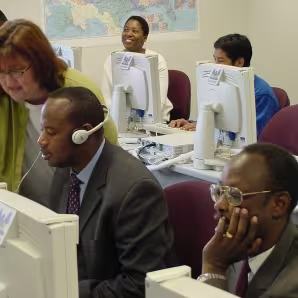
The Costs of Brain Waste among Highly Skilled Immigrants in Select States
Brain waste among highly skilled immigrants costs U.S. states billions in forgone earnings annually, with Florida posting the highest underutilization rate, as these state fact sheets show.

State Sociodemographic Portraits of Immigrant and U.S.-Born Parents of Young Children
State-level data reveal wide variation in immigrant parent populations, with implications for how states design early childhood and workforce programs under federal workforce and education laws.
Including Immigrant and Refugee Families in Two-Generation Programs: Elements of Successful Programs and Challenges Posed by WIOA Implementation
On this webinar, speakers discuss findings from a report that analyzes U.S. parent population data and draws from a field study of select two-generation programs that serve immigrant and refugee families.