National Center on Immigrant Integration Policy

The National Center on Immigrant Integration Policy serves as a crossroads for policymakers, community and system leaders, and others looking to understand ways to support successful integration of immigrants and their children into U.S. classrooms, workplaces, and civic spaces.
It produces evidence-informed, nonpartisan policy research and data, and provides technical assistance and cross-state learning opportunities for state and local leaders. By engaging with stakeholders across the early childhood, education, workforce, health, and civic sectors, the Center builds a more coherent, knowledge-driven field. It shines a spotlight on integration issues often overlooked in national debates and promotes solutions that can lift the integration trajectories of immigrant families while also fueling the vibrancy of the communities and local economies where they live. For more about the Center, click here.


More Featured Work




- General Inquiries
Showing 201–210 of 375 results
The Nutritional Health of Young Refugee Children Resettling in Washington State
Nearly half of young refugee children in Washington State were malnourished at resettlement, with programs needing to address both undernutrition and overnutrition.

A Study of Pregnancy and Birth Outcomes among African-Born Women Living in Utah
African-born women in Utah had significantly higher perinatal complication rates than U.S.-born White peers, with nearly half receiving inadequate prenatal care.

Serving Immigrant Families Through Two-Generation Programs: Identifying Family Needs and Responsive Program Approaches
Immigrant families need two-generation programs, but limited English proficiency and federal performance rules require tailored approaches that are unsupported by current funding.
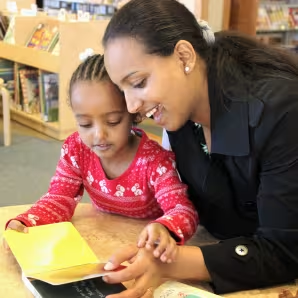
Immigration to the Heartland: A Profile of Immigrants in the Kansas City Region
The Kansas City region's immigrant population grew more than 300 percent between 1990 and 2015, with immigrants establishing deep roots and contributing broadly across industries.

Mental Health Risks and Resilience among Somali and Bhutanese Refugee Parents
Somali and Bhutanese refugee parents show anxiety and depression similar to the U.S. general population, suggesting community support buffers the effects of pre-resettlement trauma.
Closing the Gap? The Role of Funding in Equitable Education for English Learners in the United States
Marking the release of an report, this webinar explores the key education funding mechanisms in place to support English Learners, public conversations about funding, and efforts to improve the equitable distribution of educational resources.

DACA at Four: Estimating the Potentially Eligible Population and Assessing Application and Renewal Trends
Marking the fourth anniversary of the implementation of the DACA program, this webinar presents findings on the most current estimates of potential DACA beneficiaries, trends in requests and application rates, and discussion of recent policy and political developments. Experts also discuss how DACA has affected the integration of qualifying young unauthorized immigrants.

DACA at Four: Participation in the Deferred Action Program and Impacts on Recipients
DACA has delivered economic and social gains to hundreds of thousands of young unauthorized immigrants. But nearly half the eligible population had not applied as of March 2016.
Funding an Equitable Education for English Learners in the United States
English Learner (EL) funding in the United States is inequitable, with many states lacking the studies needed to design formulas that adequately serve these students.

Using Supplementary School Funding to Improve the Educational Outcomes of Migrant-Background Students: A Transatlantic Comparison
The educational needs of immigrant students in primary and secondary schools pose a growing challenge for policymakers and educators. Speakers discuss supplementary funding to support the educational needs of migrant-background students, and provide an overview of the mechanics of school funding for such children in Canada, France, Germany, and United States, examined in an MPI report.