National Center on Immigrant Integration Policy

The National Center on Immigrant Integration Policy serves as a crossroads for policymakers, community and system leaders, and others looking to understand ways to support successful integration of immigrants and their children into U.S. classrooms, workplaces, and civic spaces.
It produces evidence-informed, nonpartisan policy research and data, and provides technical assistance and cross-state learning opportunities for state and local leaders. By engaging with stakeholders across the early childhood, education, workforce, health, and civic sectors, the Center builds a more coherent, knowledge-driven field. It shines a spotlight on integration issues often overlooked in national debates and promotes solutions that can lift the integration trajectories of immigrant families while also fueling the vibrancy of the communities and local economies where they live. For more about the Center, click here.



More Featured Work




- General Inquiries
Showing 21–30 of 375 results
Set Up for Success: Supporting Immigrant Youth Through the Workforce Development System
The WIOA Youth program holds real promise for connecting immigrant youth to careers, but English proficiency rules and work authorization requirements limit who can be served.

Shifting Priorities: How the Official English Executive Order Could Affect Language Access Efforts
President Trump’s executive order proclaiming English the country's official language marks a major shift in federal language access policy—revoking longstanding mandates and leaving federal agencies with broad discretion in provision of information and services in other languages. The action raises questions about how federal, state, and local agencies administering federally funded programs will adapt to ensure language barriers do not impede public access to essential services.
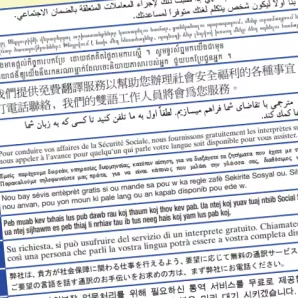
Emerging and Established Efforts by States to Expand Language Access
Colorado, Michigan, and New York officials discussed how states’ language access efforts have evolved and innovative approaches to reduce linguistic barriers for more than 25 million U.S. residents who have limited proficiency in English.

Language Access in Colorado State Agencies: Existing Efforts and Opportunities for Expansion
Colorado state agencies offer uneven language access. Creation of a statewide policy and cross-agency coordination would improve the provision of information and services to Limited English Proficient residents.

The Overlooked Impact of Immigration on the Size of the Future U.S. Workforce
Immigrant-origin individuals have been the driving force behind U.S. demographic growth in the United States over the past two decades—and likely will be for years to come.

Understanding Obstacles to Foreign Qualification Recognition for Key U.S. Early Childhood Education and Care Positions
Barriers to the recognition of academic and professional credentials earned abroad block immigrants from advancing in U.S. early childhood education and care, depriving the field of skills and culturally competent experts.

Beyond the “Black Jobs” Controversy: Immigrants and U.S.-Born Black Workers Share a Growing Jobs Pie
The controversy over whether immigrants have taken "Black jobs" obscures the reality that U.S. job growth has been such that foreign-born workers' growing share of the U.S. labor market and expanded presence across industries do not appear to have occurred at the expense of U.S.-born Black workers. This commentary offers analysis of the U.S. prime-age workforce going back to 1990 by race and nativity.

Next-Generation Strategies to Improve Language Access in Federally Supported Programs
Speakers discussed research on next-generation strategies the federal government can use to support state and local programs in effectively operationalizing and sustaining meaningful language access.

Expanding Language Access in Federally Supported Programs: Practical Solutions for Persistent Problems
Despite federal civil-rights obligations, language access in federally funded programs remains deeply uneven, leaving Limited English Proficient (LEP) residents underserved.

Leveraging Digital Skills: Immigrant-Origin High School Graduates Offer a Pool of Talent for U.S. Employers
With immigrants and their U.S.-born children expected to drive all net growth in the future labor force, there is a significant opportunity to leverage the digital skills of immigrant-origin adults to meet growing employer demand for technologically adept workers. This commentary draws on analysis of PIAAC data to study the skills of U.S. adults by immigrant generation.