- Topic
- Integration
- Keyword
- Language Access
Next-Generation Strategies to Improve Language Access in Federally Supported Programs
This transcript was generated using AI and may contain inaccuracies. If you notice an error, feel free to email [email protected].
[00:00:00.00] - Margie McHugh
Good afternoon, everyone joining us for this webinar from the East Coast in the middle of the country, and good morning to those of you joining from the West Coast. Great to have so many folks who are involved in implementation of tons of different kinds of critical programs at the federal, state, and local level joining this webinar, and also so many folks working at the community level who are trying like us to figure out why implementation of language access is not happening as, as well as we all kind of think by looking at federal programs, at federal laws and policies that it would be. So I'm Margie McHugh. I'm the director of MPI's National Center on Immigrant Integration Policy, and I'll be moderating today's webinar. You can see some of the housekeeping details there on the slide. And they are also going to be available in the chat. Just wanted to say that I think as all of you know who are joining that this webinar is partly, well, it is grounded in a brief that we just released today, Expanding Language Access in Federally Supported Programs: Practical Solutions for Persistent Problems. And you'll find many, many ways to access that and other aspects of our work looking at the slides as we, as we walk through this.
And there are plenty of ways for you to connect to our website and the like to try and find these. I guess I'll just say a little bit as part of getting going, as part of getting us started, is that for our team at the National Center on Immigrant Integration Policy, language access is both sort of its own standalone bucket of work, but also crosscuts all of the key areas that you see on the screen here that we're— that we have particularly deep portfolios of work, technical assistance, research, and information resources and the like that we kind of are the sort of the backbone of a lot of the work that we've been doing here. Since we were founded in 2007. And most recently, over the last few years, this report is grounded in work that we had been doing, both looking at the elements of state and local language access laws and policies and how to understand how they were being organized to try and figure out how to manage and ensure implementation of language access at those, at those levels of government and also work that, that we did trying to figure out with early childhood education and care why that's, that was a system that was particularly spotty in terms of the implementation of language access as far as we could see.
We also, leading into this report, had been running sort of just a national working group with a number of organizations that have a focus on language access, trying to figure out what the opportunities were to improve language access implementation, both via federal agency efforts and also at the state and local levels. So, next slide, please. I just would say that in terms of what we're gonna then springboard into based on all that, via today's webinar is looking at this report and tapping the expertise of a few key individuals just to talk about where this, where this led us in this brief. And so we'll do a very short overview of language access. It looks like so many of you who are joining the webinar, and thanks to all of you who are both doing this work day to day and also joining us now to try and delve into this with us. But so it'll be a brief overview for any of you that are pretty new to the issue. We're happy to be in further touch with you to do a deeper, deeper dive on some of the background. But today that'll be pretty brief.
We do wanna particularly define what we mean by federally supported programs, why they matter so much, and why we've built this brief brief around them. And then, and then we'll get to the real meat of things by having a panel discussion with Joann Lee, who's a special counsel on language justice at the Legal Aid Foundation of Los Angeles, and Jake Hofstetter, my wonderful colleague here at the center, and co— and I am a co-author with him on this brief that we're releasing today. But he's been our policy analyst and lead on all these issues and just really want to get into conversation with both of them as part of this. And then we're leaving a lot of time for question and answer, so you can be writing your questions in. Always best if you write your questions in early on in the, in the webinar so that we can sort of see them and line them up for the Q&A portion. So for now, let's just move forward. So I think the key thing to talk about here is simply that language access, now increasingly referred to by folks in the field as language justice.
[00:05:53.08] - Margie McHugh
It's obviously a very large group of individuals in the US who are defined as limited English proficient. In census data, they're very easy to see. At the federal, at the national, state, and local levels. And also, in addition to just the number of LEP individuals, a really key issue is the very different, the great diversity of languages that so many people speak, which really leads to the need to have strategies across programs and at all levels of government that would allow access to federal information and federal services. And, um, and then there's all sorts of public health, public safety, uh, reasons for making sure that LEP individuals are provided with access, um, to federal programs and services and information. Uh, but of course it's also been a longstanding civil rights requirement, uh, stemming from the Civil Rights Act of 1964. And then there are a good number of other federal policies and federal laws that have tried to really pin down and make real and consistent the ways in which that civil rights requirement should be met. So that is just such a simplified version of things. So as I said, come back or, you know, we can point anyone on the phone to resources if they want a little more depth on that.
But next slide, please. So in terms of today's conversation, you know, I was talking earlier about the journey that sort of brought us to this particular type of brief, and it really did start with just a simple, fairly simple question. How could these requirements have been in place for over 50 years, and how could we really just dig deeper to figure out why, even though there are resources and policies and memos and direction, you know, why, why do we still see that there are so many gaps in implementation, particularly at the state and local levels, but also still at the federal level with federally provided, federally conducted services? And like a lot of you, we, we, we, we could see the way the issue popped during the COVID-19 pandemic. And what was, what was surprising was that people seemed surprised, I guess, that, that there were so many gaps because I think most of us who have been following these issues for a while understood that there was really not a strong implementation framework, making sure that what we understood to be fairly straightforward and clear responsibilities coming down from the federal level, that they, that they really were not, these were really not being implemented in a consistent way as federal funds were passed from down to state and local entities that had those requirements.
And so it seemed like, you know, it has seemed like that kind of awakening and realization has been helpful in attracting a lot more attention to this issue. And so, yes, I think we, as we say a number of times in the report, that last little piece you see on the slide, we sometimes say it remains a distant goal, but it's definitely not a reality. So, um, so next slide. Um, I'll just close my, um, opening portion by, um, by just, uh, saying a little bit more about federally supported programs since some of you, um, might not be as familiar with that distinction that we're making. But in the brief and in our conversation today, we're talking mainly about programs that are funded by the federal government but delivered to the public by state and local entities. And this includes anyone that that federal money is flowing to. So it's government agencies and community organizations, but also pretty much anyone that's getting contracts for providing those services, the federal dollars attached down through sort of the chain of custody, if you will, of those dollars. And so we tried to find a lot of different ways in the report to say just how many services and sectors and programs that, that applies to.
And, you know, just looking at the breadth of, of state and local agencies and different kinds of service providers that are joining this webinar, you, you know, we can see you all get it, that it applies pretty broadly. And so we just keep trying, you know, we're hoping to keep spreading that message. But more importantly, with the report, try and figure out how to pin down what the elements of the framework for implementing the requirements, how to pin them in more to federal agency processes. And then similarly, how to have states in the same way that we believe the federal government needs to have a stronger and more consistent and coherent implementation framework that's made apparent to those that they initially pass funding to, um, that then in a similar way, those requirements attach to the funding, um, through the actions of state agencies as well. Um, so, so all of that is to say, um, we appreciate that there's been activity at the federal government trying to make sure that there's not a glass house problem for federal agencies that are telling those they're passing money to, that they have to be providing language access to their services and information that they offer the public.
Federal agencies have been obviously, or to us at least, trying to do a better job of making sure that when they directly deliver services to the public, for example, the place like the Social Security Administration working directly with the public, that those federally conducted programs do a good job of this as well. But what this report is focusing on more directly, some of what it speaks to is relevant to both federally conducted and federally supported, but our conversation today and a lot of the report is trying to really make our way through the various ways that federal agencies can do a better job with making sure that the federally supported programs actually understand and comply and show evidence that they are complying with language access requirements. So with all that said, I think we are now moving in— are we? Next slide— to the, to the best part. Well, including with all your questions, the best part of what we're going to be talking about today. So, so we're joined, as I said earlier, by my wonderful colleague Jake Hofstetter, policy analyst here at the National Center on Immigrant Integration Policy. He has a few portfolios in addition to language access.
He also leads a lot of our work on education and workforce programs for immigrant adults and youth. But language access is, have to say, it's his great love. And he's, because of his interest in the issue, I think we've really been making some headway in the language access space, analyzing the design and implementation of federal, state, and local policies, and really trying to dive much more deeply into understanding how to have some lasting change in the efficacy and the consistency with which they're implemented. And then we also are just so lucky to have Joann Lee, who's Special Counsel on Language Justice at the Legal Aid Foundation, of Los Angeles. She has just been just so on the leading edge of language access issues for— you don't look at Joann, but for maybe 25 years, she's been at the Legal Aid— I can't remember if you— Legal Aid Foundation of Los Angeles, if you have an easier acronym for that. But, but at the Legal Aid Foundation, she's been providing direct legal services to Asian American and Pacific Islander communities since 2000, and she has specialized both in family and immigration law with a focus on representing survivors of domestic violence, sexual assault, and human trafficking.
But she's also, for purposes of today, conducted for quite some time language rights advocacy with government entities on behalf of linguistically marginalized communities. Communities, including filing administrative complaints and litigation based on state and federal mandates. And then since, uh, in 2015, she was appointed to and served on the California Judicial Council Language Access Plan Implementation Task Force until its completion in 2019, and then also has been facilitating the National Language Access Advocates Network. That one's a little easier. We can just say N-LAAN for those of you who are, um, in the field., but N-LAAN has been working since its— she's been working with N-LAAN since its inception in 2006 and is involved in, uh, with them in other national and, uh, local language justice initiatives. So, um, Joann is really our kind of view from the field, um, today, um, and, uh, and what a view it is with everything I've just, um, described that she's been involved in. Since 2000. So Joann, we wanted to start off with you. As you know from, from the analysis and from the conversations we've been having with you over the last several years, I'd even say, we're trying to get at this disconnect between the relatively strong requirements that are there at the national level for recipients and subrecipients of federal funding, to provide language access, but then this reality that both within federal programs and across federally supported programs that the implementation is still pretty limited.
Well, not in all cases, but definitely, definitely in a lot. And especially when you think about the breadth of federal programming, when you look at it from the local level up to the, up to the federal and also across so many different funding streams and service systems. So could you just talk a little bit about how you and your, you know, your colleagues both in LA but also via N-LAAN encounter that disconnect in your work as language access advocates? And just give us your sense of are there a few, or do you even have just a few buckets of, of that you place the various problems that you see with implementation into. And I know you have like just so many different cases you could draw from, but maybe just pick a few that you think are, you know, are like the most kind of descriptive of some of the problems that you see.
[00:17:53.00] - Joann Lee
Sure. Thank you so much, Margie. There's definitely what you say is a disconnect between existing language rights requirements and what we have seen on the ground. I think, well, there are many, but I'll just try to go over a couple in this short time. I think one area of confusion stems from the use of what we call threshold languages, typically for written translations, and then just a general lack of awareness of the sort of comprehensive nature of the obligations to provide meaningful language access. I think some of this comes from the general misunderstanding and conflating of the terms interpreting, which is for spoken and sign languages, and translating, which is for written languages. And for example, in California, we have a state law which mandates written translations and bilingual staffing for languages in a way that unfortunately falls below what may be required or what is required federally and even under other state mandates. And it's actually silent on interpreting and other elements of what we, you know, know as meaningful language access. So a lot of our state and local agencies in California who are also federally funded, federally supported, are very confused by this.
And some believe that that's all they have to do. They're unaware of these other existing requirements to the exclusion in most instances of all languages other than Spanish. Another sort of related, I think, issue or area of confusion comes from the four-factor analysis which exists in a lot of the federal LEP guidance, which I believe has been misapplied and interpreted incorrectly, which has also contributed to the confusion. And I can talk about that a little bit later. But this lack of confusion, this lack of awareness and confusion has manifested in various ways. And One area where we have seen it is in the housing context. Like many other cities, LA is in the middle of a housing crisis, and one of our local housing authorities told us they only had 3 threshold languages in a city with nearly 1 million people with limited English proficiency. And they told one of our partner organizations that the language we were seeking assistance in, Korean, which is the next highest group after Spanish with LEP at 56,000, was not one of the threshold languages, and therefore they didn't even have an obligation to provide interpreters. And they justified this based on the low numbers of Korean-speaking individuals actually receiving benefits in their programs, which in reality was due to their lack of, you know, outreach and language support in the application enrollment process.
So not only was this sort of a misunderstanding or misapplication, but it was this sort of circular argument, like they don't have people in their program because they're not able to access the program. So I think there is sort of this fundamental misunderstanding by many federally supported entities like the housing authority I mentioned that if a group does not meet certain conditions, that they really aren't entitled to any language rights at all. And I think sort of an evolving cornerstone of language rights policy is this well-established principle that spoken and sign language services, usually through interpreters or qualified bilingual staff, must be provided free of charge in a timely way, regardless of the number, regardless of the significance or the portion in the population, because these are individual rights, right? Each individual is entitled to be free from discrimination based on national origin, free from discrimination based on disability, just like other protected classifications. So I really think a clear message that all services, that services in all spoken and sign languages should always be provided must be made really clear. Another disconnect that we have seen is that while some entities do actually have language access plans, there is just a lack of implementation.
There's a lack of planning, a lack of staffing, a lack of training, a lack of enforcement. And this in particular involves the absence of effective internal protocols and detailed directives, and a lack of training of staff who are implementing the policy. And I know this is covered in the brief in great detail. One example is we filed a complaint against a local world-renowned hospital that repeatedly failed to provide an interpreter to a patient despite knowing the language needs and having appointments scheduled well in advance. So there was just a lack of planning, a lack of staffing to ensure that interpreter could be provided. And they were often telling us that they just couldn't find an interpreter who spoke the language because it was an indigenous language from Latin America, and thus the patient was forced to proceed in broken Spanish. But these are situations that could have been prevented with detailed directives, planning, training, and a better understanding and acquisition of available resources, which could have guided this entity into compliance. I'll just give one last example. During the pandemic, like in many states, we did have issues with our unemployment insurance state agency, which is federally funded.
They did have some policies in place and did acknowledge their obligations, but there were a lot of just systemic and institutionalized barriers, biases, and other structural inequities that shut out many of our linguistically marginalized communities from accessing their programs and services. Staff were not trained. In some cases, they said they did not have the authority to access language support without going through certain administrative hurdles. Our clients were told things like, oh, we don't have that language, or we'll call you back, but they never did. Children were permitted to interpret. There were no dedicated staff to coordinate the language services. Many were sent to a portal that was only in English and Spanish. There were translated documents, but they were buried on the website and nobody could find them. They were not actually sent to claimants. There was a, you know, 1-800 number IVR phone tree that was like impossible to navigate. You couldn't even get to a live person to get to an interpreter. And this also fed into like a large cottage industry of brokers and notarios who were charging exorbitant fees to access benefits, sometimes transmitting inaccurate information, which implicates, you know, issues around fraud and credibility.
So through advocacy efforts, many of these issues have improved. There was a voluntary collaborative effort on the part of the state agency to mediate with access, and there were also a series of legislative changes, but there are still a number of issues that remain unresolved. But overall, I think many of these barriers and disconnects are based on just sort of a lack of having like a, a human-centered, client-centered approach. And these language access efforts just seem sort of like an add-on without much planning, without the staffing, without an understanding of what the requirements are and whether these programs and activities are actually equitably allowing our communities to meaningfully participate and benefit.
[00:25:14.20] - Margie McHugh
Thanks so much, Joann. That's a great tour of a lot of the issues that are, I think, shared in quite a few different states in terms of misunderstandings and trying to kind of navigate some of the— well, read into, I guess I would say, you know, what folks see in the federal federal regulations and the like, and then coming out with very different understandings, and then the lack of actual implementation of a lot of the things that folks say they're gonna do also, and then just get tripped up. So, Jake, I know we had a, I'm gonna turn to you. We had a hard time figuring out if it was even fair to say that there was a framework for implementation of language access at the federal level. Mainly because there, there are a lot of elements and there are a number of significant efforts at the federal level trying to make folks aware, both in federal agencies and, and then also somewhat moving down to the state and local levels, how to make folks aware of and give guidance for how to implement language access requirements, but they're really— it really is hard to find an actual implementation framework that sort of ensures that.
And so if you could riff a little bit on kind of what we mean, what really exists, you know, because I think that would be a way of teeing up, you know, the final part of our conversation about what we think needs to be done in order to really make a stronger implementation framework. So maybe just set the table for what already exists in a sense.
[00:27:12.12] - Jacob Hofstetter
Sure. So I think, you know, there is sort of a basic framework that exists on the federal level, much of this stemming from an executive order in 2000, Executive Order 13166. And essentially this has established some universal components of a framework at the federal level to better support language access in federally supported programs. So this infrastructure and these resources include agency-level guidance, which Joann referred to, or LEP guidance. In addition, an online repository of information related to language access via lep.gov. There's also a system for receiving and adjudicating complaints related to language access violations through agencies' Offices of Civil Rights, which is intended really to be the primary enforcement mechanism for folks to report the types of lacks of compliance that Joann is, uh, Joann is speaking to, and then solving those issues. In addition, there is some overarching coordination across agencies as well through the Department of Justice's Federal Coordination and Compliance Section, which manages that centralized repository, lep.gov, that I mentioned, and also serves as the official coordinating body on issues of language access across federal agencies as well, including running a limited English proficiency working group that exists between agencies and federal staff working on the issue.
And these are really sort of the main universal elements as we go into detail in the report. And as you talked about, Margie, there's also some pieces that are specific to individual agencies or offices. Or federal programs. But again, that sort of contributes to some unevenness in exactly the, the level of the framework going from program to program, from sector to sector, from funding stream to funding stream. But, you know, as you alluded to, this framework has a lot of limitations. This isn't to discount the hard work of folks on the federal level who are working on this issue, but there's just a lot of challenges with ensuring that as federal dollars go down to state and local recipients and subrecipients that they are complying with these fairly strong, fairly strong obligation to provide access to limited English proficient individuals. I think it's important to note that there are practical challenges involved here across planning, coordinating, and delivering and monitoring access for LEP individuals across this huge number of sectors and programs that you mentioned, Margie, as well as just the sheer number of states and counties, local governments, private companies, nonprofit organizations that are implicated in these obligations.
But at the same time, like I mentioned, there are also clear gaps and limitations in sort of that initial framework that's set up on the federal level. We go into this in a lot more detail in the publication that's out today, but just the 3 primary ones that we identify in our analysis include that a lot of the guidance and technical assistance that's available across federal programs is not really tailored to specific contexts and a lot of the really critical implementation challenges and questions that arise for federally supported programs at the state and local level. As a result, providers of federally supported programs may not really understand how to provide language access in their services, or as Joann alluded to in her comments, may not be fully aware of the extent of those obligations as well. So obviously language access will look different between settings, between service sectors, and while existing guidance has good info in a lot of ways and some standards and best practices, there's a lot of questions that can remain around exactly, as Joann alluded to, what's the extent of those obligations, but also practicalities like how should recipients of federal funds budget for language access?
How should they monitor subrecipients to ensure that they're complying with language access requirements? How to even provide language assistance in different settings within the programs they're running? Like in the healthcare field, for example, how to use and position an interpreter might change depending on whether an LEP individual is in a call center an emergency room or a doctor's office. So just this need for more tailored guidance that helps explain how exactly language access should be realized in these types of programs. Another real limitation that we see, which Joann also talked about, and you alluded to, Margie, as well, is just that language access isn't always embedded in regular processes that recipients and subrecipients of federal funds undertake to receive federal funds. So as a result, they may never be fully aware of either their obligations or the extent of that obligation. They may never really have to fully show that they have considered or addressed language access in both their applications for federal funds, and then subsequently in their reporting on what they did with those funds, the number of individuals they served, et cetera. And the third piece that I think is really important to highlight as well relates to enforcement mechanisms.
So as I alluded to, there is this enforcement mechanism through civil rights investigations, which is fairly strong. However, the reach, the scope, and the capacity involved with those investigations is limited. Due to the number of federally supported programs that are across the country, it's just, it's not completely realistic to expect that there could be an investigation of every single one of those. So as a result, compliance with the requirement to provide language access may not always be fully or regularly evaluated on the part of federally supported programs. I think it's also important to note as well that members of the public aren't also always aware that they can file these types of complaints or that they're entitled. To receive language access when interacting with these types of programs, which can also just contribute to what Joann is describing, which is just people never really being notified, which is providers never really being notified or having enforcement actions taken for not complying with these pretty strong language access requirements, as you mentioned, Margie.
[00:32:54.18] - Margie McHugh
Great, thanks, Jake. So Joann, I wanna go back to you, and we already, have a question, and folks, please keep the questions coming in. Very interesting to see them, and we are eager to get to them. But Joann, we had been planning to ask you, because so much of your work is bringing complaints, and also of the N-LAAN Network filing civil rights complaints with federal agency civil rights offices, And, you know, also the worry that that takes a lot of time and resources for, you know, for folks like you to do that. And that the reach of the investigations and the agreements that follow them are, you know, sometimes not, not very wide. So would you talk a little bit about just about that, about the sort of what you're thinking and feeling and finding about that particular enforcement measure and the— or tool and the power of it. And then also, what do you think looking forward? You know, what do you think would be new accountability or enforcement mechanisms that could help maximize compliance with requirements. And I should say that one of the folks who wrote in already, I'm sure you might have used this expression also in the past, that, you know, a lot of times there aren't real penalties, just slaps on the wrists.
And the writer wanted to know, what do we see as the ultimate compliance mechanism, particularly in healthcare? So I know you might not have an ultimate kind of answer, but if you do, make sure you share it now.
[00:34:57.15] - Joann Lee
Yeah, no, that's a lot to digest. I think that, you know, we've— we talk about the complaint process a lot. You know, it is a tool that we've used, but I think, as mentioned in the report, there are very lengthy timelines for resolution that have been a deterrent for both advocates and even federal agencies to really take them seriously. And so I think it's important that enforcement efforts have reasonable timelines for effective investigation and I think the complaint processes have to be accessible. They have to be available in different languages and through a wide range of entry points and methods, not just like on a form that, you know, they have to fill out and submit in a certain way. And they should be accepted from, you know, the affected individuals, obviously advocates, and even other third-party, you know, individuals assisting the folks with limited English proficiency. I think another sort of challenge that we— another thing is that it is helpful to see those publicly made public. So I know some federal agencies already do this, but I think those need to be published, the compliance reviews on the website, summaries of investigations and resolutions, I think would be very helpful.
To the public and to individuals seeking redress. I just want to say a little bit about the four-factor analysis because it has been very problematic in the sort of the compliance efforts that we have seen in our communities because it focuses so much on, you know, numerical conditions, creating the confusion that I mentioned before. And it also offers funded entities an out by saying that, you know, providing language services is too resource-intensive. I think that in this day and age, with a lot of the advancements that we've seen in telephonic and video remote interpreting, although of course the best practice is to have somebody in person, it is difficult to argue this. And we also need to really change our mindset to really embed the cost and investment of language services into the cost of of operating, of doing business. You know, we spend a lot of money on things that we never, you know, that we once thought were, you know, sort of luxuries, like, you know, every staff having a computer, you know, even just, you know, having, you know, scanners and copiers. And, you know, we evolve with, you know, what is needed for the times and what we consider essential.
And we have to embed those essential costs and staffing into the way that we operate. And I think that these factors have been used to really misuse to justify that funded entities don't have to provide even interpreting services because perhaps there isn't even a great need for that. And we have seen the four-factor analysis outlined in various LEP guidance documents, but the DOJ, even in a legal brief in 2010, said that the factors were not required. They have not consistently been referenced in many DOJ documents since then. We've also seen other agencies like HHS and the Department of Labor purposely declined to use those in regulations, citing that they are not a useful method of measuring compliance and that it deteriorated from the general obligation to provide meaningful language access. So those are some of the issues that we do see in the complaint process. But as far as accountability and enforcement measures go, I think there is a great need, and this is also outlined in the brief, For more specific language access budgeting, planning, and reporting with specific data that should be required of all recipients. That includes external demographic analyses and collection of internal data that should really be required as a comparison.
I think that systemic language barriers are based in, in some part on a just a general lack of understanding of who we should be serving. There is a lot of limitation in the data that is publicly available. We know that the American Community Survey has issues with undercounting, but also only captures 42 language groups, grouping a lot of languages together. It does not also include sign languages or indigenous languages of Latin America. So having funders, whether that be from the federal agency or, you know, some other entity who's funded to do this, provide supported entities, including like organizations like mine, with a more accurate picture of who is in our communities that incorporate the ACS, but other sources of disaggregated data as well, and that overlays variables like income, housing status, education, literacy levels, tech access, things like that would really help in monitoring and gauging compliance because then we can compare who we are actually doing outreach to, how we are serving them, and see if it matches those needs in the communities. We've also seen various sectors being told they cannot find interpreters or that they need levels of approval or advanced permission to utilize outside vendors.
And so just planning and ensuring that all frontline staff have direct access to multiple vendors and independent contractors that cover a wide range of languages and linguistic variants is also key. It's also very difficult for many of those local independent contractors and community organizations to contract directly with state and municipal entities. So this is something that I also think funders could coordinate federally or statewide or by region or by industry to support funded entities and provide an appropriate pool of vetted and trained trauma-informed client-centered interpreters and translators. Another overarching area where accountability measures and safeguards could be implemented around that of technology and especially the unfettered use of machine translation and AI, especially given the safeguards laid out in some of the recent language access plans by DOJ and HHS that I know they refer to federally conducted activities, but we can learn from those as well as the ACA's 1557 regs that, you know, provide safeguards around the use of machine translation without human review. This really needs to be addressed. And perhaps another idea is to have some sort of dedicated support center, either federally or statewide or regionally, to provide technical assistance and guidance on all of these sort of different elements of machine— around the responsible use of machine translation and AI, as well as, you know, just the elements of meaningful language access generally.
They could provide training or technical assistance And so those are just some ideas around other accountability measures that might be considered.
[00:42:05.12] - Margie McHugh
That's a great list, Joann. Thank you. And you anticipated a number of the questions that are there in the chat where folks are concerned about the use of machine translation, AI-generated, and the like. And then also there are a lot of questions having to do with sort of how legitimate is it to say that funding is an issue. And, you know, with, with it not looking— I mean, what we always say is these are civil— it's a civil rights obligation. So the federal government isn't going to pay you not to discriminate, I guess, pay you more to not discriminate against a population. And so I think a lot of our solutions need to be these things that we're referring to as kind of next-generation ways of making sure that not providing language access is, is not going to work in federal contracting processes by kind of making it more visible and, and having it be tied to who, you know, who agencies are expected to serve. So with that, Jake, I'll turn it over to you to talk a little bit about what we, you know, what we're thinking in terms of these kind of next generation strategies that would kind of pin things in better, I guess we would say, into federal agency processes, funding processes.
[00:43:40.20] - Jacob Hofstetter
Yeah, absolutely. So, Just in the interest of time, because I know we want to get to folks' questions as well, I'll, I'll give sort of a broad overview of these and just encourage you to check out the report. We have a really rich suite of different recommendations that we offer that I think are relevant to the federal government as a whole, to federal agencies, but also to state agencies as who are really working in a mirrored context of this federal, of this federal context as well, and also for advocates and other folks who are interested too. So really, our recommendations focus on the limitations that I mentioned before related to specialized technical assistance, embedded language access into regular processes, and expanding the resources and capacity of accountability measures, some of which Joann was talking about as well. The recommendations really focus— these next-generation strategies, as we describe them, really focus on practical solutions, ones that ideally do not overburden recipients and subrecipients of federal funds, who we recognize are often operating in resource-constrained settings, while also at the same time ensuring that the types of things that Joann is describing with lack of compliance are not occurring and that folks are taking reasonable steps to, to address this issue as well.
So just in terms of the main buckets we talk about in our recommendations, the first one is providing more tailored guidance for recipients to their specific service sectors and programs. One of the ideas that we propose is that individual federal programs or offices should be developing their own guidance guidance, which would lay out for recipients and subrecipients in their specific area how they can better comply and how they should think about complying with language access requirements. Another piece of expanded guidance that we recommend is providing more of a— more of a sense to recipients and subrecipients of funding as part of this tailored guidance of what sort of a baseline of compliance looks like. Of course, as Joann mentioned, there's a lot of implementation pieces that come into this, but at the same time, Assuming a federally supported program anticipates serving LEP individuals, we feel that federal agencies should be providing a basic checklist or a basic sense of what compliance looks like, whether that's appointing a language access coordinator, developing language access procedures, having a multilingual staffing plan in place, whatever that might be. Beyond sort of the guidance space, the other one, as I mentioned, is improving planning and recording reporting requirements around language access to ensure that recipients and subrecipients of federal funding are actually and meaningfully addressing language access.
And this would be embedding notifications and requirements related to language access into routine processes associated with federal funding, with federal programs and federal funding streams, whether that's funding announcements and applications and awards, as well as program reviews and reporting processes. And just with the, with the goal that this should prompt recipients and subrecipients to provide plans to provide language access and then also show evidence that they have implemented those plans as well. And in terms of the accountability space, our recommendations really focus on expanding the capacity of agencies to be able to conduct civil rights investigations, largely a lot of which refers to expanded resources for civil rights offices and investigations to speed up these investigations and also provide more capacity. But another, I think, really important important point is providing more resources and more support to recipients to monitor language access of their subgrantees as well. A lot of times who may be the organizations that are directly interacting with the public. And I think finally, as well, just quickly, that all of these strategies sort of hinge on a coordinated approach across federal programs and agencies to ensure that there's good coordination, cross-agency learning, and quality control of language access measures.
And this can really help avoid an uneven patchwork across programs and instead have a strengthened and expanded federal infrastructure that fosters a more coordinated, effective, and efficient federal response to language access that is being implemented equally and at the same pace across programs as well.
[00:47:42.19] - Margie McHugh
Thanks, Jake. That was a lot to get through, and appreciate the Well, everyone can go to the report too. I think a lot, you know, obviously it's laid out in a little more detail there. So Joann, thank you. Well, and everyone, thanks for all the questions coming in. So Joann, I just was going to combine a few of the questions for you that seem like they are about things that you would have been addressing in some of your settlement conversations around complaints that you brought. So The first, I'll just, I'll just go through them quickly. Could you say a little bit about notice requirements and, you know, kind of, is there a gold star requirement that, that you or other folks in N-LAAN sort of talk about for ensuring effective and meaningful notice of language access rights? And then secondly, Are there— maybe if you could just speak about any provisions you've sought related to hiring and— well, I guess you wouldn't have addressed retaining translators, but there's just a question about, you know, how to think about or go about that. But then overall, the question of quality in of language service providers. You know, a number of folks have commented that that's a big issue, and we know from our work with a lot of state and local agencies that there are all sorts of issues in terms of quality of translation and interpreting. And that's, you know, that's been raised in a number of contexts in the questions. So are there any— you should take a swing at at any of those three or all three if you can.
[[FOR THE Q&A PORTION OF THE TRANSCRIPT, SPEAKERS ARE NOT IDENTIFIED BY NAME. PLEASE SEE THE RECORDING TO IDENTIFY SPEAKERS.]]
[00:49:38.24] - Speaker 2
Yeah, no, that's a lot. I think with regard to notice, that is something that I think many folks in N-LAAN as well as other spaces have been discussing a lot and how we sort of have this sort of human-centered approach to notifying individuals that they have the right to ask for services in their language. And we've seen it, we talk about signage, We talk about, you know, taglines, you know, all of those things, Babel notices, you know, we wanna make sure that all of those things are, you know, enforced and provided in various contexts in very various industries. But I think it's also really important to understand where many of our client and community members are coming from. They're already likely reluctant to even ask for the assistance that they need, and they don't always know that they can ask for an interpreter or materials in their language. And even if they do, They may be embarrassed to ask for it or feel like it may slow down their case or create some kind of bias against them. We have routinely seen frontline staff, clerks, and even judges express annoyance over the need to provide interpreters or provide translated materials.
[00:50:53.15] - Speaker 2
And so, you know, our community members, many of them are just conditioned to try to get by in English or, you know, whatever the dominant language may be from their home country, like Spanish or French, when they actually may be speak an Indigenous language or an African language. And so I think a lot of these protocols have to incorporate this sort of human-centered approach to ensure that language needs are met at every step of the process. So perhaps an individual can get through like an application, a basic application in English, but for an interview or more in-depth inquiry, they need an interpreter. And so our staff trained to ask like as one of their very first questions, You know, what language would you like to use to communicate with us today? Something that I learned from CRLA, the California Rural Legal Assistance, they train all of their staff to say that. And, you know, are we collecting written language preferences? Are we checking all of these throughout the life of the case? So I do think that that notice, that know your rights piece is really important. I know Northwest Justice Project is working on a campaign and I know HHS is also looking into those, like the symbol and all of those things.
[00:52:00.21] - Speaker 2
So I think all of these things are important so that individuals know that they can ask for these types of services and that the funded entities also proactively provide them. I think on the other issues, those are also things that, you know, many advocates have been discussing. The whole language access coordinator is sort of this new position that we see in a lot of funded entities, but is there like, is there a pipeline for training them? Is there support? Is there that sort of like support center or like technical assistance? I know the National Center for State Courts has done a lot for court systems, but is there an entity like that for other government entities? I'm not sure. Maybe they're like independent consultants, but I think there is more of a need for that. And then just around the quality, I think that sort of goes to whether we can create these sort of pools of interpreters and translators who are vetted and, you know, trained and that we can all draw from. Because I think a lot of times we're just reinventing the wheel, like creating our own resources when we could try to do some of that together.
[00:53:12.24] - Speaker 2
I think one more issue is that the whole issue of like the roles of bilingual staff and whether they are compensated fairly, but also whether they are being compensated for using their language skills to communicate directly in language versus being pulled off of their work to interpret or to provide translations. And I think that's something that has to be explored and valued because I think in general we do see a lot of burnout of bilingual staff everywhere in supported entities, including, you know, my own.
[00:53:46.14] - Speaker 1
So. Great. Thanks so much, Joann. And folks, please Please keep sending questions in. Those that were— a lot of these I think we will wind up, or some of them I think we'll wind up answering specifically because they're such specific questions. And so this is your chance to still keep sending because we'll divide them up depending on whose expertise is most relevant for answering them if we haven't gotten to them yet. Jake and Joann, I just, you know, there's interesting comments and questions in the chat about meaningful access and, you know, how to better define it and, you know, at kind of what level might we be able to do that. And I would say, Jake, you know, in our In our report, I think we went in the direction of saying that that's something that is maybe better done at the agency and major program level. But is there, you know, I guess the question is getting at more, is there something that's like kind of at a higher cross-agency level that could or should be done about that? So I wonder, like, Jake, if you want to take a shot at that, and then Joann, I'm sure N-LAAN has been talking about that.
[00:55:15.11] - Speaker 1
And then since funding is threaded into so many of the comments and questions, I just wonder to what extent has Joann, in your work, has designated funding for language access sort of been on the table and, you know, sort of in what circumstances? And Jake, how to, you know, how to think about that in terms of agencies. I know a lot of how we talk about it in the report is how to request from folks how they've included that in their budget, you know, when you— and that in a sense you get less points in an RFP if you haven't anticipated it, and you're not punished in a sense, you know, for putting it in there. It's more of an expectation. But I just think this question of designated funding Can you both comment on it? So Jake, why don't we give Joann a break and you take the first whack at both of those?
[00:56:15.11] - Speaker 3
Yeah, so I think for meaningful access, to a certain extent, I think it's practical to have a definition that's more overarching. At the same time, I think what we do see and something we talk about in the report is that flexibility is built into these standards to a certain extent. To allow people to respond to their local context. And there's, there's costs and there's also benefits to that as well. But I really think what we would say is that the, I think the real benefits, which in terms of like having a more definition of what that looks like, really could come at the program level. It could come within specific service sectors, because I think that's ultimately at the point of implementation. I think while I think an overarching standard would be useful, I think what would be really helpful for a lot of federally supported programs or folks working on the state local level is understanding really what does this look like in the types of services that I'm delivering to the public. Like, what is the basic, um, sort of standards? What are the basic sort of, uh, best practices that I should take within the service sector I'm looking in, rather than taking something that's more abstract and trying to apply it to the services that they provide?
[00:57:20.08] - Speaker 3
So that would be my response of the meaningful access one. Um, in terms of the funding question, um, could you just remind me of the funding question again?
[00:57:30.03] - Speaker 1
Margie. Funding, you know, to what extent has that, has that been used or come up? You know, because I think that's what, you know, as Joann was saying earlier, you know, like a lot of folks are seeing it as a money issue and expecting to get more money. And so, you know, to what extent, I mean, I think in our work at the center, we have been calling for, you know, or through the Task Force on New Americans under President Obama and then under the Biden administration where unfortunately the— there just seems to— it's been very disappointing that nothing has come of the task force activity so far in terms of a report and the like. But we have frequently said that perhaps ORR should be for federally involved individuals like those under the refugee resettlement program that may maybe HHS could be stepping in and trying to do group purchase to bring down the price for some of the low incidence languages. But that, you know, I think our sense has been that it's hard to get designated funding, but there might be ways to kind of push certain federal actors into the space of at least aggregating demand And therefore bringing down the cost for folks who are working with particular populations.
[00:58:56.06] - Speaker 1
But anyway, I don't think we have— I think that we've sort of gotten the sense that we have to plug it in to reward folks for doing it, you know, to have it be that in a contracting process you're both expected to address it, you're expected to put money in your budget. And you lose points in a sense if you don't. I think that's been more our sense of how to handle it. But Joann, let's switch over to you. We're going over a little bit, but so just do you have some quick thoughts both on meaningful access and how to kind of better, maybe better define that legally? And then also this question of designated funds.
[00:59:44.08] - Speaker 2
Yeah, I mean, I definitely agree with, with Jake that, you know, there, there needs to be more guidance around that and, and specific directives by industry, but I also think it's important to have some uniformity and consistency across programs. We shouldn't have really drastically different standards. For example, like in housing versus healthcare versus courts. I mean, if you think about it from the perspective of the individual, these programs are they don't differentiate that, right? They don't think, okay, this is a city program or this is a state program or this is like federally funded or federally conducted. So I do think that, you know, we have to work to make sure that there is consistency across so that all of our linguistically marginalized communities can equitably access all of those services. And that, you know, some of these collaborations that are mentioned in the brief about, you know, cross-agency, I think that's really important so that there is some agreement across sectors. And then regarding the designated funding, I do, I mean, we apply for grants too where we're, you know, there is something in the RFP saying like you have to account for this.
[01:00:53.20] - Speaker 2
But I think if you're, if you don't have a lot of experience with that, you just have no idea how much things cost and you don't know who's in your service area, some entities. So I think having that piece around data and then technical assistance with actual resources, this is a pool of interpreters and translators you can take from, and this is how much it costs to serve like this many people. I mean, of course it's not gonna be exact, but I think in the beginning when we started doing that, now we budget for it in every grant that we're allowed to do it on and liberally. But we were sort of like guessing like, well, how much is it gonna cost to translate a declaration or whatever it is? And I think having some guidance and technical assistance around that will help. Entities when they're putting their budgets together.
[01:01:40.24] - Speaker 1
Great. All right. Well, so thank you so much, Joann and Jake and all of you who have joined us. We will get back to you, those of you who have written in such very specific and great questions. Appreciate all of the work and the kind of mental and other energy that so many of you on the phone are putting into this issue. Sorry, on the webinar, not phone. So, yeah, let's stay in touch. Here's various ways to be in touch with us to access the report and the like, and looking forward to just figuring out or seeing ways in which these next generation strategies might be used both at the federal and then at the state level to really make it more real. What's existed for 50 years but still is lacking in so many places. So thanks again for joining us and best of luck with all the important work you all are engaged in.
Speakers discussed research on next-generation strategies the federal government can use to support state and local programs in effectively operationalizing and sustaining meaningful language access.
More than 25 million U.S. residents have limited proficiency in English, and as the COVID-19 pandemic demonstrated, all levels of government have an important need to deliver services, outreach, and critical health and safety information to individuals and communities who communicate in languages other than English. Providing access to public services and information for individuals who have limited proficiency in English has been a civil rights requirement for federally funded state and local programs for decades. Ensuring these entities meet their language access obligations has become a more pressing concern in recent years due to the size, growth, and dispersal of the country’s immigrant and Limited English Proficient (LEP) populations.
Because federal funding reaches so deeply into state and local systems and so widely across the country, language access requirements affect virtually all sectors of government and cover many programs delivered by state and local governments, companies, and community organizations. However, significant gaps in compliance with these requirements by recipients of federal funds mean that language access often remains a goal rather than a reality.
During this webinar, speakers discussed research from the MPI’s National Center on Immigrant Integration Policy that detailed next-generation strategies the federal government can use to support state and local programs in effectively operationalizing and sustaining meaningful language access. Speakers also highlighted current challenges in providing language access in federally supported programs and offered recommendations for how to weave language access into existing processes; maximize limited resources; and foster a more coordinated, effective, and efficient federal response to agency and public needs.
Speakers:
Jacob Hofstetter, Policy Analyst, National Center on Immigrant Integration Policy, MPI
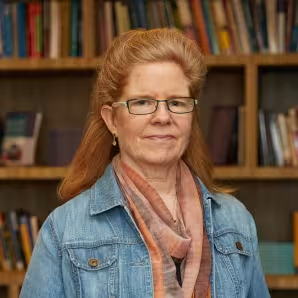
Joann Lee, Directing Attorney, Special Counsel on Language Justice, Legal Aid Foundation of Los Angeles
Moderator:
Margie McHugh, Director, National Center on Immigrant Integration Policy, MPI
About the National Center on Immigrant Integration Policy
The Center is a national hub connecting policymakers, educators, community leaders, and service providers with evidence-informed policy research, technical assistance, and data to advance effective immigrant integration at U.S., state, and local levels.
- Topic
- Integration
- Keyword
- Language Access
- Region
- North America
- Country
- United States
- Speakers
-
Jacob Hofstetter
Policy Analyst

Joann Lee
Directing Attorney, Special Counsel on Language Justice,,Legal Aid Foundation of Los Angeles

- Moderator
-
Margie McHugh
Director, National Center on Immigrant Integration Policy


Related Content


