Ariel G. Ruiz Soto

Ariel G. Ruiz Soto is a Senior Policy Analyst at MPI, where he works in the U.S. Immigration Policy Program and the Latin America and Caribbean Initiative.
His mixed-methods research examines how governments across the Western Hemisphere design, coordinate, and implement migration policies, as well as how those policies affect foreign- and native-born populations. He also analyzes sociodemographic trends used to estimate the unauthorized immigrant population in the United States, helping to inform evidence-based policy debates.
He writes regularly on immigration enforcement, migrant reception and reintegration, and asylum and refugee policy in the United States, Mexico, and Central America. He is a co-author of On the Move: Migration Policies in Latin America and the Caribbean (Stanford University Press, 2025), which examines how host countries in Latin America and the Caribbean have responded to large-scale and uneven migration flows.
Mr. Ruiz Soto holds a master’s degree from the University of Chicago’s School of Social Service Administration with a focus on immigration policy and service provision, and a bachelor’s degree in sociology from Whitman College.
- Media Inquiries
-
Michelle Mittelstadt
202 266 1910 [email protected]
Explore Content by Ariel G. Ruiz Soto
Showing 61-70 of 86 total results
Invertir en el vecindario: Cambios en los patrones de migración entre México y Estados Unidos y oportunidades para una cooperación sostenible
La migración no autorizada de mexicanos disminuye, pero los flujos centroamericanos crecen, exigiendo cooperación bilateral en materia de asilo, vías legales e integración.
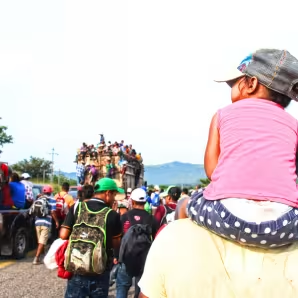
Investing in the Neighborhood: Changing Mexico-U.S. Migration Patterns and Opportunities for Sustainable Cooperation
Mexico-U.S. migration has shifted: unauthorized Mexican flows slowed while Central American arrivals surged, requiring regional cooperation on asylum reform and legal pathways.
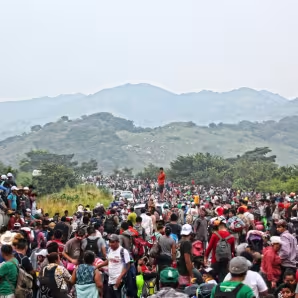
From Control to Crisis: Changing Trends and Policies Reshaping U.S.-Mexico Border Enforcement
Punitive enforcement-only measures failed to stem record flows of Central American families at the U.S.-Mexico border in 2019, underscoring the need for a new approach.

Soluciones estratégicas para afrontar la crisis migratoria en Estados Unidos y México
MPI y El Colegio de México proponen cinco estrategias para reducir la migración irregular centroamericana mediante reforma del asilo, vías legales e inversión en desarrollo.
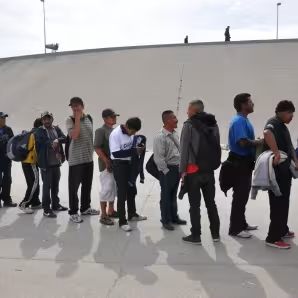
Strategic Solutions for the United States and Mexico to Manage the Migration Crisis
MPI and El Colegio de México outline five strategies to address irregular Central American migration through asylum reform, legal pathways, and targeted development aid.
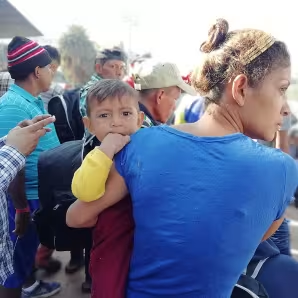
A Profile of Highly Skilled Mexican Immigrants in Texas and the United States
Many college-educated Mexican immigrants in Texas face underemployment due to credential-recognition barriers and limited English proficiency.
Sustainable Reintegration: Strategies to Support Migrants Returning to Mexico and Central America
Mexico and Central American countries expanded reintegration services for returning migrants after 2015, but limitations in coverage, resources, and coordination persist.
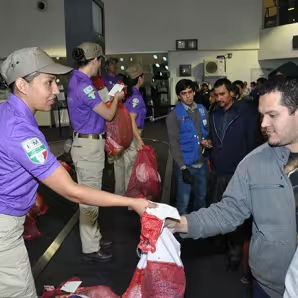
A Profile of Houston’s Diverse Immigrant Population in a Rapidly Changing Policy Landscape
Houston's 1.6 million immigrants as of 2016 faced compounding uncertainty as enforcement expands and humanitarian protections narrow.

A Narrower Path in the House for Most DREAMers
Covering fewer Dreamers than Senate proposals, a pair of 2018 House bills would protect anywhere from 590,000 to 1.25 million young unauthorized immigrants, MPI estimates.
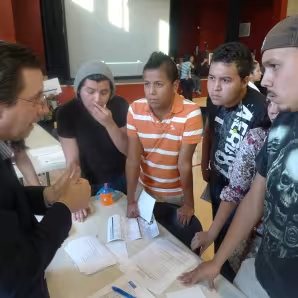
In Search of Safety, Growing Numbers of Women Flee Central America
Women from Central America face femicide and forced gang recruitment, and receive inadequate protection in the United States and upon return home.