Revving Up the Deportation Machinery: Enforcement under Trump and the Pushback

Related Content
Highlights
Interior immigration arrests rose 42 percent during Donald Trump's first eight months, but “sanctuary” policies limited enforcement and created uneven outcomes nationwide.
- During the first eight months of the first Trump term, U.S. Immigration and Customs Enforcement (ICE) made 110,568 interior arrests—up 42 percent from the same period in fiscal year (FY) 2016. Interior removals rose 37 percent, to 61,094.
- Nearly 70 percent of arrests in the early Trump months originated with state prisons and local jails, down from more than 85 percent in FY 2008–11, reflecting the power of limits on ICE cooperation.
- California's share of national arrests fell to 14 percent between FY 2013-17 after the state restricted cooperation, while Texas's share rose to 28 percent after it mandated full cooperation.
- Growing variation in state enforcement is creating disparate outcomes: in Texas, Tennessee, and Georgia, driving without a license can result in deportation, while in California, Chicago, and New York, immigrants can be arrested for crimes and still avoid federal custody.
The Trump administration has significantly cranked up the immigration enforcement machinery in the U.S. interior, with arrests and deportations up about 40 percent in its first eight months over a year earlier. Yet pushback from California and other locations with “sanctuary” policies makes it quite unlikely that U.S. Immigration and Customs Enforcement (ICE) will be able to match record enforcement levels.
ICE arrests and removals during fiscal 2017 were about half their peaks during the early Obama years, before that administration significantly narrowed its enforcement priorities.
This report caps a year-long study that took MPI researchers to 15 locations across the United States, some fully cooperating with federal immigration enforcement and others not. There they interviewed everyone from senior ICE field leaders to state and local elected officials, immigrant-rights advocates, former immigration judges, and consular officials. The researchers also analyzed ICE enforcement data obtained via Freedom of Information Act requests.
The study finds that the engine that fueled ICE’s peak effectiveness—the intersection of federal immigration enforcement with state and local criminal justice systems—is being throttled by state and local policies that limit cooperation with ICE. Nearly 70 percent of ICE arrests in the early Trump months originated with local jails and state prisons, a sizeable share that is nonetheless down from more than 85 percent in fiscal 2008-11.
Beyond sanctuary policies, the report finds growing resistance at other levels. Some cities are changing policing practices to reduce noncitizen arrests, such as decriminalizing driving without a license. Immigrant advocates are conducting more “know-your-rights” trainings, teaching people they do not have to open their doors to ICE. And others are mobilizing to monitor ICE operations in the field, or increasing funding for legal representation for those facing removal hearings.
Related Resources
Don't have time to read the full report? Check out this report in brief, which summarizes the full report's top findings, and other helpful resources.
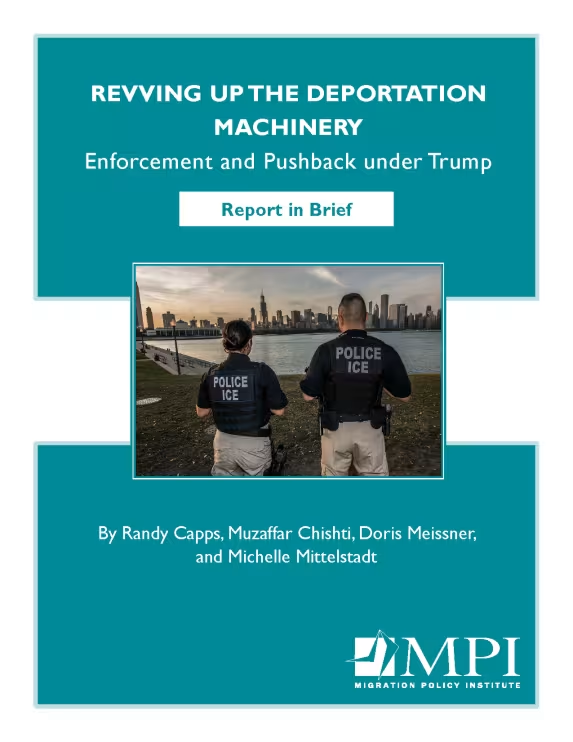
Table of Contents
I. Introduction
II. Continuity and Change in Federal Immigration Enforcement: From Clinton to Trump
III. By the Numbers: ICE Arrest, Detainer, and Removal Activity
IV. Changing ICE Arrest Patterns: New Targets, New Locations
V. Reduction in Use of Prosecutorial Discretion After Arrest
VI. Responses by States, Localities, Consulates, and Immigrant Communities
VII. Impact of the New Enforcement Climate on Immigrant Communities
VIII. Conclusions
Appendices
About the U.S. Immigration Policy Program
The U.S. Immigration Policy Program provides analysis of U.S. immigration pathways, the impacts of enforcement and other policies, and the characteristics of immigrant populations.