Ariel G. Ruiz Soto

Ariel G. Ruiz Soto is a Senior Policy Analyst at MPI, where he works in the U.S. Immigration Policy Program and the Latin America and Caribbean Initiative.
His mixed-methods research examines how governments across the Western Hemisphere design, coordinate, and implement migration policies, as well as how those policies affect foreign- and native-born populations. He also analyzes sociodemographic trends used to estimate the unauthorized immigrant population in the United States, helping to inform evidence-based policy debates.
He writes regularly on immigration enforcement, migrant reception and reintegration, and asylum and refugee policy in the United States, Mexico, and Central America. He is a co-author of On the Move: Migration Policies in Latin America and the Caribbean (Stanford University Press, 2025), which examines how host countries in Latin America and the Caribbean have responded to large-scale and uneven migration flows.
Mr. Ruiz Soto holds a master’s degree from the University of Chicago’s School of Social Service Administration with a focus on immigration policy and service provision, and a bachelor’s degree in sociology from Whitman College.
- Media Inquiries
-
Michelle Mittelstadt
202 266 1910 [email protected]
Explore Content by Ariel G. Ruiz Soto
Showing 41-50 of 86 total results
Promising Alternatives to Irregular Migration: Expanding Temporary Worker Programs in Canada, Mexico, and Costa Rica
This webinar examined the potential for Canada, Mexico, and Costa Rica to expand temporary worker programs for Central Americans, possibly converting some irregular flows into legal ones.
Hacia una Gobernanza Regional sobre Migración y Desplazamiento Forzado: Un Evento Paralelo de la Novena Cumbre de las Américas
Al margen de la Novena Cumbre de las Américas, este evento examinó las acciones adoptadas en materia de gobernanza migratoria regional, las lecciones aprendidas y el papel de los mecanismos regionales para responder a la migración y el desplazamiento forzado.

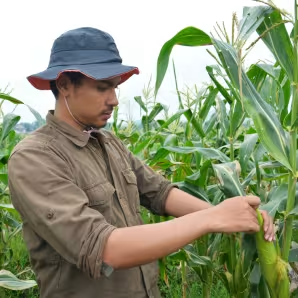
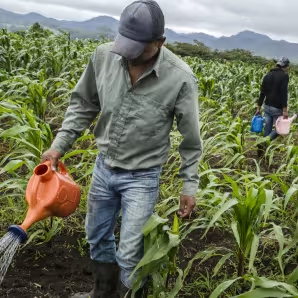
Programas de trabajadores temporales en Canadá, México y Costa Rica: ¿Son vías prometedoras para gestionar la migración centroamericana?
Canadá, México y Costa Rica tienen programas de trabajadores temporales subutilizados que, reformados, podrían reducir la migración irregular centroamericana.

Temporary Worker Programs in Canada, Mexico, and Costa Rica: Promising Pathways for Managing Central American Migration?
With reforms, temporary worker programs in Canada, Mexico, and Costa Rica could become viable legal pathways for Central Americans while meeting labor needs.
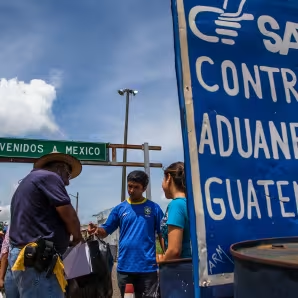
Beyond the Border: Opportunities for Managing Regional Migration between Central and North America
With migration from Central America increasing, the region from Canada to Panama faces an opportunity to build an effective regional approach to migration by focusing on several areas that are ripe for significant policy innovation. This commentary sketches a vision, offering a road map to more detailed research that outlines strategies for cooperation on legal pathways, humanitarian protection, migration management, and sustainable development.
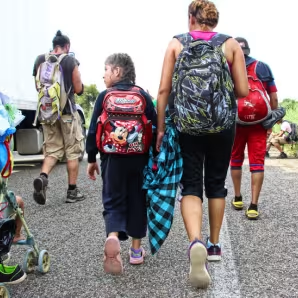
Charting a New Regional Course of Action: The Complex Motivations and Costs of Central American Migration
A survey of thousands of migrant-sending households in El Salvador, Guatemala, and Honduras finds economic hardship drives migration desire, though few turn intentions into plans.

Building a Modern U.S. Immigration and Asylum System in the National Interest
History rhymes on U.S. immigration—but former INS Commissioner Doris Meissner says the stakes today are categorically different.
Lessons from Europe: The U.S. opportunity to rethink the links between development assistance and migration
As the United States embarks on a new strategy to address the root causes of migration and displacement from Central America, there is much that it can learn from Europe's experience in linking up migration and development aid. This commentary examines the experience of the EU Emergency Trust Fund for Africa (EUTF), drawing five key lessons directly applicable to the situation in Central America.



Laying the Foundation for Regional Cooperation: Migration Policy & Institutional Capacity in Mexico and Central America
Since 2015, Mexico and Central America have built fragmented, enforcement-heavy migration systems. This report maps gaps and paths toward improved regional cooperation.