Ariel G. Ruiz Soto

Ariel G. Ruiz Soto is a Senior Policy Analyst at MPI, where he works in the U.S. Immigration Policy Program and the Latin America and Caribbean Initiative.
His mixed-methods research examines how governments across the Western Hemisphere design, coordinate, and implement migration policies, as well as how those policies affect foreign- and native-born populations. He also analyzes sociodemographic trends used to estimate the unauthorized immigrant population in the United States, helping to inform evidence-based policy debates.
He writes regularly on immigration enforcement, migrant reception and reintegration, and asylum and refugee policy in the United States, Mexico, and Central America. He is a co-author of On the Move: Migration Policies in Latin America and the Caribbean (Stanford University Press, 2025), which examines how host countries in Latin America and the Caribbean have responded to large-scale and uneven migration flows.
Mr. Ruiz Soto holds a master’s degree from the University of Chicago’s School of Social Service Administration with a focus on immigration policy and service provision, and a bachelor’s degree in sociology from Whitman College.
- Media Inquiries
-
Michelle Mittelstadt
202 266 1910 [email protected]
Explore Content by Ariel G. Ruiz Soto
Showing 31-40 of 86 total results
Migration Narratives in Northern Central America: How Competing Stories Shape Policy and Public Opinion in Guatemala, Honduras, and El Salvador
A study of 2018–22 migration narratives in Guatemala, Honduras, and El Salvador found government deterrence messaging misaligned with community realities.

The U.S.-Mexico Border Becomes More High-Tech
MPI analysts who toured the U.S.-Mexico border discuss the increasingly sophisticated U.S. Customs and Border Protection operations to address asylum seekers and other migrants arriving at official ports of entry.
A Complex Picture: Diversifying Migration Flows & Policies at the U.S.-Mexico Border
What is driving the increasingly diverse flows to the U.S.-Mexico border, and how are officials responding on the ground?
El Cambio de los Patrones y Políticas Migratorios en las Américas
América Latina ha pasado de ser una región de emigración a convertirse en uno de los destinos migratorios de más rápido crecimiento del mundo, impulsada en parte por el desplazamiento masivo de Venezuela y las crisis regionales que se entrecruzan.
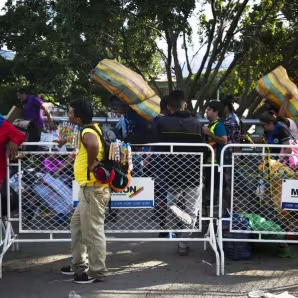
In a Dramatic Shift, the Americas Have Become a Leading Migration Destination
Latin America has transformed from a region of emigration to one of the world's fastest-growing migrant destinations, driven partly by Venezuela's mass displacement and intersecting regional crises.
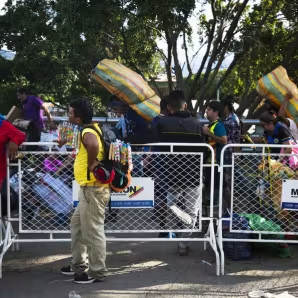
A Post-Title 42 Vision for Migration Management Comes into Focus
Facing a dramatically different reality arriving at the U.S.-Mexico border with the end of a pandemic-era policy that resulted in more than 3 million expulsions, the Biden administration unveiled a policy vision that marries expanded legal pathways with stiff consequences for those seeking to enter without authorization. The strategy can succeed, but speedier while still fair border asylum decisionmaking must be an essential component, this commentary argues.
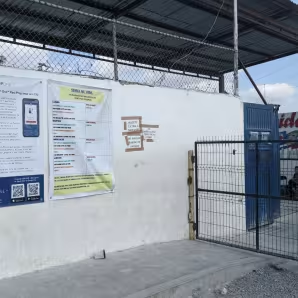
El número récord de encuentros con migrantes en la frontera México-Estados Unidos encubre la historia más importante
Los titulares enfocados en la cifra récord de 2,4 millones de migrantes encontrados en la frontera México-Estados Unidos durante el año fiscal 2022 encubren la historia más importante: Los flujos migratorios se han diversificado rápidamente más allá de México y el norte Centroamérica, y como resultado, las políticas de control migratorio son incongruentes con la realidad de hoy. Esto demuestra la evidente necesitad de nuevos enfoques regionales, argumenta este comentario.
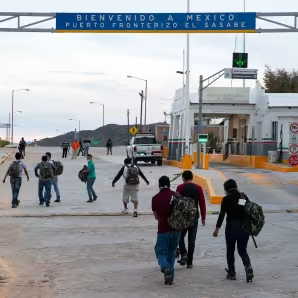
Record-Breaking Migrant Encounters at the U.S.-Mexico Border Overlook the Bigger Story
Headlines focusing on the record-breaking nature of the 2.4 million migrant encounters at the U.S.-Mexico border in fiscal year 2022 overlook the much bigger story: Migrant and asylum seeker flows have rapidly diversified beyond Mexico and northern Central America and as a result, U.S. enforcement policies are misaligned. Today's reality sharply underscores the need for new regional approaches, this commentary argues.
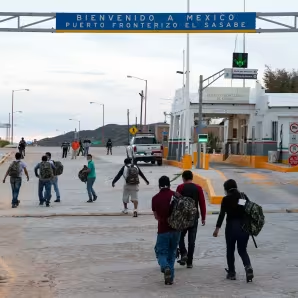
Labor Migration and Development in Central America
Experts discussed challenges faced by countries of origin and destination in ensuring mutual benefits through labor migration and migration and development strategies in Guatemala, El Salvador, and Honduras.
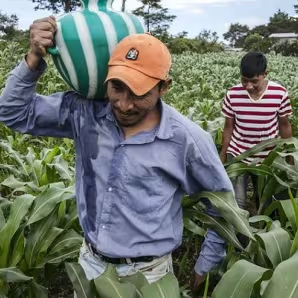
Alternativas a la migración irregular: Ampliación de los programas de trabajo temporal en Canadá, México y Costa Rica
Este seminario web examina el potencial de Canadá, México y Costa Rica para expandir los programas de trabajadores temporales para los centroamericanos, ofreciendo un medio importante para convertir algunos flujos irregulares en flujos legales.