U.S. Immigration Policy Program

The U.S. Immigration Policy Program provides thought leadership on ways to improve the U.S. immigration system so that it works most effectively in the national interest. To that end, its work focuses on immigration pathways to the United States and immigration enforcement policies and their impacts. It examines the complex demographic, economic, social, political, foreign policy, and other forces that shape U.S. immigration.
Program staff produce data and analyses of immigration trends and the characteristics of U.S. immigrant populations, including unauthorized immigrants. And they conduct original research on the impacts of policy change and the experiences of immigrant populations in diverse parts of the country. This work is frequently informed by private convenings of policymakers and key stakeholders. For more, click here.
The Latest Research
U.S. Deportations and “Self-Deportations” in the First 18 Months of the Second Trump Term
Filling a gap amid a slowdown in official data reporting from the federal government, this analysis offers a window into deportation and "self…

Featured
Physicians in an Era of Changing Immigration Policy: The Case of Nephrology
The care of kidney disease in the United States relies heavily on international medical graduates (IMGs). Recent policy changes could deepen…

Temporary Visa Holders in the United States
The number of U.S. temporary visas plummeted during the COVID-19 pandemic, rebounded, and then fell again in fiscal year (FY) 2025. Preliminary data…

Following Years of High Border Arrivals, the U.S. Unauthorized Immigrant Population Hits New Peak
MPI estimates the U.S. unauthorized immigrant population reached a new peak of 15.8 million as of mid-2024, after holding steady at around 11 million…

More Featured Work
From Counterterrorism to Immigration Enforcement: 25 Years On, Post-9/11 U.S. Changes Have Been Repointed
Post-9/11 national security tools have been repurposed for immigration, expanding the U.S. government’s capacity for surveillance, data sharing, and…

Attacked as "De Facto Amnesty," U.S. Temporary Protected Status Is Abruptly Eroded
The Trump administration moved to terminate most of the 17 Temporary Protected Status (TPS) designations in place when its second term began,…

Though Rare, Birth Tourism to the United States Sparks Outsized Concern
While rare, birth tourism has become a central but contested justification in the Trump administration's push to end the guarantee of birthright…

Key Statistics
Learn more about immigrants and immigration to the United States
14.8%
The immigrant share of the total U.S. population
Learn how this share has evolved (opens in a new tab)50.2 million
The number of immigrants in the United States
Explore Data Profiles by State (opens in a new tab)18.4%
The share of workers in the U.S. civilian labor force who are immigrants
Get the data at U.S. and state levels (opens in a new tab)
Showing 281–290 of 824 results
“Merit-Based” Immigration: Trump Proposal Would Dramatically Revamp Immigrant Selection Criteria, But with Modest Effects on Numbers
President Donald Trump's merit-based immigration plan would shift admissions from primarily family-based to mostly employment-based without meaningfully reducing total immigration.

"Merit-Based" Immigration: Designing Successful Selection Systems
MPI and OECD experts discuss what policymakers should consider in designing and managing immigrant selection systems in a time of intense labor-market and demographic change.
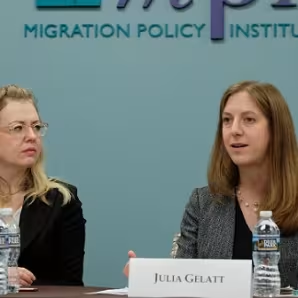
A Mirror for the Nation? The Changing Profile of Mexican Immigrants in Texas
At this event, experts from MPI and Southern Methodist University’s Texas-Mexico Center offer an overview of immigration trends and key characteristics of highly skilled Mexican immigrant adults at the national level and for Texas, and engage in a discussion on the causes behind the changing trends in immigration and implications for Texas, its economy, and more broadly for the nation.
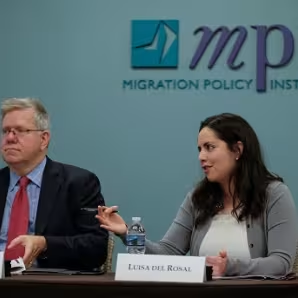
A Profile of Highly Skilled Mexican Immigrants in Texas and the United States
Many college-educated Mexican immigrants in Texas face underemployment due to credential-recognition barriers and limited English proficiency.

Noncitizens in the U.S. Military: Navigating National Security Concerns and Recruitment Needs
Enhanced vetting requirements since 2016 have limited U.S. military service for noncitizens even as recruitment shortfalls grow, leaving hundreds discharged and thousands waiting.

Eight Key U.S. Immigration Policy Issues: State of Play and Unanswered Questions
This review maps eight pressing U.S. immigration issues where Congress faces key unanswered questions, including border security, refugee admissions, and H-1B reform.

Immigration-Related Policy Changes in the First Two Years of the Trump Administration
During the first half of its first term, the Trump administration pursued a broad immigration agenda primarily through executive action.

Despite Flurry of Actions, Trump Administration Faces Constraints in Achieving Its Immigration Agenda
Court injunctions, local resistance, and resource constraints are blocking the Trump administration's immigration enforcement agenda at the border and in the interior in its first term.
Children of Immigrants and Child Welfare Systems: Key Policy and Practice
Marking the release of an MPI report, this webinar examines the intersection between immigration and child welfare systems and promising child welfare policies and agency approaches to address the needs of children of immigrants and their families.

Is U.S.-Mexico Cooperation on Migration Possible?
As the numbers of Central American migrants crossing into Mexico and the United States rises—putting migration front and center in the U.S.-Mexico relationship again—this event examines the opportunities for cooperation between the two countries, along with ways to improve U.S. and Mexican asylum systems, create new approaches to labor migration, address smuggling networks, and modernize border management.


- General Inquiries
- Media Inquiries
-
Michelle Mittelstadt
202 266 1910 [email protected]