U.S. Immigration Policy Program
The U.S. Immigration Policy Program provides thought leadership on ways to improve the U.S. immigration system so that it works most effectively in the national interest. To that end, its work focuses on immigration pathways to the United States and immigration enforcement policies and their impacts. It examines the complex demographic, economic, social, political, foreign policy, and other forces that shape U.S. immigration.
Program staff produce data and analyses of immigration trends and the characteristics of U.S. immigrant populations, including unauthorized immigrants. And they conduct original research on the impacts of policy change and the experiences of immigrant populations in diverse parts of the country. This work is frequently informed by private convenings of policymakers and key stakeholders. For more, click here.
The Latest Research
U.S. Deportations and “Self-Deportations” in the First 18 Months of the Second Trump Term
Filling a gap amid a slowdown in official data reporting from the federal government, this analysis offers a window into deportation and "self…

Featured
Physicians in an Era of Changing Immigration Policy: The Case of Nephrology
The care of kidney disease in the United States relies heavily on international medical graduates (IMGs). Recent policy changes could deepen…

Temporary Visa Holders in the United States
The number of U.S. temporary visas plummeted during the COVID-19 pandemic, rebounded, and then fell again in fiscal year (FY) 2025. Preliminary data…

Following Years of High Border Arrivals, the U.S. Unauthorized Immigrant Population Hits New Peak
MPI estimates the U.S. unauthorized immigrant population reached a new peak of 15.8 million as of mid-2024, after holding steady at around 11 million…

More Featured Work
From Counterterrorism to Immigration Enforcement: 25 Years On, Post-9/11 U.S. Changes Have Been Repointed
Post-9/11 national security tools have been repurposed for immigration, expanding the U.S. government’s capacity for surveillance, data sharing, and…

Attacked as "De Facto Amnesty," U.S. Temporary Protected Status Is Abruptly Eroded
The Trump administration moved to terminate most of the 17 Temporary Protected Status (TPS) designations in place when its second term began,…

Though Rare, Birth Tourism to the United States Sparks Outsized Concern
While rare, birth tourism has become a central but contested justification in the Trump administration's push to end the guarantee of birthright…

Key Statistics
Learn more about immigrants and immigration to the United States
14.8%
The immigrant share of the total U.S. population
Learn how this share has evolved (opens in a new tab)50.2 million
The number of immigrants in the United States
Explore Data Profiles by State (opens in a new tab)18.4%
The share of workers in the U.S. civilian labor force who are immigrants
Get the data at U.S. and state levels (opens in a new tab)
Showing 261–270 of 824 results
“Cubicle Activism”: Companies Face Growing Demands from Workers to Cut Ties with ICE and Others in Immigration Arena
A rising wave of employee activism has pressured corporations to sever ties with immigration enforcement agencies. But few companies have complied.

16th Annual Immigration Law and Policy Conference
The 16th annual conference features thoughtful policy and legal analysis and discussion of the most important immigration topics from leading government officials, attorneys, researchers, advocates, and others.
Health Insurance Test for Green-Card Applicants Could Sharply Cut Future U.S. Legal Immigration
A new Trump administration action requiring intending immigrants to prove they can purchase eligible health insurance within 30 days of arrival has the potential to block fully 65 percent of those who apply for a green card from abroad, MPI estimates.

Supreme Court Asylum Ruling Latest Sign Judiciary Is Not the Brake on the Trump Administration that Immigration-Rights Activists Sought
The Supreme Court's September 2019 ruling upholding a transit-country asylum ban illustrates its consistent deference to executive authority on immigration.

Investing in the Neighborhood: Changing Mexico-U.S. Migration Patterns and Opportunities for Sustainable Cooperation
Mexico-U.S. migration has shifted: unauthorized Mexican flows slowed while Central American arrivals surged, requiring regional cooperation on asylum reform and legal pathways.
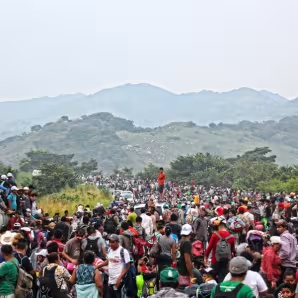
Invertir en el vecindario: Cambios en los patrones de migración entre México y Estados Unidos y oportunidades para una cooperación sostenible
La migración no autorizada de mexicanos disminuye, pero los flujos centroamericanos crecen, exigiendo cooperación bilateral en materia de asilo, vías legales e integración.

As the United States Resettles Fewer Refugees, Some Countries and Religions Face Bigger Hits than Others
Even as refugee admissions have dropped sharply during the Trump administration, some countries and religions have been significantly more affected than others, as this commentary explores. In fiscal year 2019, 79 percent of refugees were Christian and 16 percent Muslim—as compared to 44 percent Christian and 46 percent Muslim in fiscal year 2016, which was the last full year of the Obama administration.

Chronicling Migration in the 21st Century Through One Family's Journey
This event marked the launch of New York Times reporter Jason DeParle's book tracing the arc of migration as a phenomenon, witnessed through three decades observing a particular Filipino family moving from Manila to Texas. The conversation explored both the human and policy aspects of migration and development.

Rethinking U.S. Immigration Policy: Building a Responsive, Effective Immigration System
This event marks the launch of a major new initiative—Rethinking U.S. Immigration Policy—that aims to generate a big-picture, evidence-driven vision of the role immigration can and should play in America’s future in order to leverage a comparative advantage for the nation.

Millions Will Feel Chilling Effects of U.S. Public-Charge Rule That Is Also Likely to Reshape Legal Immigration
The Trump administration's 2019 public-charge rule risks prompting 22.7 million noncitizens and U.S.-citizen family members to drop benefits while also reshaping legal immigration.

- General Inquiries
- Media Inquiries
-
Michelle Mittelstadt
202 266 1910 [email protected]