National Center on Immigrant Integration Policy

The National Center on Immigrant Integration Policy serves as a crossroads for policymakers, community and system leaders, and others looking to understand ways to support successful integration of immigrants and their children into U.S. classrooms, workplaces, and civic spaces.
It produces evidence-informed, nonpartisan policy research and data, and provides technical assistance and cross-state learning opportunities for state and local leaders. By engaging with stakeholders across the early childhood, education, workforce, health, and civic sectors, the Center builds a more coherent, knowledge-driven field. It shines a spotlight on integration issues often overlooked in national debates and promotes solutions that can lift the integration trajectories of immigrant families while also fueling the vibrancy of the communities and local economies where they live. For more about the Center, click here.



More Featured Work




- General Inquiries
Showing 341–350 of 375 results
DREAM vs. Reality: An Analysis of Potential DREAM Act Beneficiaries
Roughly 2.1 million people could qualify under the 2010 DREAM Act, but only about 825,000 would be likely to obtain permanent legal status.

Migration and Occupational Health: Shining a Light on the Problem
Discussion with the Occupational Safety and Health Administration Chief of Staff; Director of the National Institute for Occupational Safety and Health; Director of the Migration and Health Research Center, UC Davis; and representatives from Farmworker Justice and Health Initiative of the Americas. Moderated by MPI's Michael Fix.

2010 E Pluribus Unum Prizes: Honoring Exceptional Immigrant Integration Initiatives
Winners of the 2nd annual E Pluribus Unum Prizes awarded to exceptional immigrant integration initiatives by MPI's National Center on Immigrant Integration Policy are the Illinois New Americans Integration Initiative; the Latino Community Credit Union in Durham, NC; Tacoma Community House in Tacoma, WA; and Upwardly Global in San Francisco, CA. McDonald's Corp. of Oak Brook, IL, received the sole honorable mention. The Prizes seek to reward exemplary efforts that uphold and update the ideal of "out of many, one" and inspire others to take on the important work of helping immigrants and their children join the mainstream of U.S. society as well as build stronger ties between immigrants and the native-born. Award winners were honored at the second annual awards ceremony in Washington, DC, on May 18, 2010. Watch highlights of the ceremony here.

Promoting Success on Both Sides of the Border: Binational Approaches to U.S. Immigrant Integration
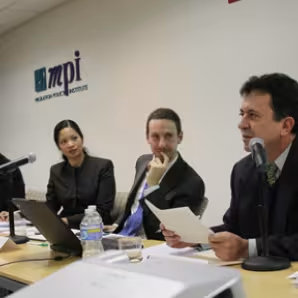
A discussion and report release with Ambassador Carlos García de Alba, Executive Director, Institute for Mexicans Abroad; and MPI's Laureen Laglagaron, Kathleen Newland, Aaron Terrazas, and Michael Fix.
Protection through Integration: The Mexican Government's Efforts to Aid Migrants in the United States
Mexico increasingly seeks to protect its migrants in the United States through consular services, programs, and closer ties to communities abroad.
The Binational Option: Meeting the Instructional Needs of Limited English Proficient Students
U.S. schools face persistent shortages of English as a Second Language and bilingual teachers; binational exchange programs offer an underused short-term solution.
Immigrants and Health Care Reform: What's Really at Stake?
Uninsured immigrants use emergency care at low rates; excluding them from U.S. health reform raises safety net costs while adding minimally to overall costs if they are included.
Is This Working? Assessment and Evaluation Methods Used to Build and Access Language Services in Social Services Agencies
U.S. agencies that systematically assess language needs and service quality can better match language access to Limited English Proficient (LEP) clients.
Taking Limited English Proficient Adults into Account in the Federal Adult Education Funding Formula
Workforce Investment Act Title II funding should reflect the size and needs of Limited English Proficient (LEP) adults, not just lack of a diploma.
MPI Symposium on Citizenship
Discussion on citizenship with leading experts and key policymakers, including top government officials from the United States, United Kingdom, Canada, Australia, and New Zealand.