National Center on Immigrant Integration Policy

The National Center on Immigrant Integration Policy serves as a crossroads for policymakers, community and system leaders, and others looking to understand ways to support successful integration of immigrants and their children into U.S. classrooms, workplaces, and civic spaces.
It produces evidence-informed, nonpartisan policy research and data, and provides technical assistance and cross-state learning opportunities for state and local leaders. By engaging with stakeholders across the early childhood, education, workforce, health, and civic sectors, the Center builds a more coherent, knowledge-driven field. It shines a spotlight on integration issues often overlooked in national debates and promotes solutions that can lift the integration trajectories of immigrant families while also fueling the vibrancy of the communities and local economies where they live. For more about the Center, click here.


More Featured Work




- General Inquiries
Showing 141–150 of 375 results
Children of Immigrants and Child Welfare Systems: Key Policy and Practice
Marking the release of an MPI report, this webinar examines the intersection between immigration and child welfare systems and promising child welfare policies and agency approaches to address the needs of children of immigrants and their families.

Addressing Trauma in Young Children in Immigrant and Refugee Families through Early Childhood Programs
During this webinar, speakers discuss a MPI policy brief that explores the intersection of trauma and early childhood development, exploring how migration-related trauma and stressors can influence the wellbeing of young children of immigrants, and points to key opportunities for states to support, through early childhood and other programs.
How Many Unauthorized Immigrants Graduate from U.S. High Schools Annually?
MPI estimated 98,000 unauthorized immigrants graduate from U.S. high schools per year, with California and Texas accounting for 44 percent.
The Unintended Consequences for English Learners of Using the Four-Year Graduation Rate for School Accountability
The four-year graduation rate for school accountability disadvantages English Learners, creating incentives to deny enrollment to older newcomers who need more time.

Mitigating the Effects of Trauma among Young Children of Immigrants and Refugees: The Role of Early Childhood Programs
Young children of immigrants and refugees face elevated trauma risk. Early childhood programs can help but lack capacity and culturally responsive resources.

Immigrant Families and Child Welfare Systems: Emerging Needs and Promising Policies
Growing immigrant family numbers and tougher enforcement strain child welfare. This report identifies key policy gaps and promising agency approaches to better serve families.

Upskilling the U.S. Labor Force: Mapping the Credentials of Immigrant-Origin Workers
This webinar discusses the first-ever profile of the 30 million immigrant-origin adults in the United States who lack a postsecondary credential such as a college degree, apprenticeship certificate, or occupational license. The researchers discuss their findings and policy implications with leading experts.

More Than a DREAM (Act), Less Than a Promise
The first bill introduced in the 116th Congress to offer a path to legal status to Dreamers, the American Dream and Promise Act of 2019, could legalize nearly 2.7 million, MPI estimates.
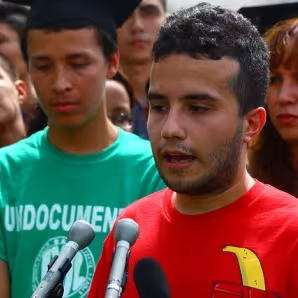
Credentials for the Future: Mapping the Potential for Immigrant-Origin Adults in the United States
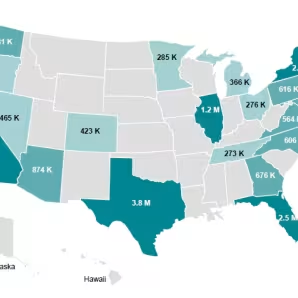
In 2017, 30 million immigrant-origin adults lacked postsecondary credentials, making them an underserved yet critical target for U.S. upskilling efforts.
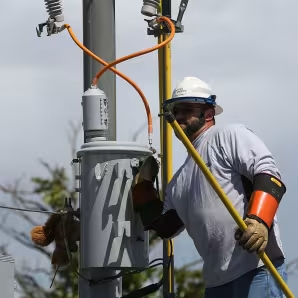
Immigrant-Origin Adults without Postsecondary Credentials: A 50-State Profile
A 50-state profile finds 30 million immigrant-origin adults lacked postsecondary credentials in 2017, with English proficiency and legal status key upskilling barriers.