Immigrant Families and Child Welfare Systems: Emerging Needs and Promising Policies

Growing immigrant family numbers and tougher enforcement strain child welfare. This report identifies key policy gaps and promising agency approaches to better serve families.
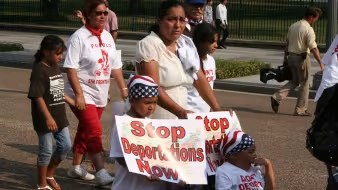
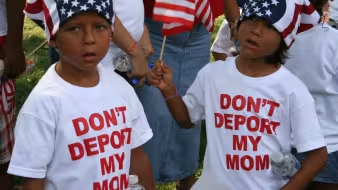
Recent demographic trends and a rapidly changing immigration policy landscape, including rising federal immigration enforcement, have important implications for state and local child welfare agencies. A growing share of children in the United States have at least one immigrant parent—slightly more than one in four as of 2017. Nearly 90 percent of these children were born in the country and are therefore U.S. citizens, and about one-quarter have an unauthorized immigrant parent.
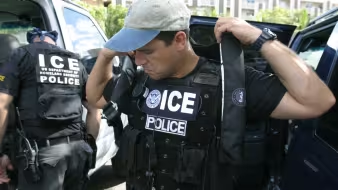
Children of immigrants, like other U.S. children, may enter the child welfare system if there are reports of abuse or neglect. Yet immigrant families can face unique challenges when it comes to interacting with child welfare professionals, including those linked with cultural misunderstandings and limited English proficiency. Children with parents who are unauthorized immigrants may also enter the child welfare system if U.S. Immigration and Customs Enforcement (ICE) arrests, detains, or deports a parent. Fear of immigration enforcement may make some families with unauthorized immigrant members wary of engaging with government entities, including child welfare agencies, and parents who have been detained can find it difficult to keep up with cases involving their children.
Some states and localities have developed specialized policies and practices for working with children in immigrant families, though these vary considerably. This report explores this diversity of approaches, drawing on interviews with child welfare officials from 14 states, six counties, and New York City. For each of nine key issues—ranging from agency staffing and training, to language access policies and cooperation with foreign consulates—the researchers identify a recommended approach and discuss relevant policies and practices.
Key Findings & Recommendations
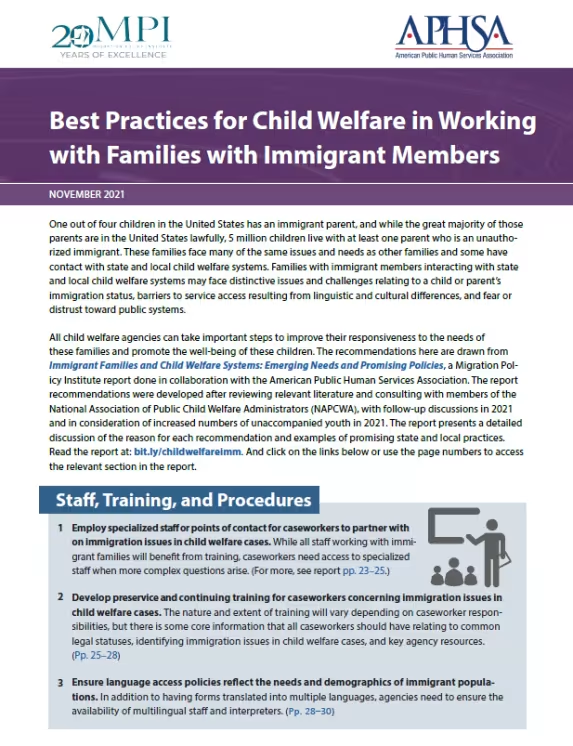
Short on time? Check out this executive summary or two-pager with key recommendations.
Table of Contents
I. Introduction
II. Children of Immigrants, Immigration Enforcement, and Child Welfare
A. Recent Trends in Immigration Enforcement
B. Consequences of Parental Detention or Removal for Children
C. Children of Immigrants and Child Welfare Systems
III. Children of Immigrants and Child Welfare: Key Policy and Practice Issues and Agency Approaches
A. Organizational Structure
B. Training on Immigration-Related Issues
C. Language Access
D. Licensing
E. Placement of a Child with a Caregiver outside the United States
F. Memoranda of Understanding with Foreign Consulates
G. Screening for Immigration Benefits
H. Confidentiality and Information Sharing
I. Policies When Parents Are in Detention
IV. Compilation of Recommendations
About the Human Services Initiative
The Initiative produced work focusing on U.S. federal, state, and local policies on immigration issues affecting children, families, and health and human services.
About the U.S. Immigration Policy Program
The U.S. Immigration Policy Program provides analysis of U.S. immigration pathways, the impacts of enforcement and other policies, and the characteristics of immigrant populations.
About the National Center on Immigrant Integration Policy
The Center is a national hub connecting policymakers, educators, community leaders, and service providers with evidence-informed policy research, technical assistance, and data to advance effective immigrant integration at U.S., state, and local levels.

Related Content