Global Program

The Global Program acts as a policy laboratory for innovative, evidence-based, and politically feasible solutions to migration policy challenges. From direct policy advice to deep comparative research, its work interrogates policy design and effectiveness, helps countries newer to immigration learn from innovation and evidence in other regions, and anticipates how demographic, economic, and technological shifts will reshape migration in the years ahead. It supports governments in responding to crises with greater coordination and foresight, and provides a trusted off-the-record space for engaging with sensitive topics. Its main geographical focus is Europe, the Americas, and Australia, but it increasingly works with governments and other partners worldwide, including in East Africa and Asia. For more on the Global Program, click here.
Featured
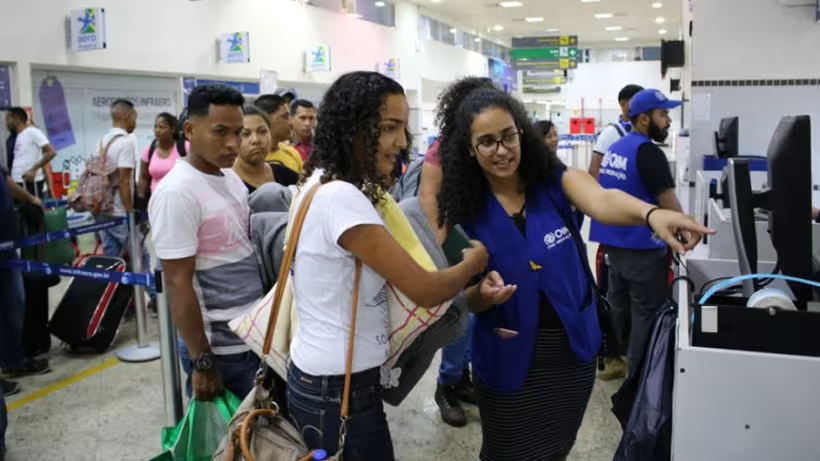
What Can Latin America Learn from Brazil’s Pragmatic, Politically Durable Migration Approach?
Brazil’s migration approach, which has endured across ideologically varied administrations, offers a model for other countries in Latin America and…
Migration Diplomacy in an Age of Transactionalism
As international cooperation frays, balanced diplomacy—rather than coercive dealmaking—promises the most effective approach to emerging migration…

More Featured Work




Key Statistics
International migrants comprise 3.7 percent of the global population. Learn more about them
304.0 million
The number of migrants globally in 2024
50.6 million
The number who as of 2025 were refugees or asylum seekers
94.0 million
The number of international migrants in Europe—the top destination globally


Showing 1–10 of 699 results
What Can Latin America Learn from Brazil’s Pragmatic, Politically Durable Migration Approach?
Brazil’s migration approach, which has endured across ideologically varied administrations, offers a model for other countries in Latin America and the Caribbean, centering jobs, interiorization, and legal status for newcomers.
¿Qué puede aprender América Latina del enfoque migratorio de Brasil, su pragmatismo y continuidad política?
El enfoque migratorio de Brasil, que ha mantenido su continuidad bajo gobiernos de distintas orientaciones ideológicas, ofrece lecciones para otros países de América Latina y el Caribe al centrarse en el empleo, la integración en distintas zonas del país y la regularización migratoria de los recién llegados.
Migration Diplomacy in an Age of Transactionalism
As international cooperation frays, balanced diplomacy—rather than coercive dealmaking—promises the most effective approach to emerging migration challenges.

Population Aging Is Here. Immigration Can Offer Half an Answer.
Immigration on its own cannot solve population aging, but five policy principles can help it play a more effective role in a broader demographic strategy.

Spain and Latin America Take Diverging Paths on Regularization
Spain’s 2026 regularization drew nearly 1.2 million applications, even as many Latin American countries have pulled back from similar measures for Venezuelans.

España y América Latina siguen caminos divergentes en materia de regularización
El proceso de regularización de 2026 en España recibió cerca de 1,2 millones de solicitudes, aun cuando muchos países latinoamericanos han dado marcha atrás en medidas similares para los venezolanos.
Why Is Sudan's Humanitarian Crisis Largely Invisible?
Sudan is experiencing the world's largest displacement crisis, but why is the crisis is overlooked, what are the regional spillover effects, and what would an effective international response require?

Countries Are Pushing Borders Outward to Expand Deterrence and Protection Alike
Externalization—the enlistment of partner countries to manage migration before people arrive or assist with removals and returns—has shifted from the policy fringe into the mainstream. Models range from deterrence to protection.


Rebuilding Lives in Guatemala: Understanding Returnee Profiles and Reintegration Challenges
Guatemalan returnees’ profile is changing, as they often have lived outside Guatemala for longer and have deep roots elsewhere. This report analyzes ways to strengthen reintegration services.
