Rebuilding Lives in Guatemala: Understanding Returnee Profiles and Reintegration Challenges
IOM/Muse Mohammed
Related Content
Highlights
Guatemalan returnees’ profile is changing, as they often have lived outside Guatemala for longer and have deep roots elsewhere. This report analyzes ways to strengthen reintegration services.
- More than 55,000 Guatemalans were deported in 2025, with a shifting profile: more men, older returnees, more Indigenous-language speakers, and a growing share from the rural Western Highlands—which accounted for 50 percent of returnees versus 34 percent in 2024.
- Deportations increasingly involve long-term U.S. residents: the share deported after five to nine years in the United States grew over the first nine months of 2025; 61 percent of surveyed returnees were their household's primary income earner, underscoring the urgency of reintegration support.
- Half of returnees had no interest in emigrating again, and 78 percent of those considering re-migration said they would stay in Guatemala if employment were available. Yet skills mismatches, employer hesitance, and uneven geographic access to services block economic reintegration.
- Guatemala's Return Home Plan offers a proactive framework, but the report urges stronger interagency coordination, improved data systems, deeper partnerships with the private sector and NGOs, and embedding return and reintegration within national development and macroeconomic strategies.
Executive Summary
Return migration to Guatemala, while by no means new, has attracted greater public and policy attention in recent years. The profile of Guatemalan migrants forcibly returned to the country has also shown signs of shifting. Of the more than 55,000 to arrive in Guatemala after deportation in 2025 (mostly from the United States and, to a lesser extent, Mexico), a larger share were men, speakers of Indigenous languages, from Guatemala’s Western Highlands, and slightly older than returnees in 2024. Among Guatemalans who were deported from the United States and participated in a voluntary government survey, the share who had spent a relatively short time in the United States (less than five years) decreased over the first nine months of 2025, while the share with a longer U.S. residence history (five to nine years) grew. This change is likely a reflection of shifts in U.S. policy that have seen deportations increasingly involve migrants in the interior of the country rather than recent border-crossers. Guatemalan survey respondents who had spent more time in the United States were more likely to speak English and to have U.S.-based family members, making the prospect of re-establishing themselves in Guatemala more complex for some.
These trends raise important questions for Guatemala. The government has in recent years taken steps to improve reception and reintegration support for returnees and to capitalize on their skills and ambitions, culminating in the launch of the Return Home Plan in 2025. This framework is significant for its proactive approach to managing the return and reintegration process, its emphasis on institutional coordination and early engagement, and its efforts to anticipate changes in migration patterns. For example, in terms of assisting returnees immediately upon arrival, the plan has consolidated services provided by the government and partner organizations at a Service and Registration Center in Guatemala City, while also providing referrals to additional assistance in communities where returnees settle.
This report—the result of a mixed-methods study conducted by Migration Policy Institute (MPI) researchers in partnership with the International Organization for Migration (IOM)—analyzes how returnee profiles and needs are changing and what these shifts mean for Guatemala’s reception and reintegration system. Drawing on administrative data, a voluntary survey of more than 12,000 returnee cases, 22 focus groups with returnees and private-sector leaders, and dozens of interviews with government and civil-society representatives in Guatemala and the United States, the research reveals a system at an inflection point. Because the data collection occurred alongside the rollout of the Return Home Plan, this should not be taken as an evaluation of its effectiveness, but rather an indication of the evolving challenges it faces.
Box 1. Return Terminology
Unless otherwise specified, this report uses the term “returnees” to describe individuals who were forcibly returned (i.e., deported) by U.S. or Mexican immigration authorities to Guatemala. Individuals who returned voluntarily without being placed into formal deportation proceedings and those who were in proceedings but were given the benefit of “voluntarily departure” to arrange their own return via commercial flights are not included in the data sources used in this analysis.
Insights shared in focus groups and interviews point to a set of interconnected issues before, during, and after return that, if addressed, could lead to more successful reintegration outcomes. For example, Guatemalan consulates in the United States reported growing demand from Guatemalans in the country for services related to family and asset protection, yet many immigrants reportedly rely more heavily on legal aid organizations and community groups than on official services. This reflects two distinct challenges: uneven consular capacity to meet higher demand for services and limited trust in government institutions among some Guatemalans. Most returnees surveyed between January and September 2025 arrived in Guatemala alone, often with family members still in the United States, and some were facing economic insecurity from outstanding migration debt and lost belongings, hinting at the diversity of immediate support needs within this population.
Still, many returnees see their future in Guatemala. Half of those surveyed had no interest in emigrating again, and among the 31 percent considering remigration, most said they would stay in Guatemala if they had employment opportunities. Returnees expressed strong interest in formal employment, entrepreneurship, and skills certification to validate work experience gained abroad—aspirations that indicate the potential value returnees can bring to Guatemalan communities. Yet reintegration is a long process, and challenges reportedly include limited awareness of available programs, geographic barriers (e.g., uneven availability of services and jobs for returnees from rural areas), mismatches between returnees’ U.S. work experience and local labor markets, some employers’ hesitance to hire returnees, and U.S.-Guatemala wage disparities that make some returnees view entrepreneurship as more viable—yet often without adequate capital or business support.
"Many returnees see their future in Guatemala."
Addressing these challenges and building successful reintegration programs will be essential as the profile of returnees has begun to change and may continue to do so. Guatemalans who have lived for decades in the United States and lack support networks in Guatemala may have more intensive reintegration needs than prior returnee populations, but also bring with them skills, work experience, and entrepreneurial ambitions that can strengthen local economies, if properly supported.
To meet these challenges and further strengthen the Return Home Plan, the Guatemalan government and its partners could consider:
- Strengthening governance and institutional coordination. As returnee profiles change, coordination across institutions will be just as important as having robust programs when it comes to reaching returnees with needed support. Guatemala’s National Migration Authority, which is chaired by the vice president, provides a high-level mechanism for interagency coordination on migration matters and could be strengthened further to ensure that pre-return, reception, and reintegration services function as a continuum of support. This would require more systematic coordination with the ministries and agencies responsible for labor, social welfare, public finance, regional development, and foreign affairs and help ensure that reintegration is reflected not only in migration policy discussions but also in service delivery in communities of return.
- Using data and improving data collection to enable a whole-of-government response. Guatemala’s data collection tools—including the voluntary survey that provided data for this study—can be improved and leveraged to connect migration governance and policy areas such as social welfare, labor, and regional development planning. This could include refining the existing returnee survey to collect information on additional topics, mapping local labor demand by industry to understand employment opportunities, and making data systems interoperable, all of which would help identify returnees’ needs and connect them with appropriate services.
- Build trust and program impact through partnerships. Many Guatemalan migrants place greater trust in community-based, faith-based, and nongovernmental organizations than in government institutions. Thus, alongside strengthening its own infrastructure, the Guatemalan government could deepen partnerships with organizations that already serve as first points of contact for migrants abroad and upon return as a way to reach additional segments of the returnee population and boost program impact.
- Deepening engagement with the private sector and local economies. Returnees are likely to contribute more economically if reintegration efforts are more closely linked to national investment and productivity strategies. Likewise, connecting reintegration programming with infrastructure projects, sectoral investment plans, and value-chain development initiatives that generate new employment—particularly in high-return regions such as the Western Highlands—may lead to more successful outcomes.
- Embedding return and reintegration within national development and macroeconomic strategies. Return and reintegration policies increasingly intersect with broader development and macroeconomic considerations. For example, some returnees previously contributed to household consumption via remittances, and sustained returns could have an impact on local economies. Taking return migration dynamics into account in national development planning would allow Guatemala to better anticipate shocks, align resources, and ensure that return and reintegration are part of a broader strategy for development.
Helping returnees successfully re-establish themselves in Guatemala is critically important to their ability to build a future in the country and to efforts to maximize their contributions to local communities. By building on the Return Home Plan, Guatemala has an opportunity to support this process and, potentially, to serve as a model for other countries facing similar dynamics. Continued investment in data on returnee profiles, emerging needs, and programmatic outcomes will be essential to a successful response to both immediate and future migration trends.
1. Introduction
Guatemala has long received Guatemalan migrants forced to return from other countries, but this return movement has entered a period of flux. Since 2025, shifting U.S. immigration enforcement policies have aimed to increase deportations. As border arrivals fell to historic lows, attention shifted toward enforcement operations in the interior of the country, which require greater resources and logistical coordination to implement at scale. Along with unauthorized immigrants of other nationalities, those from Guatemala—10 percent of all unauthorized immigrants living in the United States1—increasingly face the possibility of deportation.
About 55,000 Guatemalans were deported to Guatemala from the United States and Mexico in 2025—the lowest annual total in more than a decade,2 excluding 2020 when the COVID-19 pandemic limited deportations to 46,000.3 Yet, U.S. deportations to Guatemala started to increase gradually in April 2025, and by September 2025 they had surpassed 2024 monthly figures.4 In addition, congressional legislation in mid-2025 provided an additional $170 billion over four years to expand immigration enforcement—including $75 billion allocated to interior enforcement—which may further expand deportations in the coming years.
Compared to prior years, when most deportations were of migrants who had recently arrived at the U.S.-Mexico border, the heightened focus on deportations from the U.S. interior is shifting the profile of immigrants involved, with many having deeper ties within U.S. communities. For example, of the estimated 1.4 million unauthorized Guatemalan immigrants who resided in the United States in 2023, 60 percent had lived in the country for more than ten years, 33 percent lived with at least one U.S.-citizen child, and 19 percent were married to a U.S. citizen or lawful permanent resident.5 If deported, such individuals may have distinct needs from migrants deported after a shorter time in the United States, such as for family reunification assistance, mental health support, and help navigating government institutions in Guatemala.6
At the same time, the skills and experiences many Guatemalan unauthorized immigrants gain in the United States7 could open employment opportunities for some after return and benefit the communities in which they settle. Tapping into this potential requires close coordination across labor, education, and private-sector actors. And depending on the types of jobs migrants held in the United States and those available in Guatemala, labor market reintegration may be a more or less seamless process.
"Receiving and reintegrating returnees who have lived abroad for longer and have family ties in the United States present new challenges."
These trends have implications not only for individual migrants’ reintegration but also for how the Guatemalan government implements reception and reintegration services under its Return Home Plan (see Box 2). The government has in recent years taken significant, proactive steps to anticipate changes in migration patterns and to strengthen its reception and reintegration system. For example, the government has improved interinstitutional coordination through its National Migration Authority, a high-level mechanism chaired by the vice president; updated its reception protocols; and expanded the geographic reach of reintegration services through the creation of municipal offices. However, receiving and reintegrating returnees who have lived abroad for longer and have family ties in the United States present new challenges, suggesting a need for adjustments across all phases of the government’s system to further improve institutional coordination and ensure successful reintegration outcomes.
Box 2. Guatemala’s Return Home Plan (Plan Retorno al Hogar)
Launched in February 2025, Guatemala’s Return Home Plan is a government-led, interinstitutional framework designed to strengthen reception and reintegration support for returning migrants in anticipation of changing migration dynamics. Led by the Guatemalan Institute of Migration, the plan focuses on three phases:
- Close to You: Pre-return outreach and consular engagement;
- Dignified Return: Registration, documentation, and immediate assistance upon arrival; and
- New Opportunities: Referrals to employment, training, and reintegration services.
Guatemalans deported by air arrive and are processed at a reception center within Guatemala City’s international airport. Those who are deported by land are processed at a reception center near the city of Tecún Umán, along the Mexico-Guatemala border.
One of the plan’s most notable features is the creation of a Service and Registration Center (CAR), which is located in Guatemala City (distinct from the airport-based reception center) and brings together more than 20 government institutions, international organizations, and private-sector actors to provide coordinated services. Returnees can also request referrals for long-term reintegration services in the department or municipality in which they will live. Only returnees deported by air to Guatemala City have the option to access CAR services. However, those deported by land and those who opt out of CAR services upon arrival can access similar services remotely through a government-run call center.
Source: Government of Guatemala, Plan Retorno al Hogar (Guatemala City: Government of Guatemala, 2025).
The stakes for supporting returnees’ successful reintegration are high, not only because of the size and changing characteristics of this population but also because a sustained increase in deportations could affect Guatemala in other ways. Migrant remittances are a driver of consumer purchasing power and economic growth, accounting for about 20 percent of Guatemala’s gross domestic product (GDP) in 2025.8 Reductions in remittances could negatively affect households that rely on this income, lead to economic contractions, and exacerbate existing labor market challenges in a country where 66 percent of employment is informal and 14 percent of workers are underemployed.9
This report by the Migration Policy Institute (MPI), which is grounded in a mixed-methods study carried out in partnership with the International Organization for Migration (IOM) in Guatemala, analyzes the sociodemographic profile of Guatemalans deported to Guatemala in 2025. It highlights key challenges returnees face prior to their deportation, once they arrive in Guatemala, and during the reintegration process months after their return. The report concludes with a set of considerations that could help the Guatemalan government improve its reintegration services, including under the Return Home Plan, and strengthen parallel efforts by nongovernmental organizations and the private sector.
Box 3. This Study’s Methodology and Data
In partnership with the International Organization for Migration (IOM) in Guatemala, Migration Policy Institute (MPI) researchers employed a mixed-methods approach to studying changes in the sociodemographic profile of Guatemalan returnees and their reintegration experiences in 2025. MPI researchers analyzed a dataset of more than 12,000 cases of adult returnees who participated in a voluntary survey between January and September 2025, administered by the Guatemalan Institute of Migration. (Note: Some individuals who were deported more than once during this period may have been surveyed multiple times.) These cases are a non-probabilistic, non-representative subset of the 55,000 cases of returnees being deported from the United States and Mexico in 2025. Therefore, while these survey findings offer the most accurate and recent insights into Guatemalan returnees’ characteristics and experiences, these findings are not generalizable to the overall population of returnees.
To complement the survey data, MPI researchers analyzed qualitative evidence from 20 focus groups facilitated by IOM with 156 adult returnees across ten of Guatemala’s departments in August and September 2025. Although the research team encouraged the participation of adults who had returned to the country in 2025, an unknown number of participants may have returned in prior years. Therefore, focus group participants’ experiences should be understood as indicative of broader conditions that returnees have faced in recent years rather than reflective specifically of their access to services introduced in 2025.
Finally, MPI researchers analyzed additional qualitative data that they and IOM experts collected from governmental and community stakeholders in August and September 2025. This included 31 semi-structured interviews with local government representatives and leaders of immigrant and community organizations in Guatemala; five interviews with representatives from Guatemala’s embassy and consular network in the United States; and two focus groups with private-sector stakeholders in Guatemala City and Washington, DC. The interviews focused on immigrants’ service needs, institutional capacity constraints, and the implementation of the Return Home Plan. The private-sector focus groups aimed to understand participants’ views of the opportunities and challenges involved in reintegrating returnees into the Guatemalan labor market.
2. Guatemalan Returnees’ Evolving Profile
The sociodemographic profile of Guatemalan returnees subtly shifted in 2025. Compared to 2024, returnees in 2025 were more likely to be adult men and to have been deported from the United States rather than Mexico (see Table 1). Their median age also increased from 26 to 29 years old, and higher shares self-identified with the K’iche’ and Mam linguistic communities.
Table 1. Sociodemographic Characteristics of Guatemalan Returnees in 2024 and 2025
|
|
2024 |
2025 |
|---|---|---|
| Total Deportations |
76,768 |
55,181 |
| Sending Country | ||
|
United States |
80% |
88% |
|
Mexico |
20% |
12% |
| Sex | ||
|
Men |
73% |
88% |
|
Women |
27% |
12% |
| Demographic Group | ||
|
Adult |
89% |
97% |
|
Accompanied Minor |
8% |
2% |
|
Unaccompanied Minor |
3% |
1% |
| Age | ||
|
Median Age |
26 |
29 |
| Linguistic Community | ||
|
Spanish |
65% |
59% |
|
K’iche’ |
7% |
11% |
|
Mam |
5% |
11% |
|
Q’eqchi’ |
5% |
6% |
|
Q’anjob’al |
2% |
3% |
|
All Others |
16% |
10% |
Higher shares of returnees arriving in Guatemala in 2025 were originally from Guatemala’s Western Highlands, a largely rural region with high concentrations of Indigenous residents that has been a top migrant-sending region for decades. Specifically, the departments of Huehuetenango, San Marcos, Quiché, and Quetzaltenango located in the Western Highlands accounted for 50 percent of returnees in 2025 compared to 34 percent in 2024 (see Table 2). At the municipal level, returnees were more likely to be from rural communities outside of Guatemala City. Just 3 percent of returnees in 2025 reported Guatemala City as their municipality of origin, down from 6 percent in 2024. At the same time, the shares of returnees who were from Joyabaj in Quiché and Concepción Tutuapa and Malacatán in San Marcos each doubled from 1 percent in 2024 to 2 percent in 2025.
Table 2. Top Departments and Municipalities of Origin for Guatemalan Returnees in 2024 and 2025
|
|
2024 |
2025 |
|---|---|---|
| Total Deportations |
76,768 |
55,181 |
| Top Departments | ||
|
Huehuetenango |
11% |
19% |
|
San Marcos |
10% |
14% |
|
Quiché |
7% |
10% |
|
Quetzaltenango |
6% |
7% |
|
Guatemala |
9% |
6% |
|
All Others |
56% |
44% |
| Top Municipalities | ||
|
Guatemala, Guatemala |
6% |
3% |
|
Joyabaj, Quiché |
1% |
2% |
|
Concepción Tutuapa, San Marcos |
1% |
2% |
|
Malacatán, San Marcos |
1% |
2% |
|
Tajumulco, San Marcos |
1% |
1% |
|
Tacaná, San Marcos |
1% |
1% |
|
Momostenango, Totonicapán |
1% |
1% |
|
San Mateo Ixtatán,Huehuetenango |
1% |
1% |
|
Cuilco, Huehuetenango |
1% |
1% |
|
Totonicapán, Totonicapán |
1% |
1% |
|
All Others |
87% |
84% |
Given returnees’ strong ties to Indigenous and rural communities, these data suggest an increasing need for reintegration services targeting Indigenous individuals in search of support and employment opportunities both in their rural origin communities and in the Guatemala City metropolitan area. At the same time, increased deportations of migrants originating from the Western Highlands are notable in that they may cause economic shocks in the region, which has become highly dependent on a steady stream of remittances.10
A. How Long Have Returnees Been Abroad?
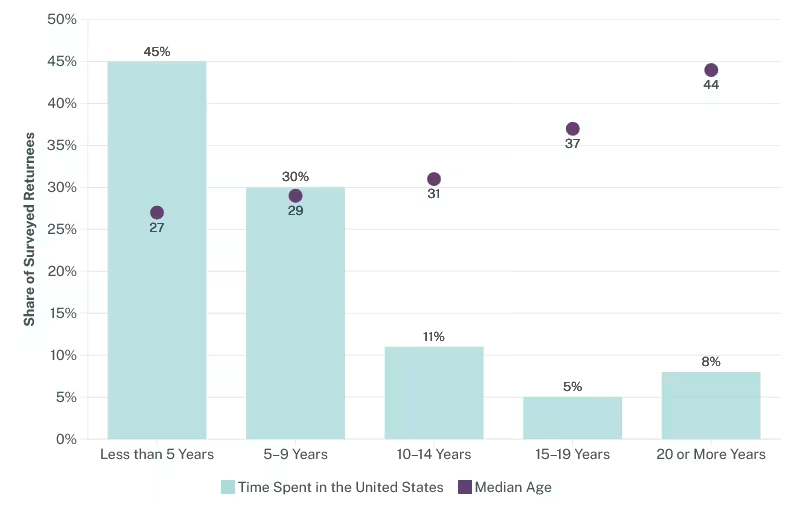
Among the subset of returnees who arrived in Guatemala between January and September 2025 and volunteered to be interviewed by the Guatemalan Institute of Migration (see Box 3), the vast majority were returning from the United States.11 Approximately 45 percent of these returnees had spent less than five years living in the United States, another 30 percent had spent between five and nine years, and the remaining 25 percent had lived in the United States for ten or more years (see Figure 1). Returnees who spent longer in the United States had a higher median age, indicating that many had spent much of their adult lives outside Guatemala.
Figure 1. Surveyed Guatemalan Returnees’ Time Spent in the United States and Median Age, January–September 2025
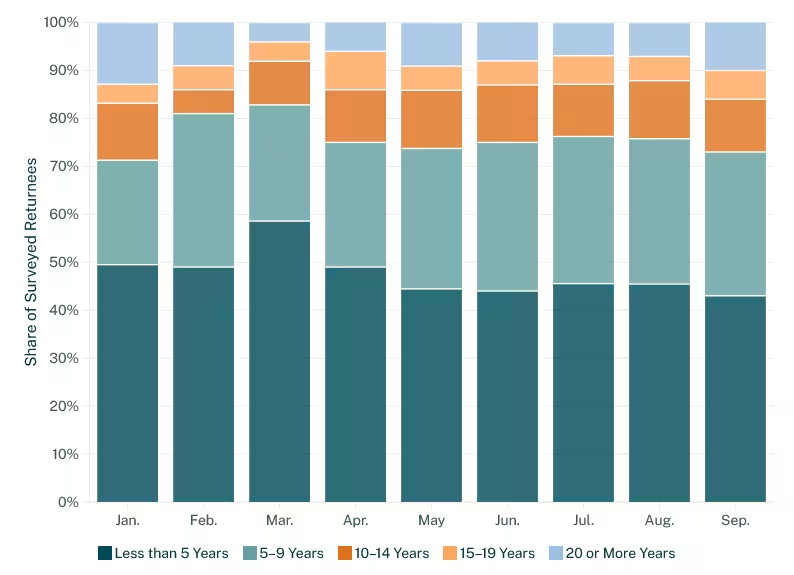
Notably, the amount of time survey respondents had spent in the United States before being deported changed over this nine-month period in 2025. The share of returnees who had spent less than five years in the United States decreased from 50 percent in January to 43 percent in September, while the share who had spent between five and nine years increased from 22 percent to 30 percent (see Figure 2). Though it varied somewhat from month to month, the combined share of returnees who had spent ten years or more in the United States decreased slightly from 29 percent in January to 27 percent in September 2025. The survey did not ask returnees questions about their living conditions in the United States and experiences during detention, information that could be useful to gather should the survey be refined in the future.
Figure 2. Surveyed Guatemalan Returnees’ Time Spent in the United States, by Month, January–September 2025
B. What Skillsets Do Returnees Bring with Them?
Among surveyed returnees arriving from both the United States and Mexico in January through September 2025, most (94 percent) reported being able to speak, read, and write in Spanish. Their level of English proficiency was significantly lower: 11 percent of returnees reported being able to speak and write in English, 10 percent said they could speak but not write, and 22 percent said they understand when someone speaks to them in English. Of the first two categories (those who could speak and/or write), nearly half described their level of proficiency as basic. The other 56 percent of returnees said they could not speak, write, or understand spoken English, and this percentage was higher among returnee women (74 percent) than men (54 percent).
Returnees described generally low levels of education and technological skills. Slightly more than one-quarter (27 percent) of surveyed returnees reported having less than an elementary school education, 51 percent said elementary school was their highest level of education, 10 percent had a high school diploma, and 9 percent had a university or technical college degree. Only 36 percent of returnees said they knew how to use a computer.
Despite their lower levels of English proficiency, returnee women reported slightly higher levels of educational attainment and computer skills than men: 16 percent of women said they had a high school diploma compared to 10 percent of men, and 46 percent of women said they knew how to use a computer compared to 35 percent of men.
These data highlight returnee characteristics that reintegration programming should take into consideration, building on individuals’ skills and addressing challenges to support successful outcomes. For example, identifying returnees with high levels of English proficiency soon after their return and matching them with job opportunities that utilize these skills (such as in tourism or hospitality) could improve their economic reintegration. A similar approach that matches returnees with jobs based on their educational attainment and computer skills could also benefit returnees and the local economy. Such approaches depend, however, on a degree of alignment between returnees’ skills and local labor market needs, and they can prove more difficult in rural and semi-urban communities where employment options may be limited.12
C. What Are Returnees’ Employment Experiences and Intentions?
Finding employment as quickly as possible was among the top priorities of surveyed returnees. This is consistent with the reasons most reported for having left Guatemala in the first place: to seek a better life and because of a lack of employment opportunities. Among returnees who arrived between January and September 2025, 61 percent reported being their household’s primary income earner, suggesting an urgent need to find work in order to continue to support the household they left behind and/or the one they rejoined in Guatemala.
"Among returnees who arrived between January and September 2025, 61 percent reported being their household’s primary income earner."
Returnees most common occupation prior to migrating to the United States or Mexico was full-time work in agriculture-related jobs (30 percent). Across occupations, 71 percent said their income prior to emigrating was insufficient to meet their basic needs, and 77 percent reported earning below the 2025 minimum wage—between 2,000 and 3,000 quetzales (approximately USD 260–390).13 This baseline helps illustrate why, for many, migration functioned as a strategy to access higher-paying and more stable employment.
While abroad, primarily in the United States, the majority of returnee men (55 percent) worked in construction-related jobs (e.g., carpenter, roofer, electrician), while the most common jobs among returnee women were in restaurants (19 percent) and other service jobs (18 percent). Now back in Guatemala, returnees primarily indicated interest in finding formal employment opportunities (34 percent), establishing their own business (11 percent), or working in informal agricultural jobs (10 percent). Survey respondents’ lower interest in agricultural work compared to other options is notable, given that nearly one-third worked in agriculture prior to emigration, and suggests some are seeking a different economic future for themselves.
More than three-quarters (78 percent) of surveyed returnees were interested in obtaining a certification or diploma validating skills they acquired abroad. In addition, 43 percent expressed interest in participating in work training courses such as those provided by the Technical Institute for Training and Productivity (INTECAP). When asked for examples of the kinds of courses they were interested in, men expressed a particular interest in auto and machinery mechanics courses, while women tended to mention cosmetology and other beauty-related courses. These topics, however, were not part of the 2025 INTECAP course catalog, indicating a mismatch between returnees’ professional interests and existing training options.
In addition to being a key element of reintegration, finding employment was also central to whether returnees saw themselves staying in Guatemala or migrating again in the future. Half of those surveyed said they did not want to emigrate again. And among the 31 percent of returnees who did express interest in emigrating again, 78 percent said they would consider staying in Guatemala if new employment opportunities were available to them. When asked specifically if they would move for a job, 74 percent of all surveyed returnees said they were open to relocating within Guatemala and an even higher share (84 percent) would consider moving to another country through lawful pathways for work. These responses highlight the centrality of labor market opportunities to how returnees envisage and make plans for their future.
D. How Do Returnee Characteristics Vary by Time Spent Abroad?
Looking specifically at Guatemalan returnees from the United States, survey respondents’ length of U.S. residence was associated with different skills and characteristics, in both expected and unexpected ways. Returnees who spent more time in the United States were more likely to report knowing how to speak and write in English and to have family there (see Figure 3). They also reported having less outstanding debt from their migration journey than those who had migrated more recently and spent less than five years in the United States. These patterns suggest these longer-term migrants’ deeper social and economic integration within U.S. communities, which may heighten the complexity of return while also meaning some return with employment and wage expectations that will be difficult to meet in Guatemala.
Figure 3. Select Characteristics of Surveyed Guatemalan Returnees, by Years Spent in the United States, January–September 2025
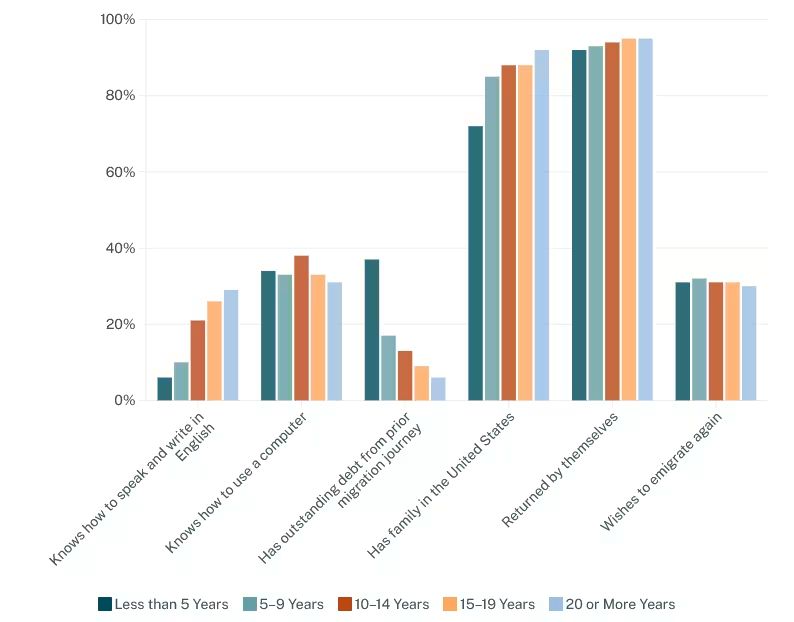
Time in the United States was not associated with differences in other skills and characteristics. Regardless of how many years they spent abroad, surveyed returnees had similar levels of computer competency, likelihood to have returned alone, and interest in migrating again in the future.
The number of years returnees spent in the United States did not appear to influence what occupations they held. Whether they spent less than five years or 20 or more years abroad, 55 percent of returnee men said they worked construction jobs in the United States. The number of survey responses from women in this dataset is smaller, making cross-time comparison more difficult, but returnee women generally held service occupations, and the share reporting this kind of work increased only slightly over time (18 percent for those who lived in the United States for less than five years versus 20 percent for those who lived in the country for 20 or more years). This suggests that returnees’ job opportunities in the United States were limited to a relatively narrow set of lower-skilled occupations, whether due to their skillset, networks, or other structural factors (e.g., stricter workplace enforcement of legal status requirements in mid- to high-skilled occupations).
Returnees may seek employment in the same or similar sectors in Guatemala as those in which they worked while abroad. But, influenced by experiences in the United States, some may have expectations (e.g., wages, workplace dynamics) that are different to what they will find in the same industries in Guatemala. These dynamics have implications for how reintegration policies anticipate demand for employment support, internal mobility, and differentiated services (e.g., for Guatemalans who were abroad for short versus long periods of time).
3. Returnees’ Experiences, Needs, and Challenges
The Return Home Plan’s three operational stages—pre-return, reception, and reintegration—represent phases of an individual’s return trajectory in which they may face evolving challenges and have distinct support needs. This section considers each stage, drawing findings from the various quantitative and qualitative data sources employed in this study. The sub-section on the pre-return phase, for example, highlights common themes from interviews with Guatemalan embassy and consular representatives in the United States as well as focus groups with Guatemalan returnees. The sub-sections on reception and reintegration draw on insights from the 2025 returnee survey, interviews with Guatemalan government and community stakeholders, focus groups with Guatemalan private-sector leaders, and relevant secondary sources.
A. Pre-Return: Consulates at the Forefront of Reintegration
The reception and reintegration process starts in the United States or Mexico, well before migrants arrive back in Guatemala. In light of the increase in immigration enforcement in communities across the United States, consular representatives described in interviews growing demand among Guatemalan immigrants for services related to family and asset protection, including help applying for Guatemalan citizenship for U.S.-born children, power of attorney to transfer assets or custody of children if needed, and information on household goods and tax regulations in Guatemala.14 At the same time, consulates reportedly observed a modest increase in immigrants—including some who were not in deportation proceedings or detention—seeking information on voluntary return.
Consular Responses to Immigrant Needs
The scale and consistency of consular responses vary from location to location, shaped by staffing capacity, local enforcement dynamics, and differing interpretations of consular mandates under the Return Home Plan. But overall, representatives of Guatemalan consulates described expanding outreach and communication efforts to share information on immigrants’ rights in the United States and reintegration opportunities and assistance available in Guatemala, including through mobile consulates, digital platforms, and partnerships with trusted community and faith-based organizations.15
While consulates do not provide legal guidance, some have reportedly scaled up referrals to legal aid organizations and/or made attorneys available in person, by phone, or by email to meet rising demand.16 Attorneys were described as conducting legal evaluations to determine whether unauthorized immigrants may be eligible to adjust their status and remain in the United States, as well as to write power-of-attorney documents. Guatemalan consular representatives also mentioned efforts to safeguard immigrants’ due process rights during deportation proceedings and to support family reunification by reuniting children with deported parents, where appropriate.
The evolving returnee profile places new demands on coordination between consulates and Guatemalan institutions, particularly the Guatemalan Institute of Migration. Coordination challenges and unclear institutional roles can hinder the ability of consulates to provide needed support. Consular representatives are meant to provide general information about deportation proceedings and reintegration programs, such as INTECAP skill certification programs.17 However, because the guidance consulates receive from the Ministry of Foreign Affairs is fairly broad, officials reported considerable variation in the extent and details of information provided on INTECAP enrollment procedures, employment opportunities outside Guatemala City, and what returnees should expect when arriving at the Service and Registration Center (CAR) in the capital city, among other topics.18 Open communication channels and regular exchanges of information between the Guatemalan Institute of Migration and consulates could enrich and bring greater consistency to consulates’ information provision and enable consulates to notify family members in the United States when returnees arrive in Guatemala.
Trust, Information, and Reliance on Nonstate Actors
Despite expanded consular outreach, many Guatemalan immigrants in the United States rely on a patchwork of nongovernmental organizations and individuals for assistance, rather than consulates or other official institutions.19 In focus groups, many returnees recalled receiving information about their rights from legal aid organizations and emotional support and information about reintegration programs in Guatemala from other immigrants and from community- and faith-based organizations.20 The government survey discussed in Section 2 does not ask returnees about their awareness of reintegration programs prior to being deported or the information they may have received at consulates—data that would help identify information gaps.
This tendency to seek and receive support from nongovernmental entities is partly due to misunderstandings within the community about who consulates will assist (e.g., believing they only help immigrants with legal status). In more extreme cases, some returnee focus group participants reported believing that consulates collaborate with U.S. immigration enforcement agencies.21 These misconceptions make it harder for consulates to conduct successful outreach.22 As such, partnerships with trusted organizations can allow consulates to better reach Guatemalans in need of assistance.
Language barriers can exacerbate the challenges of disseminating accurate information. Consulate representatives described difficulties providing information and services in Indigenous languages.23 This issue is particularly pressing in states such as California and Florida where large numbers of Indigenous Guatemalan immigrants live, and in light of data showing that a growing share of the returnees identified with Indigenous linguistic communities in 2025 compared to 2024 (see Section 2). Addressing these language barriers would mark an important step toward ensuring all Guatemalan immigrants in need of information have access to it during this critical pre-return phase.
Constraints and Barriers in Detention Contexts
Procedural barriers limit consulates’ ability to assist Guatemalans in detention. Unlike other countries and jurisdictions, Guatemalan consulates do not receive mandatory notifications from U.S. immigration authorities when Guatemalan nationals are detained.24 Instead, consular staff described relying on their own outreach and relationships with local immigration offices, with varying degrees of success, to identify and track where Guatemalan immigrants were being detained.25 In some cases, consular representatives reported triangulating information with the Guatemalan embassy in Washington, DC, and U.S. Immigration and Customs Enforcement headquarters for this purpose. This becomes more complicated when immigrants are frequently transferred between detention facilities, however, and even when consulates are aware of where immigrants are, they often lack sufficient personnel to visit detention centers at the scale needed. Consular access also varies between detention facilities because there is no legal obligation to share detainees’ information; in some facilities, U.S. authorities provide consular officers with a complete list of Guatemalan detainees, while in others, they only share the information of detainees who individually seek consular assistance.26
These procedural issues, combined with many Guatemalan immigrants’ limited trust in their consular representatives, constrain immigrant awareness of and interest in available consular services. Several returnees said in focus groups that they avoided or refused consular assistance because they believed it would not help or perhaps even would worsen their situation; others could not recall how to seek assistance due to stress while they were detained.27 These findings suggest that strengthening consular outreach and response capacity, as well as building trust in the consular network among immigrant communities, would help increase immigrants’ access to and uptake of consular assistance.
B. Reception: A Stepping-Stone Toward Long-Term Reintegration
Migrants’ reception as they arrive in Guatemala is a critical transition point between return and longer-term reintegration. The centralization of services and information at the CAR represents an important effort to reduce administrative barriers immediately upon arrival. For instance, returnees in need of housing can find information about the Housing Fund (Fondo para la Vivienda), which subsidizes the purchase, construction, or improvement of homes and prioritizes applications from returnees.28
As the profile of returnees evolves, the Guatemalan Institute of Migration’s recent implementation of a comprehensive, voluntary survey at the CAR and via call center (for returnees who do not arrive in Guatemala City or who seek help after reaching their communities) represents a positive step toward gaining a deeper understanding of returnee needs and designing targeted programming to ensure successful reintegration.
Emotional and Psychological Challenges
Returnees often arrive experiencing significant emotional distress that manifests differently depending on time abroad and the circumstances of their return. In focus groups, returnees who had lived abroad for extended periods described experiencing sadness for various reasons, including leaving behind families and belongings, not achieving goals (for example, related to their family’s social mobility), and returning with “empty hands and debts.”29 These statements echo findings from the analysis of returnee survey data—that the majority of returnees in January through September 2025 were returning to Guatemala alone and had left family behind in the United States (see Section 2.D.). In addition, some returnees in the focus groups reported suffering violence and abuse during their migration and return journeys.30
There appears to be a disconnect between returnees’ need for psychosocial support services and whether they seek them out. Upon arrival at the CAR, survey respondents (particularly men) reported low demand for psychosocial support, yet focus group participants expressed a need for such assistance to support their reintegration into Guatemalan society.31 This difference may be due, at least in part, to the fact that survey responses were collected soon after arrival, when returnees may have been focused on other pressing issues (such as finding housing, contacting loved ones), while focus group participants had been in Guatemala for longer and had time to reflect on their full range of needs. In addition, the CAR’s unfamiliar and institutional setting, the survey-based assessment modality, and social stigma around mental health issues may have discouraged some returnees, especially men, from disclosing psychosocial struggles.32
Economic Vulnerability
Economic insecurity is the most immediate and ongoing challenge for many returnees, and can have an impact on other dimensions of an individual’s reintegration. Many focus group participants stated that they left homes, belongings, and other assets in the United States and arrived in Guatemala with debt from their initial journey abroad, impeding their ability to restart their lives.33 Others lost personal items during the return journey, including personal identification documents, cash, and mobile phones, making it difficult to contact or reach their families upon arrival.34 After arriving in their respective communities, many returnees also reported that their earnings were insufficient to cover daily expenses and repay migration-related debts, pushing some to incur additional debt from new loans taken from family and community members.
"Economic insecurity is the most immediate and ongoing challenge for many returnees, and can have an impact on other dimensions of an individual’s reintegration."
This financial strain affected returnees’ access to stable housing as well. In interviews, government and community stakeholders described returnees having sold their homes or used them as collateral to secure loans to pay for their trip to the United States or Mexico.35 Returnees who spent years abroad were more likely to have paid off their debts and some may have built homes back in Guatemala, but migrants who had been abroad for a shorter period often needed to rent housing upon return.36 However, many returnees were unable to pay rent; some reported relying on family members for accommodation or financial support, but others did not have family in the country or their families were facing financial constraints themselves. And while family support can play a stabilizing role, it can also generate feelings of guilt, dependency, and stress.37
Access to Support Networks
Despite laudable efforts from the Guatemalan government to provide information about reintegration assistance in a centralized manner at reception centers and the CAR, stakeholders noted that information provided in these spaces may be incomplete, fragmented, and rushed.38 The disorientation and psychological strain of the deportation process, coupled with returnees’ focus on meeting immediate needs (such as contacting family, finding housing) may also mean they are less prepared to absorb information about longer-term reintegration supports—a trend noted in interviews by private-sector actors that offer CV preparation help and discuss job opportunities at the CAR.39
As such, it is important that returnees have access to assistance beyond the services available immediately upon arrival at reception centers and the CAR. About 90 percent of returnees surveyed between January and September 2025 said they could receive general assistance from their family, but a much smaller share—29 percent—said the same about their broader community.40 While returnees’ reasoning may vary, comments by focus group participants suggest some worry about being judged or believe their communities to have limited means to assist them.41 This points to the value of reintegration programming that involves the communities to which migrants return in supporting their reintegration. Providing complementary reception services at the local level—once returnees are more settled—may improve returnee participation and outcomes. Follow-up contact with returnees through community-based offices, municipal employment centers, or caseworkers could help bridge the gap between initial reception and longer-term reintegration.42
Gaps in Support for Voluntary Returnees
Notably, Guatemalans who return voluntarily from the United States or Mexico may be even less aware of services and supports that are available to them. Those returning via commercial flights or land borders typically do not pass through the CAR and therefore may not receive information on such services or be captured in administrative systems. Migrants who return voluntarily can receive information about available services by calling the call center, but it is unclear how many do so. As such, the government currently has limited mechanisms to identify and proactively engage voluntary returnees once they settle in their communities. With the country’s reception framework primarily designed around forced return, this gap may grow if voluntary return becomes more common.
C. Reintegration: Building Livelihoods After Return
Reintegration is a long-term process that continues for years after individuals return to Guatemala. Some returnees, particularly those who lived abroad for extended periods of time, might return to communities they do not recognize and where they have weak social connections, understanding of local labor market dynamics, and sense of belonging. With more Guatemalans returning after having built lives in another country, reintegration policies will face the challenge of helping them find their footing and reconnect with local communities.
Throughout 2025, the Guatemalan government expanded its institutional response to reintegration needs, mobilizing multiple agencies to expand programming and increase their presence beyond Guatemala City. Notable steps include the Ministry of Labor’s creation of a Unit for the Assistance of Returned Migrants, which offers employability services, and the strengthening of municipal one-stop employment centers, which were operating in more than 80 municipalities as of January 2026.43 In addition, the Banco de los Trabajadores (Workers’ Bank) launched the Guatemalans Made of Value program to offer returnees tailored financial solutions and job reintegration tools.44
In focus groups, returnees particularly praised the seamless and efficient Personal Identification Document (DPI) replacement process after arriving in their communities.45 To reduce cost barriers in this process, Guatemala’s National Registry of Persons waives the service fee for those deported by air.46 Others highlighted how they learned about available programs via calls from government service providers, which they described as making them feel supported. Those who accessed INTECAP training courses also described those as having had a positive effect, reporting improved employment prospects or the ability to start small businesses.47
Information Gaps and Uneven Outreach
At the same time, limited awareness of what reintegration programs exist and how to access them is a known barrier to uptake and effectiveness.48 Returnees typically learn about reintegration services through informal networks rather than government outreach, which may lead to the spread of outdated or inaccurate information, particularly as government-backed services evolve and amid the shifting international funding landscape.49 For example, some focus group participants knew certain opportunities existed but thought they could only be accessed in Guatemala City, reflecting inadequate information about the services (albeit more limited) that are available in semi-urban and rural communities.50
These gaps disproportionately affect returnees with fewer resources, limited digital access, and those who speak Indigenous languages—groups that are increasingly represented among returnees, especially those from rural departments and the Western Highlands. The Ministry of Labor’s expansion of one-stop employment centers to more municipalities and the Guatemalan Institute of Migration’s creation of regional migration offices to provide services at the local level are positive steps toward strengthening reintegration assistance outside of urban areas, particularly if coupled with robust outreach.51
Geographic Barriers
Beyond the fact that reintegration services are more accessible in some communities than others, geography can play a decisive role in reintegration in several other ways. In the rural or semi-rural areas many returnees originate from, formal employment opportunities are limited—particularly in sectors such as construction, services, and specialized trades in which many returnees gained experience abroad. As a result, reintegration often involves difficult trade-offs between reestablishing one’s self in a community where the returnee may have a support network or moving to one of the country’s urban centers where jobs are more abundant.
Interviewees from the private sector also noted that while Guatemalan companies have begun to post job vacancies on OportuGuate—a government-led website for returnees seeking employment opportunities—insufficient numbers of returnees are applying to the open positions.52 As is the case for government services, low engagement may reflect limited awareness of this platform and practical barriers (e.g., jobs may be far from where returnees live or require skillsets they do not have).53 In focus groups, private-sector representatives emphasized the need to expand employment opportunities beyond Guatemala City to avoid overcrowding the metropolitan area’s job market, reach returnees closer to where they are, and foster economic development in less urban areas.54
Similar obstacles can keep returnees from taking advantage of job training opportunities. INTECAP courses vary by location, and not all centers have the same career portfolios. This means that a returnee may need to travel to another center to attend the training course they are interested in, if they have the time and funds to do so.55 INTECAP offers scholarships covering tuition, program costs, and classroom supplies to help address this challenge. However, there are reportedly gaps in awareness of these subsidies among staff and participants at some training centers, resulting in uneven access, and the scholarships do not cover some equipment a course may require.56 As of January 2026, IOM was partnering with INTECAP to provide stipends for transportation and food, which are not included in INTECAP scholarships, with the aim of improving participant retention rates. A different approach can be seen in the GuateAprende platform, which is part of the Guatemalans Made of Value program and provides more than 90 online technical and specialization courses and certifications free of cost.57 Such initiatives may help alleviate key barriers that affect in-person courses, but the digital divide—most prevalent in rural areas—may make online courses inaccessible for some returnees.
Institutional Trust and Program Delivery Models
As was the case in the pre-return and reception phases, trust emerged as a critical factor shaping returnees’ engagement with programs and services during the reintegration phase. Focus group participants consistently expressed greater trust in international and nongovernmental organizations than in government institutions.58 Returnees reported gravitating toward these organizations’ programs and services because they perceive them as more comprehensive, long term, and individualized (including in terms of follow-up and psychosocial support) than government assistance. For example, returnees expressed satisfaction with Swisscontact and Norwegian Refugee Council programs due to their integrated training, monitoring, and personalized support, from entrepreneurial training to business certification and seed capital.59
Government agencies face challenges to providing similar levels of individualized support. Capacity constraints, high caseloads, limited personnel outside Guatemala City, and difficulties maintaining contact with returnees as they move within the country all hinder consistent engagement.60 Delays in follow-up or fragmented communication can erode trust, particularly among returnees who are already skeptical of institutions.
Employment Expectations, Pressures, and Skills Mismatches
Tensions exist between employers’ labor needs and expectations and returnees’ skillsets. When U.S. immigration enforcement shifted to focus on deportations from within U.S. communities, some private-sector stakeholders reportedly anticipated that Guatemalans who had lived in the United States for longer periods would arrive with strong English and technological skills and hoped to recruit them via the CAR to work in high-demand sectors such as call centers.61 However, this was not the case for many returnees in 2025 (see Sections 2.B. and 2.D.). Instead, many bring specialized knowledge in fields such as landscaping, agriculture, and construction. It remains to be seen whether returnees’ skillsets will complement or compete with those of workers already in the country, and the extent to which they can be tapped to fill jobs in sectors with high labor needs.
In focus groups, returnees expressed a desire to use skills acquired abroad (such as construction techniques) in Guatemala, but learned they had to validate their foreign work experience, typically through INTECAP certification and training programs.62 While some returnees were interested in these programs, the substantial time commitment—introductory courses average 80 hours of training, while technical courses require 250 to 2,500 hours—have a high opportunity cost, and many returnees choose to work immediately instead of enrolling or completing these courses.63 Unlike the relatively flexible jobs returnees held in the United States that generally did not require credentials or certifications, Guatemalan employers in industries such as construction, agriculture, and gastronomy tend to require credentials for the same or similar occupations, leaving many focus group participants feeling that their on-the-job experience was going unrecognized.64
Acknowledging these barriers, some private-sector actors noted in interviews their willingness to partner with the government to streamline recruitment and skill validation processes, potentially allowing more flexible documentation of returnees’ prior work experience.65 The private-sector-led nonprofit association CentraRSE has launched an initiative, called the Business Group for the Labor Inclusion of Migrants, to train executives and human resources leaders on hiring practices that are inclusive of returning migrants.66 Another opportunity to improve returnees’ labor market inclusion is for the government to work more closely with small and medium-sized enterprises, which are often more open to adapting and simplifying their recruitment processes and which collectively employ around 80 percent of workers in the country.67 However, some private-sector representatives expressed concern about investing resources to hire returnees who might emigrate again, creating a catch-22: returnees need stable employment to reduce pressure to emigrate again, but employers hesitate to hire and train them precisely because they fear they will leave.68
Workforce Challenges
In addition to skills, returnees’ time abroad can also shape their employment expectations. In focus groups, they emphasized their need for jobs that paid well and compared the wages of similar jobs in the United States and Guatemala, noting that physically demanding jobs such as logging seemed worthwhile in the United States, where estimated daily earnings in 2025 were about USD 58, but not in Guatemala, where workers earned roughly USD 13 per day.69 Employment opportunities were further limited by employer hesitance to hire returnees due to certification or emigration concerns, as discussed above, and in some cases by discrimination, as some employers associate deportation with criminality.70 Initiatives such as the employer trainings run by CentraRSE’s Business Group for the Labor Inclusion of Migrants could help debunk misinformation and reduce discrimination.
Facing a variety of challenges, many returnees described feeling pushed toward entrepreneurship to generate income and apply specialized skills learned abroad.71 Yet, the loss of U.S.-based assets, accumulation of debt, and limited capital created significant barriers to achieving their entrepreneurial goals. Some reported difficulties in accessing formal credit and instead relied on higher-interest loans from acquaintances or pawn shops.72 There is thus demand for programming and services that can help overcome these challenges, such as the loans provided by the Workers’ Bank, which have tailored repayment schedules and are available to returnees with a business plan and to Guatemalans in the United States seeking to invest and build capital before their return.73
4. Conclusions and Policy Considerations
The Guatemalan government has taken deliberate steps in recent years to strengthen its reception and reintegration support for Guatemalans forced to return from other countries, culminating in the launch of the Return Home Plan in 2025. Compared to prior policies, this framework reflects a more proactive approach to return and reintegration governance, emphasizes coordination and early engagement, and seeks to anticipate changes in migration patterns. In practice, the plan has consolidated immediate services provided by the government and partner organizations at a central reception site and provides referrals to additional assistance in communities where returnees settle.
The survey data and interview and focus group insights analyzed in this report, because they were collected alongside the rollout of the Return Home Plan, should not be taken as an assessment of its effectiveness. However, the study’s findings do reinforce the value of a joined-up approach, like the one taken under the plan, to supporting returning Guatemalans. Key elements of such an approach could include timely and accurate guidance prior to return, assistance meeting immediate needs upon arrival, and longer-term and localized reintegration assistance as returnees make sense of how to apply their skills in and reconnect to Guatemalan communities. These findings also point to the importance of return and reintegration programming that takes into account the varying socioeconomic profiles and needs of Guatemalan returnees, including those who have lived in the United States for extended periods, have looser support networks in Guatemala, and have higher employment expectations. For example, with longer time spent and more family ties in the United States, returnees may have differing predeparture needs (such as for support with family reunification and asset management) and benefit from distinct forms of post-arrival assistance (such as gaining recognition for work experience abroad).
The government of Guatemala has the opportunity to further strengthen the Return Home Plan by recalibrating institutional roles, coordination mechanisms, and policy tools, while maintaining its objective of anticipating future changes in migration patterns. Among the most important opportunities in 2026 and beyond are:
-
Strengthening governance and institutional coordination. As returnee profiles vary, with some returnees in need of more intensive services, coordination across institutions will matter as much as programmatic coverage. Guatemala has already made important progress by improving interinstitutional coordination through the National Migration Authority, implementing the Return Home Plan, and establishing the Service and Registration Center (CAR) in Guatemala City to centralize services and information at arrival. As return dynamics evolve, coordination efforts could be further reinforced to ensure that pre-return, reception, and reintegration services function as a connected continuum of support rather than as loosely linked stages.
More systematic coordination across labor, social welfare, public finance, regional development, and foreign affairs institutions is needed to incorporate reintegration not only in migration policy discussions but also in service delivery and resource allocation in communities of return. This could be done, for example, by ensuring that the National Migration Authority can serve as a bridge between ministries and agencies whose work shapes returnees’ long-term reintegration outcomes. Closer operational alignment between consulates, the Guatemalan Institute of Migration, workforce institutions, and subnational authorities would also help ensure that information provided to Guatemalans prior to return is consistent with the services and opportunities available to them upon arrival and in local communities.
-
Using data and improving data collection to enable a whole-of-government response. The collection of information on returning Guatemalans through registration and voluntary surveys, the sources of the data analyzed in this study, is an important first step toward evidence-informed policymaking. As returnee profiles evolve, these data collection tools could do more than describe who is returning—they could help connect migration governance with social welfare, labor, and regional development policy. Improving interoperability between migration registration systems and the broader social safety net, for example, would allow returnees to be identified early for services such as employment support, training, housing, or psychosocial assistance. Strengthening the flow of data, with appropriate safeguards, between national and subnational authorities would help the latter anticipate return pressures and adapt service delivery accordingly.
Improving data quality and granularity is equally important. Current data collection instruments capture detailed information about returnees’ socioeconomic characteristics but do not ask other questions that could help the government to improve services and meet short- and longer-term needs among returnees (for example, about their experiences during the deportation process or their awareness of available reintegration services). Another opportunity to improve data collection and use would be to map local labor demand by industry and adjust employment and training services accordingly. Finally, Guatemala could explore ways to initiate registration and needs assessment before return occurs, building on the existing registration system and involving consulates or trusted intermediaries in destination countries. Beginning this process prior to deportation or voluntary return could reduce information gaps at arrival, improve continuity of support, and reinforce the Return Home Plan’s proactive orientation.
- Building trust and program impact through partnerships. Evidence from interviews and focus groups suggests that many Guatemalan migrants place greater trust in community-based, faith-based, and nongovernmental organizations than in government institutions, particularly during periods of stress and uncertainty. Building trusted, impactful services is therefore not only a matter of strengthening public infrastructure but also working through trusted intermediaries. The Guatemalan government could deepen strategic partnerships with organizations that already serve as first points of contact for migrants abroad and upon return, including legal aid providers, faith-based groups, and community organizations. In Guatemala, for example, local nongovernmental organizations often provide forms of assistance that complement public services, such as follow-up engagement, mental health services, and longer-term programming.
-
Deepening engagement with the private sector and local economies. The Guatemalan government has taken important steps to engage the private sector in return and reintegration efforts, including through job-matching initiatives, employer partnerships at the CAR, and collaboration with business associations to reduce barriers to hiring returnees. As returnee profiles evolve and more individuals with longer work histories abroad arrive in Guatemala, these partnerships provide a strong foundation on which to build.
At the same time, returnees’ labor market reintegration would benefit from being more closely linked to broader investment and productivity strategies. Without parallel efforts to expand economic activity, higher labor supply risks intensifying competition within a relatively static job market. A next step could therefore be to align reintegration policy with infrastructure projects, sectoral investment plans, and value-chain development initiatives capable of generating new employment—particularly in high-return regions. Beyond the domestic market, returnees’ skills, work experience, and connections abroad present opportunities to connect reintegration with export-oriented sectors, global value chains, and diaspora-linked investment. Introducing pilot initiatives and foresight-oriented approaches to test different models could help identify pathways that transform return migration into a driver of productivity, competitiveness, and longer-term development.
- Embedding return and reintegration within national development and macroeconomic strategies. As return dynamics shift, return and reintegration policies increasingly intersect with broader development and macroeconomic considerations. Some returnees previously contributed to household consumption and local economies in Guatemala through remittances, particularly in regions such as the Western Highlands. Sustained returns may therefore have implications for Guatemalan economic stability and regional and household-level inequality. Embedding migration governance within national development planning—alongside labor mobility initiatives, regional development strategies, and public services—would help Guatemala to better anticipate shocks, align resources, and ensure that return and reintegration considerations remain part of a broader strategy for inclusive development.
Helping returning nationals reintegrate into local communities is a complex and often nonlinear process. Guatemala, by building on the momentum of the Return Home Plan, has an opportunity to serve as a model for other countries. Ultimately, the success of efforts to modernize the reception and reintegration system will depend on the government’s ability to incorporate the plan into the broader policy and social agenda, presenting returnees as part of the present and future of Guatemala.
"Ultimately, the success of efforts to modernize the reception and reintegration system will depend on the government’s ability to incorporate the plan into the broader policy and social agenda, presenting returnees as part of the present and future of Guatemala."
Acknowledgments
This report and the mixed-method study it results from were made possible by support from the Guatemala Office of the International Organization for Migration (IOM). The returnee survey dataset used in this study was generously provided by the Guatemalan Institute of Migration (IGM).
The authors appreciate the assistance provided by IOM Guatemala during the study. They thank the IOM research team that conducted dozens of stakeholder interviews as well as focus groups with Guatemalan returnees. The authors are also grateful for the valuable feedback from IOM colleagues at the U.S. and Guatemala offices that enriched this report. In addition, the authors thank the many interviewees and focus group participants, both in Guatemala and the United States, for sharing their time and insights, which were central to this research.
Finally, the authors thank their Migration Policy Institute (MPI) colleagues Oscar Rosales Krumdieck, who provided essential research assistance; Andrew Selee, who provided strategic guidance; Lauren Shaw, who carefully edited the report; and Michelle Mittlestadt, who led outreach and dissemination. They also thank Juan Sebastián Brizneda Henao for translating the report into Spanish.
MPI is an independent, nonpartisan think tank dedicated to improving immigration and integration policies through authoritative research and analysis, opportunities for learning and dialogue, and the development of new ideas to address complex policy questions. MPI adheres to the highest standard of rigor and integrity in its work. The analysis, recommendations, and policy ideas put forth by MPI are solely determined by its researchers.
IOM is committed to the principle that humane and orderly migration benefits migrants and society. As an intergovernmental organization, IOM acts with its partners in the international community to: assist in meeting the operational challenges of migration; advance understanding of migration issues; encourage social and economic development through migration; and uphold the human dignity and well-being of migrants.
The designations employed and the presentation of material throughout the document do not imply the expression of any opinion whatsoever on the part of IOM or MPI concerning the legal status of any country, territory, city or area, or its authorities, or concerning its frontiers or boundaries.
Latin America and Caribbean Initiative
The Initiative combines rigorous research with direct engagement of governments, institutions, and stakeholders to help build orderly, rights-respecting migration systems across one of the world's most dynamic migration regions.
Notes
-
1
Julia Gelatt, Ariel G. Ruiz Soto, and James D. Bachmeier, Changing Origins, Rising Numbers: Unauthorized Immigrants in the United States (Washington, DC: Migration Policy Institute, 2025).
-
2
Migration Policy Institute (MPI) tabulation of data from the Guatemalan Institute of Migration (IGM), “Guatemaltecos retornados año 2025,” accessed December 12, 2025.
-
3
MPI tabulation of returnee data compiled by the International Organization for Migration (IOM), “Retornos,” accessed October 16, 2025.
-
4
MPI analysis of administrative data available via IGM, “Informes Estadísticos—Base de datos 2025 & Base de datos 2024,” accessed January 7, 2026.
-
5
MPI estimates based on analysis of U.S. Census Bureau data from the pooled 2019–23 American Community Survey (ACS) and the 2023, 2022, and 2008 Survey of Income and Program Participation (SIPP), weighted to 2023 unauthorized immigrant population estimates provided by Jennifer Van Hook of The Pennsylvania State University.
-
6
Valerie Lacarte, “The Health Costs to Children of Stepped-Up U.S. Immigration Enforcement” (short read, MPI, June 2025); Mitra Naseh et al., “Mental Health Implications of Family Separation Associated with Migration Policies in the United States: A Systematic Review,” Social Science & Medicine 352 (July 2024).
-
7
For example, 19 percent of Guatemalan unauthorized immigrants living in the United States as of 2023 spoke English very well or as their only language, according to MPI estimates based on analysis of U.S. Census Bureau data from the pooled 2019–23 ACS and the 2023, 2022, and 2008 SIPP, weighted to 2023 unauthorized immigrant population estimates provided by Van Hook.
-
8
International Monetary Fund, “Guatemala” (Country Report No. 25/260, Washington, DC, September 2025).
-
9
Guatemalan National Institute of Statistics, Boletín estadísico (Guatemala City: Guatemalan National Institute of Statistics, 2025), 2.
-
10
Andrew Selee, Luis Argueta, and Juan José Hurtado Paz y Paz, Migration from Huehuetenango in Guatemala’s Western Highlands: Policy and Development Responses (Washington, DC: MPI, 2022); Atahualpa Amerise, “Arquitectura de las remesas: cómo el dinero que llega de EE.UU. está transformando los pueblos y ciudades de Guatemala,” BBC News Mundo, December 5, 2025.
-
11
Of the 12,050 survey responses, 11,813 were from individuals returning from the United States and 237 from Mexico. This is likely due at least in part to the fact that survey collection largely occurred in Guatemala City, where migrants deported from the United States arrive by air; the survey was not collected at the government processing center in Tecún Umán near the Mexico-Guatemala border, where most Guatemalans (aside from unaccompanied children) are returned from Mexico.
-
12
Ariel G. Ruiz Soto, Rodrigo Dominguez-Villegas, Luis Argueta, and Randy Capps, Sustainable Reintegration: Strategies to Support Migrants Returning to Mexico and Central America (Washington, DC: MPI, 2019).
-
13
Respondents’ pre-migration minimum wage varied depending on when they emigrated. Approximately 75 percent of returnees in this sample reported being abroad for fewer than ten years, meaning they emigrated after 2015. Guatemala’s lowest monthly minimum wage was 3,347 quetzales in 2025 and 2,201 quetzales in 2015. See Guatemalan Ministry of Labor and Social Welfare, “Salario mínimo,” accessed January 15, 2026; Guatemalan Ministry of Labor and Social Welfare, “Salario mínimo año 2,015,” accessed January 15, 2026.
-
14
Author interviews with Guatemalan government officials in the United States, September 2025.
-
15
Author interviews with Guatemalan government officials in the United States, September 2025.
-
16
Author interviews with Guatemalan government officials in the United States, September 2025.
-
17
Author interviews with Guatemalan government officials in the United States, September 2025.
-
18
Author interviews with Guatemalan government officials in the United States, September 2025.
-
19
Author analysis of insights from focus groups conducted by IOM with adult Guatemalan returnees, August–September 2025.
-
20
Author analysis of insights from focus groups conducted by IOM with adult Guatemalan returnees, August–September 2025; Acacia Center for Justice, “Coalition of More than 100 Legal Organizations Denounce Government’s Termination of Unaccompanied Kids Program” (press release, March 24, 2025); Rachel Uranga, “Legal Help in Immigration Court Fades as Trump Administration Ramps up Arrests,” Los Angeles Times, July 23, 2025.
-
21
Author analysis of insights from focus groups conducted by IOM with adult Guatemalan returnees, August–September 2025.
-
22
Author interviews with Guatemalan government officials in the United States, September 2025.
-
23
Author interviews with Guatemalan government officials in the United States, September 2025.
-
24
U.S. Department of State, “Countries and Jurisdictions with Mandatory Notifications,” accessed November 25, 2025.
-
25
Author interviews with Guatemalan government officials in the United States, September 2025.
-
26
Author analysis of insights from focus groups conducted by IOM with adult Guatemalan returnees, August–September 2025; author interviews with Guatemalan government officials in the United States, September 2025. For information on official protocols, implementation of which can vary by state and facility, see U.S. Immigration and Customs Enforcement (ICE), National Detention Standards (Washington, DC: ICE, 2025); U.S. Department of State, Consular Notification and Access Manual, 5th ed. (Washington, DC: U.S. Department of State, 2018).
-
27
Author analysis of insights from focus groups conducted by IOM with adult Guatemalan returnees, August–September 2025; author interviews with Guatemalan government officials in the United States, September 2025.
-
28
Jaylenne Zeceña, “Migrantes guatemaltecos retornados recibirán prioridad en subsidios habitacionales,” LaHora.gt, June 9, 2025.
-
29
Author analysis of insights from focus groups conducted by IOM with adult Guatemalan returnees, August–September 2025.
-
30
Author analysis of insights from focus groups conducted by IOM with adult Guatemalan returnees, August–September 2025. Because these focus groups included some Guatemalans who returned prior to 2025 and the IGM survey does not include questions about treatment during detention, it is not possible to use these data sources to examine how conditions may have changed.
-
31
Author analysis of insights from focus groups conducted by IOM with adult Guatemalan returnees, August–September 2025; MPI analysis of returnee survey data provided by IOM Guatemala and collected by IGM between January and September 2025.
-
32
Maribel Gutiérrez et al., La salud mental en la población adulta salvadoreña. Un riesgo emergente en un contexto de envejecimiento poblacional y crisis de cuidado (La Libertad, El Salvador: United Nations Development Program, 2024); Juan José Azurdia, “Política de salud mental en Guatemala. Análisis del ciclo de vida de una política pública,” Revista Psicólogos 15, no. 31 (2024): 16–25.
-
33
Author analysis of insights from focus groups conducted by IOM with adult Guatemalan returnees, August–September 2025.
-
34
Information shared with the authors by IOM Guatemala researchers, November 2025.
-
35
Author analysis of interviews conducted by IOM with local government officials and community stakeholders in Guatemala, September 2025.
-
36
Author analysis of interviews conducted by IOM with local government officials and community stakeholders in Guatemala, September 2025.
-
37
Noticias Telemundo, “Guatemala recibe a últimos deportados del año, uno dice que no recuerda nada” (video, YouTube, December 30, 2025).
-
38
Author analysis of interviews conducted by IOM with local government officials and community stakeholders in Guatemala, September 2025.
-
39
Author interviews with Guatemalan private-sector representatives in Guatemala and the United States, September–October 2025; author analysis of insights from focus groups conducted by IOM with adult Guatemalan returnees, August–September 2025.
-
40
MPI analysis of returnee survey data provided by IOM Guatemala and collected by IGM between January and September 2025.
-
41
Author analysis of insights from focus groups conducted by IOM with adult Guatemalan returnees, August–September 2025.
-
42
Author analysis of interviews conducted by IOM with local government officials and community stakeholders in Guatemala, September 2025.
-
43
Isaac Ramirez, “Mintrab crea unidad de atención a migrantes retornados,” Agencia Guatemalteca de Noticias, February 7, 2025; Guatemalan Ministry of Labor and Social Welfare, “MINTRAB fortalece la colaboración para el empleo y el desarrollo en Guatemala” (news release, October 24, 2025); remarks by a government representative at high-level event, January 15, 2026.
-
44
Banco de los Trabajadores, “Bantrab lanza Guatemaltecos Hechos de Valor, un programa de atención integral para connacionales, retornados y beneficiarios de remesas” (news release, July 17, 2025).
-
45
Author analysis of insights from focus groups conducted by IOM with adult Guatemalan returnees, August–September 2025.
-
46
Guatemalan National Registry of Persons, “DPI gratis para los migrantes retornados,” accessed January 15, 2025.
-
47
Author analysis of insights from focus groups conducted by IOM with adult Guatemalan returnees, August–September 2025.
-
48
Author analysis of interviews conducted by IOM with local government officials and community stakeholders in Guatemala, September 2025.
-
49
Author analysis of interviews conducted by IOM with local government officials and community stakeholders in Guatemala, September 2025.
-
50
Author analysis of insights from focus groups conducted by IOM with adult Guatemalan returnees, August–September 2025.
-
51
Remarks by government representatives at high-level event, January 15, 2026.
-
52
OportuGuate, “Empleo,” accessed December 30, 2025; author interviews with Guatemalan private-sector representatives in Guatemala and the United States, September–October 2025.
-
53
Author analysis of insights from focus groups conducted by IOM with adult Guatemalan returnees, August–September 2025.
-
54
Author interviews with Guatemalan private-sector representatives in Guatemala and the United States, September–October 2025.
-
55
Information shared with the authors by IOM Guatemala researchers, November 2025.
-
56
Technical Institute for Training and Productivity (INTECAP), “Becas para retornados,” accessed December 30, 2025; information shared with the authors by IOM Guatemala researchers, November 2025.
-
57
Banco de los Trabajadores, “GuateAprende,” accessed January 15, 2025.
-
58
Author analysis of insights from focus groups conducted by IOM with adult Guatemalan returnees, August–September 2025.
-
59
Author analysis of insights from focus groups conducted by IOM with adult Guatemalan returnees, August–September 2025. For more on these programs, see Norwegian Refugee Council, “NRC’s Operations in North of Central America and Mexico” (fact sheet, November 2024); Swisscontact, “Guatemala,” accessed December 15, 2025.
-
60
Author analysis of insights from focus groups conducted by IOM with adult Guatemalan returnees, August–September 2025.
-
61
Author interviews with Guatemalan private-sector representatives in Guatemala and the United States, September–October 2025.
-
62
Author analysis of insights from focus groups conducted by IOM with adult Guatemalan returnees, August–September 2025.
-
63
Information shared with the authors by IOM Guatemala researchers, November 2025.
-
64
Author analysis of insights from focus groups conducted by IOM with adult Guatemalan returnees, August–September 2025; Ximena Fernández, “De migrante a profesional calificado: Certificaciones pueden abrir puertas a retornados,” Prensa Libre, April 3, 2025; Ximena Fernández, “Crece desafío por insertar a migrantes retornados en el mercado laboral en Guatemala,” Prensa Libre, December 26, 2025.
-
65
Author interviews with Guatemalan private-sector representatives in Guatemala and the United States, September–October 2025.
-
66
Revista Estrategia y Negocios, “Plataforma empresarial busca integración laboral de migrantes retornados en Guatemala,” Revista Estrategia y Negocios, March 3, 2025.
-
67
Guatemalan Ministry of Economy, Política para el Desarrollo de la MIPYME 2024-2032 (Guatemala City: Guatemalan Ministry of Economy, 2024); Luis Sosa, Elizabeth Ochoa, and Jorge Coj, Panorama de oportunidades Guatemala (N.p.: Inter-American Development Bank, 2023).
-
68
Author interviews with Guatemalan private-sector representatives in Guatemala and the United States, September–October 2025.
-
69
Author analysis of insights from focus groups conducted by IOM with adult Guatemalan returnees, August–September 2025; U.S. Department of Labor, “State Minimum Wage Laws,” updated January 1, 2026; Guatemalan Ministry of Labor and Social Welfare, “Salario Mínimo.”
-
70
Author analysis of insights from focus groups conducted by IOM with adult Guatemalan returnees, August–September 2025. ICE data show that, between the start of 2025 and September 2025, the share of detained immigrants who had a criminal conviction shrunk considerably, to about one-third; see Figure 2 in Ariel G. Ruiz Soto, “A New Era of Immigration Enforcement Unfolds in the U.S. Interior and at the Border under Trump 2.0” (commentary, MPI, Washington, DC, October 2025). On discrimination against returning migrants, see Ariel G. Ruiz Soto et al., Migration Narratives in Northern Central America: How Competing Stories Shape Policy and Public Opinion in Guatemala, Honduras, and El Salvador (Washington, DC: MPI, 2023).
-
71
Author analysis of insights from focus groups conducted by IOM with adult Guatemalan returnees, August–September 2025.
-
72
Author analysis of insights from focus groups conducted by IOM with adult Guatemalan returnees, August–September 2025.
-
73
Banco de los Trabajadores, “Crédito Emprendedor,” accessed January 15, 2026.



Related Content