America’s Closing Door: Where Do Cuban Migrants Go Now?
Part of The World of Migration
This transcript was generated using AI and may contain inaccuracies. If you notice an error, feel free to email [email protected].
CHAPTERS
01:36 Cuba's Historical U.S. Policy & the Embargo
03:45 Cuba's Deepening Humanitarian Crisis
08:24 Latin America as a New Destination for Cuban Migrants
13:05 Cubans Stranded in Transit: Central America & Mexico
16:06 How Cubans Are Leaving & The Rise of Smuggling Networks
21:16 A Decade of Eroding Cuban Migrant Protections in the U.S.
27:31 Deportations to Third Countries & Cubans in Legal Limbo
32:04 Cuban-American Diaspora Politics & the Road Ahead
TRANSCRIPT
[00:00:02.760]
Hi, welcome back to World of Migration, a podcast from the Migration Policy Institute that delves into interesting and important developments globally on immigration, immigrant integration, and humanitarian protection. My name is Valerie Lacarte. I am a senior policy analyst at MPI, and I am your host today. President Trump's foreign policy shakeup is sending shockwaves worldwide, including right next door, just 90 miles from the Florida coast. Cuba is facing unprecedented circumstances. First, we had the event in Venezuela. In January 2026, the U.S. ousted President Nicolás Maduro, one of Cuba's staunch supporters and a key economic lifeline for the island. Then days later, the Trump administration imposed sweeping oil tariffs on any country selling or providing fuel to Cuba. This has resulted in rolling blackouts lasting up to 20 hours a day, deepening shortages of food and medicine, and an economy in freefall. This latest economic pain comes on top of years, decades even, of economic, political, and social contractions that have seen close to 2 million Cubans head to the United States, significantly higher numbers since 2021. Cuba has always been a subject of U.S. foreign policy calculations. Ever since the 1959 revolution that brought a communist government to power under Fidel Castro.
[00:01:36.880]
In the 6 decades since, the U.S. embargo has cut Cuba off from imports, foreign investment, and international financial systems. And yet the Cuban government survived, leaning on allies such as the Soviet Union and more recently Venezuela. Even as the U.S. has deployed harsh policies against Cuba, It has historically shown significant welcome to Cubans who have left Cuba, seeing them as refugees from communism. In fact, no immigrant population has been treated more favorably over the decades than Cubans, with the Cuban Adjustment Act of 1966 giving them rapid access to a green card and public benefits. But there's clearly been a change over the past decade in the way Cuban migrants are being treated in the U.S. And under the current administration, Cubans, like other groups of migrants, are seeing the termination of some of their legal pathways. Arrests and deportations to the island have even resumed. Cuba faces a grim future in the near term with its allies off the scene, its economy collapsing amid increasing U.S. sanctions and the blockade, and the doors to the U.S. closing. Where will Cubans fleeing the island go? Will there be a new wave of migration to Latin America and the Caribbean?
[00:02:56.230]
And are we paying enough attention to what's unfolding in Cuba? That's what we're here to explore today. To help us answer these questions, I am pleased to welcome María José Espinosa Carrillo, Executive Director of the Center for Engagement and Advocacy in the Americas, CEDA, which is an advocacy organization that is women and immigrant-led. CEDA is dedicated to shaping humane and cooperative U.S. foreign policy toward Latin America and the Caribbean. María José is an economist and a foreign policy expert. She began her career as a professor in the School of Economics at the University of Havana, Cuba. María José, Thank you for joining us today.
[00:03:42.490]
My pleasure, Valerie. So good to be here.
[00:03:45.450]
Well, thank you very much. And before we dive into our very interesting conversation, I do want to make sure we address the severity of the current economic crisis in Cuba that's been brought about by the US fuel embargo and the loss of key ally Venezuela. How are Cubans experiencing the fuel shortages and other disruptions in their daily lives, María José? Can you tell us more about their access to basic services and public systems?
[00:04:16.470]
Of course, that's an excellent question. And I think the best way to understand what's happening in Cuba right now is that this is not a new crisis, but a much deeper one. Cuba has gone through difficult periods before. You know, the most well-known is a special period in the 1990s after the collapse of the Soviet Union. But then there were moments of partial recovery, especially in the 2000s, around 2014 and 2016, when the US and Cuba began a process of diplomatic re-engagement under President Obama. And that period brought some optimism, you know, greater access to internet, more economic activity, some openings in the private sector, more US travel to the island, and more connection to the outside world. But it lasted only 2 years. Uh, first, the first Trump administration reversed all the Obama measures, and then the Cuban government did not advance domestic reforms that were very important. And so you get to 2020 with the pandemic, and it decimated the country's foreign exchange. You have less mobility, and you see more control of the, of the Cuban state. And that landed in the July 2021 protests that were the largest mass protests since 1959.
[00:05:38.590]
We had in Cuba more than 50,000 cities that went out to protest, and, and that was unprecedented. And that was met with government repression and the jailing of, of those who participated. Uh, lots of them were very young, and some of them were children. Uh, so I think 2021 actually marks a before and after. And as you mentioned, since then, more than 18% of the Cuban population has emigrated. But what we're seeing now feels different. I traveled to Cuba 3 weeks ago, and what I heard most consistently on the ground is that people are exhausted physically, they're emotionally exhausted and mentally exhausted. Uh, there is a strong sense that the country is drifting, that there isn't a clear direction or a visible roadmap. You mentioned the oil embargo by the US. But also some of the internal measures that haven't been implemented. And you see that some Cubans have greater access to basic necessities, but all Cubans' lives have been affected by the blackouts. Imagine that you're living 20, 23 hours of your day without electricity. And in addition to the nationwide blackouts, there are daily planned blackouts that have been happening for years now.
[00:06:59.210]
And so for most of the day, Cubans cannot access electricity or running water or use any appliances, and that impacts every aspect of your life every day. Some kids are not, uh, cannot go to school because transportation is also being impacted. You have a lot of issues accessing cooking gas, and so you see some people using other methods to, to warm their food. It is really a situation that has also impacted hospitals, access to surgeries. You know, you have the hospitals that depend on electricity without electricity and then depend on generators and then the generators depend on oil. So it's really a humanitarian crisis that, again, is not new but has really deepened in the past, you know, 2 months, and it's very noticeable. So if the conditions continue, you have real risks ahead for Cubans, you know, worsening of public health. You have greater vulnerability during hurricane season in the Caribbean, have the possibility of, of a new wave of migration, actually, as we're talking about this, if, if people really try and seek to find a way off the island.
[00:08:24.500]
Yes, that's right. And thank you for providing this, these details, because I think it's hard sometimes for people to really picture on the, on the daily what that really means, right? You know, as we've said already in the, in the introduction, for instance, you know, for years the U.S. was the clear destination for Cubans fleeing the island. But recent data suggests that more Cubans may be heading to South America. Or remaining in Central America, right? In 2025, we've seen Brazil emerge as a major new destination with over 42,000 Cubans applying for asylum, which surpassed Venezuelans as the top nationality seeking protection. That's a new development. Also in Uruguay, we— Uruguay has been seeing an increase in the number of Cuban arrivals, compared to the year before. We also know that there's an important decrease in the numbers of Cubans that are transiting through typical routes towards the US, like the Darién Gap, which is between Colombia and Panama. Uh, the numbers of migrants overall have fallen by 99% in 2025 compared to the prior year. And of course, at the US-Mexico border, with the stricter US border policies under Trump, um, irregular crossings are down, were down 90% in 2025 compared to the year before.
[00:09:59.580]
So it does seem like Latin America is not just a corridor anymore for Cuban migrants, but rather a destination. Is this consistent with your findings?
[00:10:12.430]
Yes, uh, definitely. And Cuba has always had waves of migration, right? You have an early exodus in the early '60s when President Johnson signed the Cuban Adjustment Act that you mentioned that allowed anyone coming to the US from Cuba to obtain permanent legal status and apply for citizenship after 5 years. So you will get the green card within months. And then you have different waves in the '60s, in the '80s with the Mariel, when more than 120,000 Cubans fled the country to the US. Then you have the raft crisis in the 1990s. Basically, you have different waves of Cuban migration, mainly to the US. And I think it's important to say before we dive into the, the shift in migration now is that since 2021, and especially from 2022 to 2025, there was a new wave and a new surge in migration to the United States that has been named by a Cuban journalist, Rachel Pérez, as the walking generation. And you mentioned the numbers, you know, you have almost a million Cubans, uh, coming to the U.S., more than 500,000 that trekked from South and Central America to the U.S. Southwest border by foot, uh, on this period of time.
[00:11:37.720]
And what you see is that now that it's changing, what is changing is where people are going. The US is not the clear destination anymore for several reasons that we, we can discuss. And this is not accidental. Obviously, it's tied to history, to policy, to the Cuban-American community. But then you look at 2025 and you look at the numbers. Cubans were the third largest asylum-seeking nationality worldwide. Behind Venezuela and Sudan. So Cuba generated roughly 5.3 asylum claims per 1,000 inhabitants. That's pretty significant. And you see countries like Brazil and Mexico and Uruguay and Costa Rica receiving a significant number of Cuban migrants. You mentioned the numbers in Brazil, but also Mexico received closer to 40,000 asylum applications. Same with Uruguay, more than 25,000. So what was historically a wave to the US and in many cases to Spain has now expanded to the full region. We're seeing people now in transit in Suriname. We're seeing people in transit in Guyana that are deciding to stay. And this is responding to different factors, but mainly to the change in US policy and US migration policies toward Cubans. In the past decade. Mm-hmm.
[00:13:05.710]
Yes. And in that same vein, can you also address the issue of Cubans who may be stranded across Central America and Mexico? Because we know that Cubans are— were also among the top 2 nationalities that were transiting toward— through Honduras. And for years, Cuban migrants have been in the south of Mexico in Tapachula, Do you think that they are settling for the longer term, or are they perhaps in a holding pattern waiting to see if U.S. enforcement patterns will change?
[00:13:42.180]
That's a very good question. Usually when you saw Cuban migrants in Central America, typically they will follow a route to the U.S. And the presence, for example, in Nicaragua was increasing since October 2025. But then Nicaragua, that had previously a free visa policy for Cubans, suspended such policy. And so the flow starting to move, and that has impacted the Cubans that are in transit. For example, we saw that Cuban transit through Guatemala was sustained throughout 2025 and had some peaks at the beginning of the year. But if you even look at the surveys from the International Organization of Migration, indicated that two-thirds of Cubans in Guatemala, for example, intended to reach the US in 2025. It's the same for those that are and were transiting through Honduras. And if you look at the asylum applications, applying to asylum is an intention to stay, but it's also a response to the limited regular pathways for migration and the ways in which people can stay in countries. However, right now we have a situation in which the US has virtually closed any legal pathways for Cubans to travel to the United States. And so we see an intention of staying in countries such as Mexico, in Costa Rica, in Brazil.
[00:15:14.170]
We see significant numbers of Cubans that are settling in Brazil, that are settling in, in Uruguay, and have benefited from different pathways of migration, pathways, asylum, special regularization programs. There is an increasing number of Cubans as well in Spain, and they are waiting for a decision related to a law that would give them citizenship in Spain. So I think as the US, which is again and was the natural destination from Cuba, is closing the legal avenues for for Cubans to travel, then yes, Cubans are staying more and more in transit countries. And I think, again, it is so important to highlight that the phenomenon of Cuban migration is no longer a unique phenomenon for the US. It's a regional phenomenon.
[00:16:05.900]
That's right. Yes. And, and you just commented on something very important here on the narrowing legal pathways to the US, right? I'm wondering to what extent does this affect the way that Cubans are leaving Cuba? Because that has never been easy, right? Up to 2013, I believe there was a requirement to obtain an exit visa for anyone who wanted to leave. And today reports suggest that obtaining a passport is not only expensive, but it can be denied for unclear reasons. So can you tell us more about how Cubans are actually leaving to make it to South America? And perhaps in that same, in that same thought, do you have a sense of whether there is smuggling activities or whether there's been an increase in the use of smugglers since the start of this second Trump administration? Administration?
[00:17:07.490]
The domestic Cuban migration policy, as you pointed, until 2013, was that Cubans did not only need a visa from, you know, the country that they were visiting, but also they needed a permission from the state. That changed, and, you know, Cubans just go to the immigration office, pay for a passport. It's expensive given the salaries. pay for a passport, and with that passport they're allowed to apply for visas in different countries. There is obviously, uh, control by the Cuban state of journalists, dissidents, and others that, uh, uh, are regulated. That's the term that the Cuban government uses. And sometimes even if they have the visa, they cannot leave the island. But that's not the majority of, of Cubans. If you look at the numbers, 18% of the population have left the island in years. So most of Cubans that try to leave the country, if they have a passport and a visa, they're allowed to. Um, the, the, the, the principal route in the past, uh, 4 years, as I mentioned, was Nicaragua, right? Nicaragua had free, uh, no visa restrictions for Cubans. So you would pay a ticket, go to Nicaragua, from there cross different borders, reach the US-Mexico border.
[00:18:27.846]
Now with the closing, there are other countries that don't have visa restrictions on Cubans, such as Guyana. On top of that, until very recently, and I think still now, Cubans who wanted to require a US visa had to travel to Guyana or a third country because consular services in Havana were paused during the first Trump administration, and they're only allowed for a couple of people. So if you're a Cuban citizen, you want to travel to the US, you have to fly to Guyana, go to a US embassy in Guyana, and request a visa. And in many cases, people who don't get the visa to the US just stay in Guyana. And so you see reports of people that are either staying there looking for jobs, applying to some sort of regularization, or actually living irregularly in the country, or are trekking through South America and they're passing through the border and they go to Brazil. And so that's one of the reasons why Brazil has been such a natural destination for Cubans, because Cubans don't need a visa to travel to Guyana, at least until I recently checked. So that's one of the main, the main ways to go there.
[00:19:40.180]
But then you also have Europe and, and for Spain, it's a similar process, but you do need a visa. So you need to have some sort of economic means to apply for a visa. If you want to go to Spain, it's not as easy. To get an approval of the visa. But there are also friends and family connections in Spain. You know, we have more than a million Cubans, I think, living there. And so it's sort of a natural connection and a route that people also use. There are other routes, but mainly Cubans need to get a visa to leave the country and then go to Mexico or go to Guyana and then South America. Uruguay is also a natural destination, Costa Rica as well. So those are the routes. I do think there was an increase in smuggling even before the new policies and this administration, especially to do the Cuba, the Havana, Managua, Guatemala, Mexico route, right? Some families in the US would pay smugglers to sort of help their family members to reach the US-Mexico border. So it's not that the smugglers obviously are in Cuba, but there were some networks that were moving Cuban migrants already 3 years ago to get to the US-Mexico border.
[00:20:55.950]
I think as with other populations, migrant smuggling continues. And I do not doubt that people that want to go to Brazil and move from Guyana to Brazil are using some sort of human smuggling. I haven't seen specifics on the Cuban population, But as you know, that's something that's being used across the region and the world.
[00:21:16.950]
That's right. Yes. Thank you so much for bringing that clarification on how to leave Cuba. Can we step back a bit in history, María José? You know, it's easy to assume that the current situation reflects abrupt— the abrupt changes that we've seen in U.S. foreign policy and immigration policy under Donald Trump. But in some ways, Cubans' loss of preferential treatment has been going on for some time now. So could you please explain to our audience how the U.S. government's stance towards Cuban migrants has evolved over the last decade or so?
[00:21:59.070]
Yes. As, as you pointed out, it started in 2017, just days before President Obama left office. The US government officially ended the Wet Food/Dry Food Policy, a policy that would allow any Cuban who reaches US soil to remain in the US and apply to the Cuban Adjustment Act. The termination of the policy, I think it was part of a broader effort to normalize relations between Cuba and the US and to discourage irregular migration because this policy was seen as a pull factor. At the moment, this left thousands of Cubans stranded in transit in Mexico, in Panama, in Costa Rica, and actually forced many to seek alternative and more dangerous routes to the US, such as traveling through the Darién Gap. And we saw a lot of accounts of Cubans crossing the Darién Gap even before the Darién Gap became such a massive route for migrants. And they were using smugglers or actually attempting sea crossings on makeshift rafts. So this changed how Cubans were accepted in the U.S. and created sort of a limbo for Cubans that were still leaving today. So after this decision, the Cubans that were arriving at the border had a different treatment, meaning that some were allowed into the U.S. temporarily under a form called I-228, but without a full legal status.
[00:23:30.530]
This form would not give Cubans who entered the U.S. a parole, and that meant that those Q1s weren't allowed to adjust under the Q1 Adjustment Act and to obtain a green card. A very different treatment was given to other Q1s, uh, even in the same family, who were paroled in the U.S. and were able to adjust under the Q1 Adjustment Act. That means that that was a unique point in history for Q1s, and again, it started in 2017, but we saw that different treatment more around 2021, 2022, when you had a surge of Cuban migrants to the border. So what that means for more than 600,000 Cubans is that they can live in the US, but they don't have a clear pathway to regularize their situation, to adjust under the Cuban Adjustment Act and obtain a green card. So they're physically in the US, but in a legal limbo that Cubans hadn't faced before. Joining all other nationalities from the region that claim for asylum and use other pathways to the US. So I think that was the first big change for Cubans and put the Cuban population in a very unique moment. Then more recently, we have seen further tightening by this administration.
[00:24:52.700]
The first thing is that the humanitarian parole program that had allowed Cubans to enter and work in the US for 2 years was ended by the second Trump administration. This program was actually designed by the Biden administration in late 2022 and early 2023, and it benefited more than 120,000 Cubans. Then the Trump administration also expanded travel restrictions for Cubans. So it suspended entry of Cuban nationals as immigrants and non-immigrants in an array of visas, including tourism, studies. In December of 2025, it paused immigration cases for Cuban. So that means asylum filings, green card application, Cuban Adjustment Act cases, naturalization, all the travel documents and changes of status were pending and paused. And the same month, in December of 2025, the, the administration took a further step and terminated the Cuban Family Reunification Parole Program, which had operated for nearly two decades. Um, what does the program, uh, mean? That Cubans that were paroled through it were able to reunite with their families. But with this termination, they lost their legal status unless they were able to apply for adjustment. So just to give you an example of how impactful this program, this, this family reunification program was, in 2024 alone, more than 24,000 Cubans entered the US with immigrant visas.
[00:26:42.170]
And what we're seeing now after, after this cancelation of the family reunification program is that many children are separated from their families, especially of this new wave of migration that started in 2021, 2022. They're living in Cuba. So if you board a flight from Miami to Havana, you will encounter several parents, mainly mothers, who are going to visit their children in Cuba because this program was terminated and there is no viable way right now for Cubans to travel to the US. So no tourist visa, no student visas, no family reunification, nothing for Cubans to access the US immigration system. So this is an unprecedented time for Cuban migration to the US.
[00:27:31.510]
Yes, and you noted importantly this growing population of Cubans in the US who are in limbo, in limbo status, And how is that being experienced right now given the increase in arrests of people in limbo statuses?
[00:27:49.520]
So Cubans have emerged as one of the groups most affected by deportation to third countries. So they're not being deported to Cuba only, but to other countries. So you have limited return options to, to the island, and, uh, and there has been a historical reluctance from the Cuban government to accept certain deportees. So growing number of Cubans are being sent to Mexico. If you look at the numbers, it's quite telling. So for example, in 2025, the US maintained an almost monthly deportation flight to Cuba. So that meant that more than 1,000 Cubans were removed to Cuba in 2025. In the same period of 2025, almost 4,000 Cubans were removed to Mexico across the US-Mexico land border. So we are seeing this increase in third country deportations for Cubans, but also in 2025, the US deported at least 4 Cuban nationals to African countries where they don't have any family connections. We're talking about South Sudan and Eswatini. Q1s are also being sent at the moment to Ecuador under an agreement that exists between the Noboa administration and the Trump administration. And I have to say, I just returned from a mission to Ecuador and I am really concerned about whether the country actually provides safe and adequate, full and fair asylum procedures for those that are being deported there.
[00:29:22.570]
But Mexico, I have to say, is a concerning case. We have seen and heard that Cuban nationals deported to Mexico frequently face severe instability and lack of legal status, and some of them are living in a condition that is approaching de facto statelessness. We've seen reports from humanitarian organizations that indicate that authorities transport deported migrants far into the country and release them with very limited documentation or access to basic services. And I have to highlight a specific group of Cubans that are being deported to towns such as Villahermosa and Tapachula, where we have confirmed with shelters and partners on the ground that there is a significant presence of Cuban deportees. But there is a significant group that started being deported last year in the summer The majority of them are men and are over 50. They suffer from chronic diseases. They have extremely limited options for legal status or asylum in Mexico. They cannot contact their families or receive money from relatives. And in some cases, we've seen elderly deportees that cannot even remember family phone numbers. And some of them, many of them are living on the streets or in public parks. Parks for weeks.
[00:30:46.770]
So they survived through temporary shelter placement, but some of them unfortunately have reported that they expect to die on the street alone because they're unable to return to the US, they're unable to return to Cuba, or to stay in Mexico. We are talking about a group that came to the US mainly through the Mariel in the 1980s. Some of them, uh, and I think most of those in this group that have been deported to Mexico have committed crimes in the US. They, you know, went through the legal system in the US to pay for the crimes they committed. They lost their permanent status in the US, but they had a check-in with US border authorities, with ICE, and all of a sudden they're just being sent to Mexico without any options. So this is increasingly what we're seeing right now with the Cuban population. I think there are reports of around 40,000 Cubans that are in this sort of deportation track because they, they don't have a case for asylum, because they, they, uh, have lost their status in the U.S. So, so more and more we're seeing more Cubans are being sent either to Cuba on monthly flights but also to third countries.
[00:32:04.700]
This is all very concerning. I wonder about where the Cuban American diaspora is on in all of this. Uh, you know, we know that the Cuban diaspora in the US has always played a pivotal role in US-Cuba policy and advancing an anti-Castro worldview, um, as part of that. But at the same time, this diaspora is also evolving and changing with newer generations perhaps having a different set of ideals for Cuba. So how do you see the role of the Cuban American diaspora today in the midst of all of these issues we're talking about?
[00:32:42.880]
I think the Cuban American community remains a very important factor in all of this. As we've discussed for, for decades, the policies that were implemented, mainly the Cuban Adjustment Act, made it easier for Cubans to stay at regularized status in the U.S. And the Cuban-American community, especially right after the revolution, was sort of this, you know, welcoming community. But obviously that changed a little bit in the '80s. You know, the first wave of Cuban migrants were mainly middle-class white Cubans, and then you had the wave of the 1980s where you had the Marielitos, who had— some of them had criminal records, some of them, you know, most of them were Black and brown men. And so this, like, different waves started different responses from, from the community. But it is clear that the concentration of Cuban communities in South Florida throughout the years has created a powerful diaspora community with family, economic, and social networks that actually has encouraged, in a way, continued migration from Cuba. You know, we see a diaspora community until today that sends money, goods, and information back home. Even right now with limited flights to Cuba and with all the tensions between Cuba and the US, if you go to Miami, to the airport in Miami, you see daily flights full of Cubans that are going there to visit their family members, to bring goods, to bring remittances.
[00:34:14.430]
And it's been a very important factor. But what's interesting now is that we are at a turning point for Cubans in the US. And if you think about it, generations of politicians in the US, and especially Cuban American politicians, have made careers out of enforcing the US embargo on Cuba, but also welcoming Cubans into the country. And I think today's situation has the potential to upend Miami and South Florida politics in the near future. So I think policymakers, especially Cuban Americans and policymakers on both sides should be paying attention to this. And we had just recently seen the results of a poll that the Cuban Americans are increasingly disapproving the Trump administration immigration policies. And this was a recent Miami Herald poll that indicated that Cubans in South Florida, which we know is a very traditional Trump stronghold, found that 68% of Cubans strongly or somewhat disapprove the Trump administration increased deportations of undocumented Cubans without criminal records. They also overwhelmingly, at 81%, support allowing Cubans to legally immigrate to the United States. So we hadn't— we haven't seen, I would say, a very strong public response from the Cuban diaspora. We haven't seen big protests in Miami, but we're seeing this response at least in the polls.
[00:35:45.950]
And it is hard to overstate how disastrous the situation is in Cuba. So people will continue to migrate, and I think if this administration continues with this harsh policy against, you know, Cuban migrants and other migrants, they're going to see a response from the Cuban American diaspora community.
[00:36:03.910]
Thank you for this. And of course, María José, I have a million-dollar question for you. What can we expect for the next year? Do you believe that countries will step up to host large numbers of Cubans with this be possible in the Latin America and Caribbean region, or perhaps in some of the European countries with, with long-standing relationships with Cuba, like Spain, Russia, Italy? What do you see?
[00:36:32.070]
Well, you know, if I, if I had to guess, uh, that Cuban migration to the U.S. for now will likely continue to decline due to the real decrease in welcoming policies. I think the conditions in Cuba, if conditions in Cuba continue to deteriorate, and that will depend on, on range of issues and factors, including Cuba's domestic policies, but also this dynamic between Cuba and the US, we are going to see that Cubans will continue migrating throughout the Americas and to Spain. And Spain has already announced a policy to regularize more than half a million migrants. I would expect Spain to have a welcoming policy towards Cubans as, as they have right now. I think Brazil, countries like Brazil, Uruguay are also implementing some of, of interesting policies toward Cuban migrants, especially in Uruguay. We've seen the Cubans are the number one asylum nationality applying to asylum, and they're thinking about a regularization program for those that have stayed in the country for more than 2 years. So I think each country is sort of responding to this wave. I would expect to see more of a regional response. And I know we're in a tricky moment for regional relations, but as I said at the beginning, this is a situation that is impacting almost every country in the region.
[00:37:55.610]
And I think countries need to think about how they are going to respond to a potential wave of Cuban migration. But I also see that as this South American and Central American destination become increasingly saturated with Cuban arrivals, some migrants might begin remaining in transit countries. And we're already seeing this in Suriname and Guyana. And if we have a larger migration wave, we could see, for example, islands in the Caribbean that are impacted. And we've heard some of the Caribbean governments and nearby islands that have already indicated that they're preparing for a potential influx of Cuban migrants. Given what's happening on the island. So far, we haven't seen migration levels to increase in the, in the Caribbean. But this is an important point. What I think is that we know, those of us that work on migration issues, that having regular pathways, having responses to migrations that go beyond asylum, finding temporary ways for migrants to stay, finding labor mobility pathways will make a potential wave of Cuban migration way easier on the on the receiving countries and on the host community. So again, my hope would be for the region and Spain and other countries to get together and to think through this in creative ways that, you know, support the Cubans that are leaving the country, but also support the host communities that are welcoming them.
[00:39:22.550]
Again, we need to think about this quickly because the island can go into a major humanitarian collapse in the coming months if the current conditions continue.
[00:39:31.310]
Yes. Well, as you can imagine, I have many more questions I'd want to ask you, María José. But in the interest of time, we will wrap this up. I thank you so much for this interesting and important conversation.
[00:39:45.350]
Thank you so much to you and MPI for the invitation and for keeping this issue alive.
[00:39:51.210]
I was so pleased to be joined today by María José Espinosa Carrillo, who has spent her career specializing in US foreign policy towards Latin America and the Caribbean. We are navigating a world where borders are becoming increasingly hard, and the welcome for humanitarian migrants is less warm than it was just a few years ago. Cuba's story, like the displacement crises seen in Venezuela and Haiti, offers evidence that migration can be spurred in large numbers by instability at home, and it increasingly involves multiple countries. The current enforcement-only approach is likely to intensify irregular migration through new routes and in unsafe manners. Managing these crises requires collaboration and solidarity across borders, not just enforcement solutions. The situation in Cuba is rapidly evolving. By the time you listen to this episode, it may be that the United States has changed its stance. Regardless, nearly 7 decades since the Cuban Revolution, a deeper understanding of the country's complex socioeconomic challenges and the pathways for Cuban migrants should be part of the conversation. I'm Valerie Lacarte, and thank you for tuning in to another episode of MPI's World of Migration. If you enjoyed this conversation, please check out other episodes.
[00:41:13.790]
You can find World of Migration wherever you get your podcasts. And while you're there, please leave us a review. You can find all the episodes for this and other MPI podcasts at MPI's website, migrationpolicy.org/podcasts. This episode was produced by Daniella Espacio with editorial input from Michelle Mittelstadt and the assistance of Lisa Dixon. Our theme music is called "Bright Idea" by Geographer. Thank you again for listening, and see you next time.
When Cuba faces blackouts, shortages, and vanishing legal pathways, how will Latin America, the Caribbean, and Europe respond to growing Cuban displacement?
Cuba is facing one of its deepest economic crises ever. At the same time, the United States has significantly narrowed the legal pathways that once made it the primary destination for Cuban migrants, bringing to a close the uniquely preferential treatment Cubans had enjoyed going back to the mid-1960s. As a result, Cuban migrants are heading to destinations across Latin America in new migration patterns that the region is not yet prepared to manage. In this episode of World of Migration, host Valerie Lacarte speaks with María José Espinosa Carrillo, Executive Director of the Center for Engagement and Advocacy in the Americas (CEDA), about Cuba's deteriorating conditions, the dismantling of preferential U.S. immigration protections, and where Cuban emigrants are heading now.
Latin America and Caribbean Initiative
The Initiative combines rigorous research with direct engagement of governments, institutions, and stakeholders to help build orderly, rights-respecting migration systems across one of the world's most dynamic migration regions.
About the U.S. Immigration Policy Program
The U.S. Immigration Policy Program provides analysis of U.S. immigration pathways, the impacts of enforcement and other policies, and the characteristics of immigrant populations.
About the Global Program
The Global Program bridges policy advice, research, and candid dialogue to design effective migration policies, drawing on global evidence and anticipating the forces reshaping how people move.
- Keywords
- Visa Policy Unauthorized Immigration Legalization Family-Based Immigration Deportations Asylum Seekers
- Country
- Cuba
- Speakers
-
Valerie Lacarte
Senior Policy Analyst
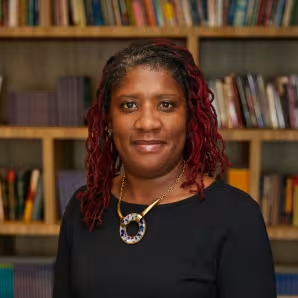
María José Espinosa Carrillo
Executive Director,Center for Engagement and Advocacy in the Americas (CEDA)