Why Is Sudan's Humanitarian Crisis Largely Invisible?

Part of The World of Migration

This transcript was generated using AI and may contain inaccuracies. If you notice an error, feel free to email [email protected].


CHAPTERS 

01:58 Sudan Displacement Crisis Overview 

03:46 Why Sudan Gets Less Global Attention Than Other Crises 

07:33 The Link Between Media Coverage and Humanitarian Funding 

10:07 Regional Spillover: How Sudan's Crisis Affects Neighboring Countries 

13:16 How Aid Cuts Are Worsening the Situation 

16:07 What a More Effective Global Response Would Look Like 

20:54 Prospects for Lasting Peace 


TRANSCRIPT 

[00:00:03.07] - John Thon Majok 

Hello. 

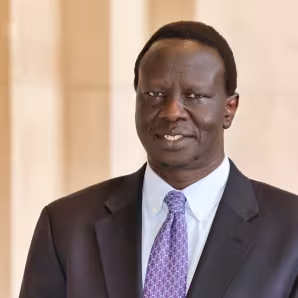
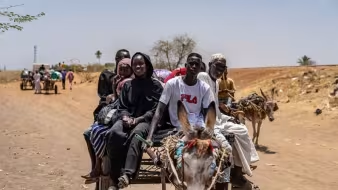
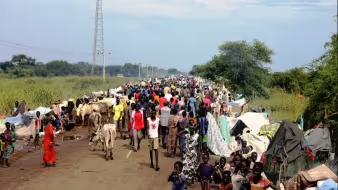
Welcome to World of Migration, a podcast from the Migration Policy Institute that delves into interesting and important developments globally on immigration, immigrant integration, and humanitarian protection. My name is John Thon Majok. I'm the director of MPI's Refugee and Forced Displacement Initiative, and I am your host today. Sudan is in a displacement crisis. Resulting from the civil war that broke out in 2023 and has created the world's largest humanitarian disaster, and the US State Department has labeled it as a genocide. Nearly 14 million people have been forcefully displaced within and beyond the country's borders as conflict rages between the Sudanese Armed Forces and the Rapid Support Forces. In addition, Sudan, which is the third-largest country in Africa, is facing the worst levels of acute food insecurity ever recorded in its history. Famine conditions have been confirmed in some areas of the country, with the risk of famine looming in many additional areas, according to the World Food Program . As war, famine, and food insecurity converge in Sudan, The International Organization for Migration, known as IOM, had warned that the country could be at a catastrophic breaking point. Diplomatic efforts to achieve meaningful progress toward a lasting peace have stalled, and aid cuts by major international donors have significantly affected the ability of humanitarian agencies to sufficiently respond to rising needs. 


[00:01:56.15] - John Thon Majok 

Yet against this backdrop, Sudan's crisis is not nearly as visible globally as it must be. The humanitarian situation in Sudan is extremely consequential for the continent of Africa and for the world, as we will explain. This episode of World of Migration explores whether Sudan is a forgotten displacement crisis and why this deteriorating situation is not getting more attention. It also tackles a question raised by advocates: what can be done in the short term and long term to raise the visibility of the situation, not least for the displaced children and women of Sudan? To unpack all this, I am delighted to be joined today by Dr. Margaret Monyani, founder and executive director of OLAM Africa Research Institute. A strategic leader with more than a decade of experience directing multi-country research on migration, human rights, and security, Margaret has written and spoken about Sudan crisis. Her work goes beyond documenting displacement trends to interrogating fault lines in regional responses. She has worked on conflict-induced displacement in East and the Horn of Africa and examining links between armed conflict, regional spillover effects, and international burden sharing. Margaret, thank you for joining us and welcome to the World of Migration podcast. 


[00:03:36.14] - Margaret Monyani 

Thank you for having me. 


[00:03:38.20] - John Thon Majok 

As I said at the outset, the International Organization for Migration has warned of a catastrophic breaking point in Sudan as war famine, and food insecurity converge. However, a simple online search on major international news outlets shows huge disparities in media coverage between the pressing conflict-fueled crisis in Sudan and elsewhere in the world. For example, from May 27, 2025 to May 27, 2026, The New York Times published 892 articles referencing Sudan, while it published 3,113 articles referencing Ukraine. Why is this global attention, Margaret, to the humanitarian situation in Sudan less than for similar displacement crisis elsewhere? 


[00:04:34.13] - Margaret Monyani 

Thank you so much for your question, John Tone, and thank you for having me. This is actually A very important discussion to have here. So like you say, the numbers tell one story about Sudan. We have these millions of people displaced, but then the response tells another story. So there is that mismatch. And then you would ask yourself, why the mismatch? Number one, I would say part of the challenge that Sudan does not fit into a neatly simple geopolitical storyline. So like the examples you have given with Ukraine, for example, the framing— when you look at the Ukraine conflict, the framing is immediately clear to international audiences. You know, like, they know it has to do with European security, there is— it has to do with Russia, NATO politics, and global order. But when you come to the Sudan case, it's much harder to package it that way. Why? It's a complex conflict. For one, it is— some people are looking at as a case of a civil war. It also has to do with the collapse of political transition. It is also a humanitarian catastrophe. At the same time, it is also a regional governance crisis. 


[00:05:49.16] - Margaret Monyani 

So all these factors are unfolding at the same time. And again, when that happens, usually sometimes complexity then makes visibility a big problem. So the difficult part, and the honestly the most uncomfortable part, is that when a crisis repeats itself, like in the case of Sudan, and more, let me be specific, African context, it starts being normalized at the international level. Because it looks at the international level, they don't like slow-burning crises. They want things that pop up once and the media, it gets media attention, People come in with donations and within 3, 4, 6 months it's done. But something that has been there perennially for years, come on, it starts to be normalized. So not invisible, but normalized. That's the word. So the suffering remains enormous, like you have said, but the urgency begins to fade because the crisis is absorbed into the background of global affairs. So many things are coming up, you know, COVID, all this, and then there is a crisis and other crisis also on the continent. Because remember, it's one among the 10 big crises on the continent. So that is why the comparison you raised with media coverage is actually very important. 


[00:07:07.19] - Margaret Monyani 

So the numbers are not just about journalism like you want to say. They tell us something about political attention. What is very particular about political attention and also donor mobilization and global agents? It works well when the Crisis is short-term but not perennial because once a crisis starts fading from headlines, you know, funding then becomes— follows the same path. 


[00:07:33.03] - John Thon Majok 

And as a follow-up to that same question, do you see a direct linkage between global attention and the emergency response? It is worth pointing out to our listeners that the Sudan Regional Refugee Response Plan an interagency appeal led by UNHCR requires nearly $1.5 billion to support countries that are hosting Sudanese refugees, but it is only 10% funded, leaving an unfunded gap of $1.4 billion. What do you make of this? 


[00:08:09.11] - Margaret Monyani 

Yes, like I said, you know, once the crisis does not sustain that attention, then funding will always follow the same path. So there is actually a direct link. So when you speak of the Sudan refugee plan, sitting only at 10%, you know, it is telling us something more profound. In what way? Um, it's not a shortage of money. It is telling some— it is, it is revealing about where Sudan currently sits. Where does it sit on, on global attention in terms of priority? Where does it sit in the hierarchy of global attention? Because humanitarian systems do not operate in isolation, you know. From politics or media visibility. They pretty much operate in the same, on the same spectrum. So the reality is, uh, crises remain constantly in the headlines. They, those ones that remain in the headlines like Sudan, they tend to generate, um, sustained diplomatic pressure, but for a period of time. And remember, when it comes to even funding, funds are never 10-year. We don't have 10-year funding. I don't know, I've not come across one. It's usually a year, 2 years, or 3 years. So fundings have cycles. Unfortunately, crisis like the conflict in Sudan doesn't. 


[00:09:25.08] - Margaret Monyani 

So Sudan is struggling to maintain that kind of momentum, you know, even though the scale of suffering is enormous. Then just to sustain, to be on top of the global hierarchy of attention has become an issue. So while it keeps going on, of course, it's years. So what happens over time is humanitarian agencies are asked to respond to increasingly complex realities with fewer resources. So it's a complex situation, but there are fewer resources, and then their funding circles, and then the attention is diminishing on the backgrounds. So what we see here, what you're mentioning, the gap is not just financial, it's also at the operational level. 


[00:10:07.09] - John Thon Majok 

With nearly 14 million people displaced inside Sudan and to neighboring countries of Chad, Egypt, Libya, South Sudan, Ethiopia, and Uganda. The regional spillover effects are experienced daily. First of all, can you discuss how Sudan crisis is affecting its neighbors? And secondly, how are African institutions and regional actors responding? 


[00:10:32.03] - Margaret Monyani 

Yeah, thank you so much for that question. You know, there is this misconception, misconception, you know, when we talk about the Sudan crisis, the misconception is that it is something happening inside Sudan, but like you have said, it is not. The effects are actually regional. We have seen people displaced from Sudan into the neighboring countries— Chad, South Sudan, Egypt, Ethiopia— all are holding, I mean, they are hosting refugees from Sudan. So, um, so I look at a country like Chad, for instance, is also grappling with its own internal issues. The same with South Sudan. But like, for, uh, for Chad, it has received a very large number of Sudan refugees while still dealing with very serious humanitarian issues internally. So South Sudan the same is also navigating fragility of its own, while at the same time, you know, receiving displaced people from Egypt as well, is balancing large refugee population alongside economic pressures. And also that— so the region is responding if you look at it like that, but it is responding while it's already stretched. So these countries are already stretched. So, um, when you look at maybe, um So those are the neighboring, immediate neighboring countries. 


[00:11:46.03] - Margaret Monyani 

You would ask where are now the institutions in terms of African institutions, the African Union, the IGAD. Yes, they have, we can say to a certain extent, recognized the seriousness of the crisis. Why do I say so? Because they have called for ceasefires, they have called for dialogue, they have called for a return to civilian-led governance, you know, but they have recognized the seriousness of the crisis. But recognition and leverage is not the same thing. You know, just having this multiple mediation efforts happening at the same time, different political interests involved, you know, and external actors playing dynamics in different ways, that also can become a problem itself. That's why we see Sudan with all— IGAD coming in, AU, neighboring countries trying to do one or two, but it's not working because they're also pushing in different and in different direction. Why, why is that the case? Because conflicts also tend to survive where there is fragmentation. Fragmentation of governance and also fragmentations of solutions. So wars or conflicts, they unfortunately are more coordinated than peace processes, as we are seeing in the region. 


[00:12:53.03] - John Thon Majok 

Of course, this crisis is unfolding amid sharp humanitarian aid cuts as major donor governments in Europe, United States, and elsewhere have scaled back their foreign assistance budgets. Could you discuss whether and how these aid cuts are worsening the situation in countries that host Sudanese refugees? 


[00:13:16.02] - Margaret Monyani 

Yeah, that is a very good question and a timely one. Honestly, this one actually needs its own podcast. So you see, aid cuts, everyone is talking about it and we are looking at the numbers. Everyone is saying maybe this particular program was getting this millions of US dollars. It's good, but sometimes when we talk about the numbers like that, it seems that when we talk about funding in that, in the, in terms of numbers, it's tends to make the experience itself too abstract. So it makes it look like on paper it becomes about percentages, about budget lines. But on the ground, what do budget cuts actually translate to? It is very human. Budgets are very human. The translation is very human. So what does that mean? It means budget cuts mean fewer food distribution. It means fewer health services. It means fewer shelters, fewer protection officers, fewer children. You see, it is very human. So, and this is happening while needs are actually increasing, not decreasing. So host countries under— and the ones I mentioned are under enormous pressure already. Communities in Chad, South Sudan, Egypt, and elsewhere are trying to absorb large-scale displacement from South Sudan. 


[00:14:28.16] - Margaret Monyani 

The numbers are there. With inflation, weakened structure, infrastructure, unemployment, limited public service, you know, They are already dealing with their internal issues. So when international assistance then declines, like we are seeing, that pressure does not disappear. It doesn't. It doubles, it triples. So it shifts directly onto the local systems and the host communities. And that now changes how displacement is experienced. You know, when there is support, it's different. But now, so people who cannot access water, they cannot access documentation because of this, the money cut. They may take riskier routes. And we've seen that through research. They enter informal labor systems, you know, or they become more vulnerable to exploitation. So underfunding does not simply reduce assistance, because that's where most policy makers, they say it has reduced. We cannot— we were reaching to 10,000 people, now we cannot reach the 10,000 we are only reaching to. No, it makes displacement itself more unstable and more dangerous over time. That's what it does. And also another layer to it, quickly to say, if host communities begin feeling abandoned while carrying increasing pressure, you know, social tensions will grow. Not necessarily because communities are unwilling to host refugees, no, but because scarcity, you know, scarcity of resources changes relationships very quickly. 


[00:15:56.16] - John Thon Majok 

In the context of what you have just described, what would a more effective global response to Sudan's displacement crisis involve? 


[00:16:06.07] - Margaret Monyani 

Wow, such a big question. I would say a more effective response maybe should begin with recognizing that Sudan is not only a humanitarian emergency, because that's how it has only been treated, a humanitarian emergency. But it is more than that. It is also a political crisis. It is also a governance crisis. It is a regional stability issue. So if we look at it from all those angles, we can't deal with a governance crisis or regional stability issue with humanitarian aid. No. Humanitarian aid, it's very essential. I'm not saying we take it away. Very essential. But it cannot carry the entire burden on its own. So the first shift has to be political. There needs to be consistent diplomatic pressure. Not occasional bouts of attention where people are calling ceasefires like we said, when the situation becomes unbearable or impossible to ignore. Then you see now government officials coming forward to say, no, we are calling on ceasefire. We see AU come, no, we want ceasefire. No, it has to be consistent diplomatic pressure. There is also the second issue is around funding, which I've said host countries need predictable and long-term support. They do—not short short-term emergency cycles that end at 1 year, 2 years. 


[00:17:29.03] - Margaret Monyani 

There is also need to move beyond emergency thinking. Like I said, many displaced Sudanese are living in towns, they're living in cities, they're trying to build their lives through local economies. So they don't need just humanitarian, they need developmental aid. And finally, perhaps there's need to be much stronger regional coordination. You know, Sudan's crisis affects not just East Africa, North Africa, East Africa, you know, the Horn, parts of the Sahel. So a fragmented response will not work. It will simply cannot keep up with the pace that that crisis is unfolding. 


[00:18:06.09] - John Thon Majok 

And in the few minutes that we have left, I have two more questions for you. John Mukum Mbaku, who is a scholar at the Brookings Institution, put it well, and I quote, "A peaceful Sudan is critical not just for economic and human development of the country, but also for the region." End quote. Could you explain a little bit how Sudan is such a linchpin for the region? 


[00:18:32.17] - Margaret Monyani 

First of all, yeah, I think that's a very good observation from John Mukum. Why? Because of where Sudan sits and what it connects geographically. Like I said, politically and economically, you know, Sudan links North Africa. It links Horn of Africa, Sahel, the Red Sea region. So instability inside Sudan does not remain contained within its borders, you know. It travels through displacement, it travels through trade routes, it border economies in all those regions, um, that I've mentioned. So the reason why, uh, um, it's important is, is because when Sudan destabilizes Neighboring countries immediately, they immediately begin absorbing pressure, whether through refugee flows like I have mentioned elsewhere, through disrupted trade, humanitarian strain if you want to put it like that, or security concerns. And over time, you know, as we have seen, these pressures reshape regional politics and governance as well. So a peaceful Sudan is not only important for the Sudanese citizens, like John says, although of course that is central, it's very important, it is also important for the regional stability. 


[00:19:42.01] - John Thon Majok 

And the final question is forward-looking. What do you think needs to be done to bring lasting peace? And how hopeful are you about this? 


[00:19:53.06] - Margaret Monyani 

So in terms of lasting peace, of course, the most immediate thing needs to be done is ending the violence. It's obviously the most immediate priority. But ceasefires, like we have seen time and again, alone are not enough. You know why? Sudan has experienced political agreements before. But they did not hold over time. So the bigger question is who gets to shape Sudan's future perhaps. If peace processes are dominated only by armed actors, as we have seen, political elites, which usually happens, but the fighting is happening at the community level, then the risk is that conflict simply reemerges. It does in another form. So civilian actors also need to be included, women, young people, local communities, displaced populations themselves, have to be part of shaping what comes next, not just the elite. Otherwise, peace will become, and we have seen, become something negotiated above society rather than built from within. We want to build the peace from within. Another aspect is an aspect of accountability. You know, there are atrocities that have been committed against the Sudanese people. We need to bring to book this, the people who are committing these atrocities. Atrocities during the conflict, but also even not just within, even in the broader region. 


[00:21:13.08] - Margaret Monyani 

So you ask, am I hopeful? Yes, but cautiously so. Why? Sudanese society has shown, of course, why am I being hopeful? The Sudanese society has shown extraordinary resilience, I must say, and political courage over the years despite the conflict. That the tragedy The tragedy is not that Sudan lacks people capable of imagining peace. That tells you that. The tragedy is that violence and competing interests from different quarters have repeatedly overpowered the efforts to bring peace to Sudan. So, but there is still political energy, civil resistance, and social resilience inside Sudan. So the challenge is whether perhaps regional and international actors are prepared to support a genuinely— and I must emphasize this— support a genuinely inclusive future before the crisis also deteriorates even further. 


[00:22:12.02] - John Thon Majok 

Thank you. I was very pleased to be joined today by Dr. Margaret Monyani, who is well known for her work studying regional responses to displacement crisis. Though there is no doubt the response to Sudan's crisis is hampered by limited resources, it is important to note that a strong network of grassroots solidarity is working to fill the gaps by addressing the humanitarian needs of internally displaced people in Sudan through emergency response rooms, communal kitchens, and mutual aid networks. However, this local response capacity is under pressure as the war continues to erode resilience. Many displaced people and their hosts are at a breaking point. It is within this context that key humanitarian voices are calling for urgent global humanitarian attention and action to scale up support that matches the magnitude of the displacement crisis in Sudan, direct humanitarian aid to the most underserved areas and local responders, invest in the ability of communities to cope with and recover from war and disaster, and support and increase diplomatic efforts to bring lasting peace and create conditions for safe return and ensure access to humanitarian assistance. Thank you for tuning in to another episode of MPI's World of Migration. 


[00:23:46.23] - John Thon Majok 

If you enjoyed this conversation, please check out other episodes. You can find World of Migration wherever you get your podcasts, and while you are there, please leave us a review. You can find all the episodes for this and other MPI podcasts at MPI's website, migrationpolicy.org/podcast. This episode was produced by Daniella Espacio with editorial input from Michelle Mittelstadt and the assistance of Lisa Dixon. Our theme music is called "Bright Idea" by Geographer. I am John Thon Majok. Thank you again for listening and see you next time. 


Sudan is experiencing the world's largest displacement crisis, but why is the crisis is overlooked, what are the regional spillover effects, and what would an effective international response require?

Sudan is experiencing the world's largest displacement crisis, yet global attention and funding remain critically low. In this episode of World of Migration, host John Thon Majok speaks with Margaret Monyani of the OLAM Africa Research Institute about why Sudan's crisis is overlooked, the regional spillover effects, and what an effective international response would require.

About the Refugee and Forced Displacement Initiative

RAFDI expands the space for new perspectives, constructive dialogue, and sustainable solutions to address global displacement, centering refugee lived experience, livelihoods, self-reliance, host-country integration, and the role of faith.