Transatlantic Council on Migration

The Transatlantic Council on Migration is a unique, deliberative body, launched in 2008, that supports pragmatic, evidence-based migration and integration policymaking across Europe and North America through essential analysis, high-level convenings, and cutting-edge policy advice to senior leaders.
The Council aims to help inform the transatlantic agenda and promote better-informed policymaking by proactively identifying critical policy issues, analyzing them in light of the best research, and bringing them to public attention. At the same time, it aims to serve as a resource for governments as they grapple with the challenges and opportunities associated with international migration. The Council’s goal is to support pragmatic and evidence-based policymaking that can adapt to evolving needs and changing political realities. Learn more about the Council here.


Showing 11–20 of 185 results
Coming Together or Coming Apart? A New Phase of International Cooperation on Migration
International migration cooperation is fragmenting, yet post-pandemic openings and regional coalitions could still revive governance if enforcement gaps are addressed.

Making Migration Policy in an Ever More Complex World
Two decades into MPI's existence, the same immigration debates that seemed intractable in 2001 remain unsolved—so what will it take to move the needle?

Migration Management and Border Security: Lessons Learned
Former CBP Commissioner Alan Bersin draws on North American and European migration crises to recommend a multilateral, networked approach to border management.

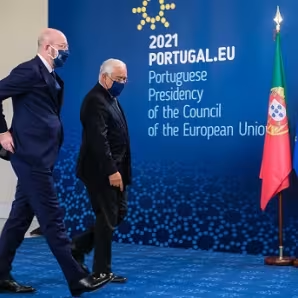
A Way Forward on Migration Under the Portuguese Presidency of the European Union?
With Portugal assuming the EU Presidency in January 2021 and prioritizing progress on the EU Migration and Asylum Pact, this webinar features senior officials from the European Union, Germany (the last holder of the presidency), and Portugal to take stock of where conversations on the pact stand and Portugal’s plans for taking forward the negotiations.
New Approaches to Climate Change and Migration: Building the Adaptive Capacity of Mobile Populations
As climate change intensifies displacement, new policy frameworks are needed to build the adaptive capacity of mobile populations and fill shortcomings in governance.

How Will International Migration Policy and Sustainable Development Affect Future Climate-Related Migration?
In a first-of-its-kind exercise, this report models how climate-related drivers of migration and displacement might be affected by varying greenhouse gas concentration scenarios.

Managing the Pandemic and Its Aftermath: Economies, Jobs, and International Migration in the Age of COVID-19
Global migration fell 46 percent in the first half of 2020. This report examines the COVID-19 pandemic's economic toll on migration systems and paths toward recovery.

Beyond Work: Reducing Social Isolation for Refugee Women and Other Marginalized Newcomers
Newcomers not in the workplace are at heightened risk for social isolation. Investment in economic empowerment, volunteering, and nonwork programs can combat social isolation.
Rebuilding Community after Crisis: Striking a New Social Contract for Diverse Societies (Transatlantic Council Statement)
This Transatlantic Council Statement urges a new social contract on economic inclusion, housing, cohesion, and values to rebuild following migration crises.

Integrating Refugees and Asylum Seekers into the German Economy and Society: Empirical Evidence and Policy Objectives
Survey data show Germany's refugees are integrating slightly faster than prior cohorts, but gender gaps, legal uncertainty, and policy tradeoffs persist.