Beyond Work: Reducing Social Isolation for Refugee Women and Other Marginalized Newcomers
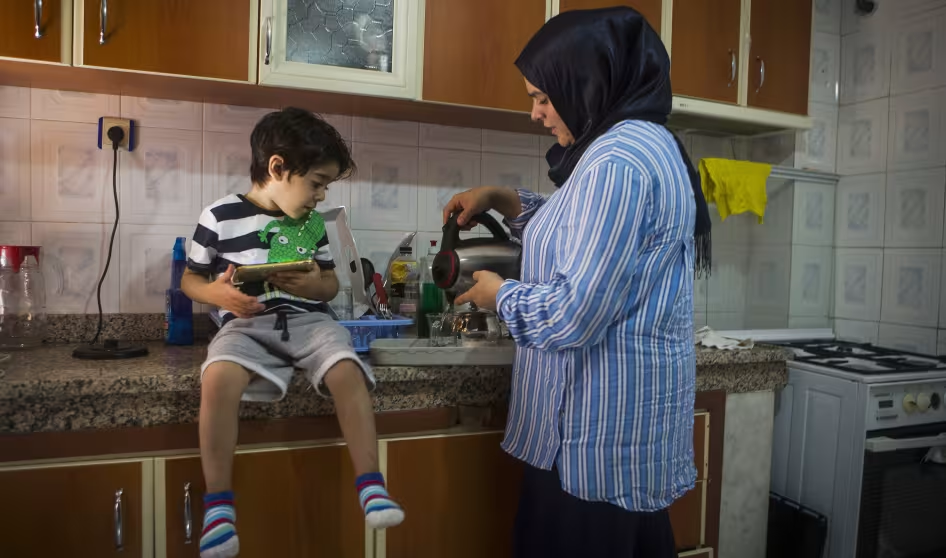
Newcomers not in the workplace are at heightened risk for social isolation. Investment in economic empowerment, volunteering, and nonwork programs can combat social isolation.
As migrant- and refugee-receiving countries in Europe, North America, and beyond prioritize services that are focused on employment, language instruction, and civic integration, newcomers who are not in the workplace are at high risk for social isolation. The consequences for this population, which is largely made up of women, refugees, the elderly, and migrants who are unskilled or illiterate, are far-reaching and go well beyond simple economics. As a result, societies should reconsider what successful integration looks like for newcomers who will never find traditional employment or who need a longer-than-average timeline to get there.
This Transatlantic Council on Migration report examines interventions that have broadened the lens of integration beyond the labor market for vulnerable newcomers in a number of Organization for Economic Cooperation and Development (OECD) countries. The report draws some preliminary observations on what works and why among the small-scale programs implemented to date, and also asks whether more could be done to factor them into the traditional machinery of integration.
Ways to reach populations at risk of social exclusion include prioritizing “work-adjacent” activities such as volunteering, fostering economic empowerment in areas overlooked by formal employment services (including crafts, cooking, and gardening) and nonwork initiatives (such as sports, arts, mentorship, and peer-to-peer programs) that boost social ties and connect newcomers with locals.
The balance for government officials who must make decisions about finite resources is a complex one, the report acknowledges. "While supporting vulnerable, socially isolated groups has benefits for the whole of society, the benefits are diffuse, accrue over the longer term and may not have political support; meanwhile, the costs of investing in this area are immediate and sometimes steep.”
Table of Contents
I. Introduction
II. The Risks of Marginalization
Barriers to Participation
III. Interventions to Combat Social Isolation
A. Economic Empowerment
B. Volunteering and Alternative Economic Contributions
C. Nonwork Initiatives to Boost Social Ties
IV. Conclusions and Recommendations
About the Transatlantic Council on Migration
Through rigorous research, high-level convenings, and tailored policy advice, the Council provides policymakers with essential analysis and cutting-edge policy recommendations to help tackle the most vexing policy questions.
About the Global Program
The Global Program bridges policy advice, research, and candid dialogue to design effective migration policies, drawing on global evidence and anticipating the forces reshaping how people move.


Related Content