U.S. Immigration Policy Program
The U.S. Immigration Policy Program provides thought leadership on ways to improve the U.S. immigration system so that it works most effectively in the national interest. To that end, its work focuses on immigration pathways to the United States and immigration enforcement policies and their impacts. It examines the complex demographic, economic, social, political, foreign policy, and other forces that shape U.S. immigration.
Program staff produce data and analyses of immigration trends and the characteristics of U.S. immigrant populations, including unauthorized immigrants. And they conduct original research on the impacts of policy change and the experiences of immigrant populations in diverse parts of the country. This work is frequently informed by private convenings of policymakers and key stakeholders. For more, click here.
The Latest Research
U.S. Deportations and “Self-Deportations” in the First 18 Months of the Second Trump Term
Filling a gap amid a slowdown in official data reporting from the federal government, this analysis offers a window into deportation and "self…

Featured
Physicians in an Era of Changing Immigration Policy: The Case of Nephrology
The care of kidney disease in the United States relies heavily on international medical graduates (IMGs). Recent policy changes could deepen…

Temporary Visa Holders in the United States
The number of U.S. temporary visas plummeted during the COVID-19 pandemic, rebounded, and then fell again in fiscal year (FY) 2025. Preliminary data…

Following Years of High Border Arrivals, the U.S. Unauthorized Immigrant Population Hits New Peak
MPI estimates the U.S. unauthorized immigrant population reached a new peak of 15.8 million as of mid-2024, after holding steady at around 11 million…

More Featured Work
From Counterterrorism to Immigration Enforcement: 25 Years On, Post-9/11 U.S. Changes Have Been Repointed
Post-9/11 national security tools have been repurposed for immigration, expanding the U.S. government’s capacity for surveillance, data sharing, and…

Attacked as "De Facto Amnesty," U.S. Temporary Protected Status Is Abruptly Eroded
The Trump administration moved to terminate most of the 17 Temporary Protected Status (TPS) designations in place when its second term began,…

Though Rare, Birth Tourism to the United States Sparks Outsized Concern
While rare, birth tourism has become a central but contested justification in the Trump administration's push to end the guarantee of birthright…

Key Statistics
Learn more about immigrants and immigration to the United States
14.8%
The immigrant share of the total U.S. population
Learn how this share has evolved (opens in a new tab)50.2 million
The number of immigrants in the United States
Explore Data Profiles by State (opens in a new tab)18.4%
The share of workers in the U.S. civilian labor force who are immigrants
Get the data at U.S. and state levels (opens in a new tab)
Showing 71–80 of 824 results
Leveraging Digital Skills: Immigrant-Origin High School Graduates Offer a Pool of Talent for U.S. Employers
With immigrants and their U.S.-born children expected to drive all net growth in the future labor force, there is a significant opportunity to leverage the digital skills of immigrant-origin adults to meet growing employer demand for technologically adept workers. This commentary draws on analysis of PIAAC data to study the skills of U.S. adults by immigrant generation.

A Century Later, Restrictive 1924 U.S. Immigration Law Has Reverberations in Immigration Debate
The 1924 Immigration Act's eugenics-influenced national-origin quotas reshaped U.S. demographics for decades and its core provisions still shape U.S. immigration law.

Translating Principles into Action: Countries Set New Agenda on the Los Angeles Declaration’s Second Anniversary
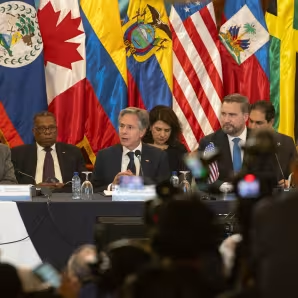
Two years after signing the Los Angeles Declaration on Migration and Protection, governments from across the Americas met in Guatemala to assess the state of cooperation in the hemisphere. Working with nongovernmental and international organizations, they also produced an agenda for practical action for the next year, as this commentary explains.
Title 42 Postmortem: U.S. Pandemic-Era Expulsions Policy Did Not Shut Down the Border
Nearly 3 million migrant expulsions occurred under Title 42. Use of the authority to expel border arrivals, which bypassed U.S. asylum law, drove up recidivism and “gotaways.”

How Immigrants and Their U.S.-Born Children Fit into the Future U.S. Labor Market
Immigrants and their U.S.-born children have driven all U.S. labor force growth since 2000 but face the need to upskill as nearly three-quarters of jobs in 2031 will require postsecondary credentials.

The Limits of the Go-It-Alone Approach: U.S. Migration Management Increasingly Requires Other Countries’ Cooperation
As border flows grow more global and diverse, the United States increasingly depends on the cooperation of Mexico and other countries to manage migration.

As Europe and the United States Face Similar Migration Challenges, Spain Can Act as a Bridge
Spain and the United States both receive their greatest number of immigrants from Latin America, and have worked collaboratively together on displacement crises and other migration issues. As shared immigration challenges dominate debate on both sides of the Atlantic, Spain can serve as a vital bridge in the policy conversation, this commentary notes.

Standoff at Eagle Pass: A High-Stakes U.S. Border Enforcement Showdown Comes to a Small Texas Park
Texas's seizure of a federal border zone during the Biden administration escalated a constitutional clash over immigration authority, with long-term implications over the federal-state balance of power.

Outmatched: The U.S. Asylum System Faces Record Demands
A record 3.2 million encounters of migrants at U.S. borders in fiscal year 2023 left the U.S. asylum system struggling to protect those eligible for protection or remove those who are not.
A New Way Forward for Employment-Based Immigration: The Bridge Visa
With the United States facing growing demographic pressures and labor needs, MPI is proposing creation of a bridge visa as a means of bringing flexibility to an employment system last overhauled by Congress in 1990.


- General Inquiries
- Media Inquiries
-
Michelle Mittelstadt
202 266 1910 [email protected]