U.S. Immigration Policy Program

The U.S. Immigration Policy Program provides thought leadership on ways to improve the U.S. immigration system so that it works most effectively in the national interest. To that end, its work focuses on immigration pathways to the United States and immigration enforcement policies and their impacts. It examines the complex demographic, economic, social, political, foreign policy, and other forces that shape U.S. immigration.
Program staff produce data and analyses of immigration trends and the characteristics of U.S. immigrant populations, including unauthorized immigrants. And they conduct original research on the impacts of policy change and the experiences of immigrant populations in diverse parts of the country. This work is frequently informed by private convenings of policymakers and key stakeholders. For more, click here.
The Latest Research
U.S. Deportations and “Self-Deportations” in the First 18 Months of the Second Trump Term
Filling a gap amid a slowdown in official data reporting from the federal government, this analysis offers a window into deportation and "self…

Featured
Physicians in an Era of Changing Immigration Policy: The Case of Nephrology
The care of kidney disease in the United States relies heavily on international medical graduates (IMGs). Recent policy changes could deepen…

Temporary Visa Holders in the United States
The number of U.S. temporary visas plummeted during the COVID-19 pandemic, rebounded, and then fell again in fiscal year (FY) 2025. Preliminary data…

Following Years of High Border Arrivals, the U.S. Unauthorized Immigrant Population Hits New Peak
MPI estimates the U.S. unauthorized immigrant population reached a new peak of 15.8 million as of mid-2024, after holding steady at around 11 million…

More Featured Work
From Counterterrorism to Immigration Enforcement: 25 Years On, Post-9/11 U.S. Changes Have Been Repointed
Post-9/11 national security tools have been repurposed for immigration, expanding the U.S. government’s capacity for surveillance, data sharing, and…

Attacked as "De Facto Amnesty," U.S. Temporary Protected Status Is Abruptly Eroded
The Trump administration moved to terminate most of the 17 Temporary Protected Status (TPS) designations in place when its second term began,…

Though Rare, Birth Tourism to the United States Sparks Outsized Concern
While rare, birth tourism has become a central but contested justification in the Trump administration's push to end the guarantee of birthright…

Key Statistics
Learn more about immigrants and immigration to the United States
14.8%
The immigrant share of the total U.S. population
Learn how this share has evolved (opens in a new tab)50.2 million
The number of immigrants in the United States
Explore Data Profiles by State (opens in a new tab)18.4%
The share of workers in the U.S. civilian labor force who are immigrants
Get the data at U.S. and state levels (opens in a new tab)
Showing 551–560 of 824 results
Immigration Reform Returns to Center Stage of U.S. Politics
For the first time since 2007, bipartisan U.S. immigration reform proposals put legalization for unauthorized immigrants on the table.

Resumen del Sector: Agricultura, Implicaciones para el Capital Humano y la Migración
El declive de la mano de obra agrícola disponible presiona hacia la mecanización y expone la fragilidad del programa H-2A, cuyas reformas han sido hasta ahora infructuosas.
Resumen del Sector: Manufactura, Implicaciones para el Capital Humano y la Migración
Los inmigrantes mexicanos y centroamericanos se concentran en empleos manufactureros de bajo valor en EE.UU., sin capacitación ni trayectorias hacia sectores en expansión.
Resumen del Sector: Sistema de Salud, Implicaciones para el Capital Humano y la Migración
Déficits educativos y barreras migratorias frenan la producción de enfermeras en EE.UU., México y Centroamérica, limitando la respuesta a poblaciones en envejecimiento.
Ripe with Change: Evolving Farm Labor Markets in the United States, Mexico, and Central America
North American farm labor supply is contracting as education and incomes rise, pressuring farmers to compete for fewer workers or invest in labor-saving mechanization.
Strengthening Health Systems in North and Central America: What Role for Migration?
Nursing shortages across five countries in North and Central America create a regional opportunity to leverage migration strategically for health workforce development.

New DHS Rule Will Help Expedite Permanent Residence for Immediate Relatives of U.S. Citizens
A 2013 regulation lets immediate relatives of U.S. citizens apply for provisional unlawful presence waivers from within the United States.
Immigration Enforcement in the United States: The Rise of a Formidable Machinery
Release of a major report that describes and analyzes the immigration enforcement system in the United States as it has developed and grown in the quarter century since the Immigration Reform and Control Act of 1986 launched the current era of enforcement.

Immigration Enforcement in the United States: The Rise of a Formidable Machinery
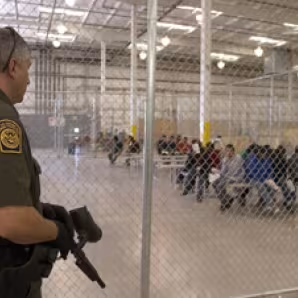
The United States has built a formidable immigration enforcement system, spending nearly $187 billion since 1986—more than on all other principal federal criminal law enforcement combined.
In the Lurch between Government and Chaos: Unconsolidated Democracy in Mexico
Mexico's democratic transition left authoritarian structures intact, allowing organized crime and corruption to fill the governance vacuum and undermine development.

- General Inquiries
- Media Inquiries
-
Michelle Mittelstadt
202 266 1910 [email protected]