Immigration Enforcement in the United States: The Rise of a Formidable Machinery
Release of a major report that describes and analyzes the immigration enforcement system in the United States as it has developed and grown in the quarter century since the Immigration Reform and Control Act of 1986 launched the current era of enforcement.
Beginning with the passage of the Immigration Reform and Control Act of 1986 (IRCA), Congress has attempted to deal with historically high levels of illegal immigration that started in the early 1970s and have continued. Since IRCA, illegal immigration and enforcement have been a dominant public concern that has driven policymaking by successive administrations and Congresses of each party, even as there has been deep ideological and partisan division over broader immigration reform during the past decade. MPI released a major study that describes and analyzes today’s immigration enforcement programs, as they have developed and grown in the 25 years since IRCA launched the current enforcement era. Entitled Immigration Enforcement in the United States: The Rise of a Formidable Machinery, the work lays out, for the first time, the totality of immigration enforcement that is in place, and identifies and describes the six pillars that comprise the complex, cross-agency immigration enforcement system that has been built.
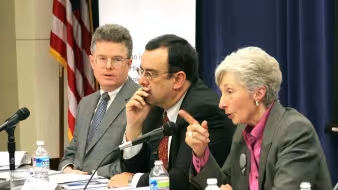
Speakers:
Doris Meissner, Senior Fellow and Director, U.S. Immigration Policy Program, MPI
Muzaffar Chishti, Director, MPI Office at NYU School of Law
Donald M. Kerwin, Executive Director, Center for Migration Studies
Demetrios G. Papademetriou, President, MPI
About the U.S. Immigration Policy Program
The U.S. Immigration Policy Program provides analysis of U.S. immigration pathways, the impacts of enforcement and other policies, and the characteristics of immigrant populations.