U.S. Immigration Policy Program

The U.S. Immigration Policy Program provides thought leadership on ways to improve the U.S. immigration system so that it works most effectively in the national interest. To that end, its work focuses on immigration pathways to the United States and immigration enforcement policies and their impacts. It examines the complex demographic, economic, social, political, foreign policy, and other forces that shape U.S. immigration.
Program staff produce data and analyses of immigration trends and the characteristics of U.S. immigrant populations, including unauthorized immigrants. And they conduct original research on the impacts of policy change and the experiences of immigrant populations in diverse parts of the country. This work is frequently informed by private convenings of policymakers and key stakeholders. For more, click here.
The Latest Research
U.S. Deportations and “Self-Deportations” in the First 18 Months of the Second Trump Term
Filling a gap amid a slowdown in official data reporting from the federal government, this analysis offers a window into deportation and "self…

Featured
Physicians in an Era of Changing Immigration Policy: The Case of Nephrology
The care of kidney disease in the United States relies heavily on international medical graduates (IMGs). Recent policy changes could deepen…

Temporary Visa Holders in the United States
The number of U.S. temporary visas plummeted during the COVID-19 pandemic, rebounded, and then fell again in fiscal year (FY) 2025. Preliminary data…

Following Years of High Border Arrivals, the U.S. Unauthorized Immigrant Population Hits New Peak
MPI estimates the U.S. unauthorized immigrant population reached a new peak of 15.8 million as of mid-2024, after holding steady at around 11 million…

More Featured Work
From Counterterrorism to Immigration Enforcement: 25 Years On, Post-9/11 U.S. Changes Have Been Repointed
Post-9/11 national security tools have been repurposed for immigration, expanding the U.S. government’s capacity for surveillance, data sharing, and…

Attacked as "De Facto Amnesty," U.S. Temporary Protected Status Is Abruptly Eroded
The Trump administration moved to terminate most of the 17 Temporary Protected Status (TPS) designations in place when its second term began,…

Though Rare, Birth Tourism to the United States Sparks Outsized Concern
While rare, birth tourism has become a central but contested justification in the Trump administration's push to end the guarantee of birthright…

Key Statistics
Learn more about immigrants and immigration to the United States
14.8%
The immigrant share of the total U.S. population
Learn how this share has evolved (opens in a new tab)50.2 million
The number of immigrants in the United States
Explore Data Profiles by State (opens in a new tab)18.4%
The share of workers in the U.S. civilian labor force who are immigrants
Get the data at U.S. and state levels (opens in a new tab)
Showing 531–540 of 824 results
As Senate Debates Immigration Reform, CBO and New Studies Examine Effects of Immigration on Nation's Fiscal Health
The Congressional Budget Office projected immigration reform would reduce the federal deficit by $175 billion over ten years.

Remaking the U.S. Green Card System: Legal Immigration under the Border Security, Economic Opportunity, and Immigration Modernization Act of 2013
The Senate's 2013 comprehensive immigration reform bill would grow skills-based green cards nearly fourfold while preserving family admissions.
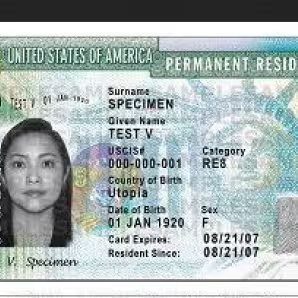
As Congress Tackles Immigration Legislation, State Lawmakers Retreat from Strict Measures
Few predicted that U.S. states racing to restrict immigration in 2011 would, by 2013, be doubling driver's license access for unauthorized immigrants and enacting tuition parity.

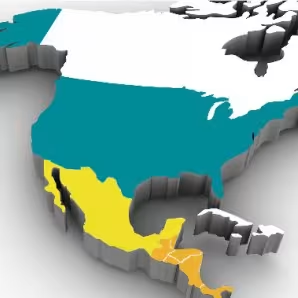
Thinking Regionally to Compete Globally: Leveraging Migration & Human Capital in the U.S., Mexico, and Central America
Shifting demographics and slowing emigration from Mexico and Central America demand a new U.S. regional strategy, this final report of the Regional Migration Study Group makes clear.
A Demographic, Socioeconomic, and Health Coverage Profile of Unauthorized Immigrants in the United States
Unauthorized immigrants are predominantly low-income, working adults, yet 71 percent of adults lacked insurance in 2011.

Sweeping Senate Bill Sets the Stage for Fundamental Overhaul of U.S. Immigration System
While most public attention has focused on the prospect legalization for millions of immigrants, S. 744's deeper ambition was to shift U.S. immigration to labor market-driven admissions.
Changing Dynamics: Immigration, Mexico, and the United States
A discussion with Mexico’s Ambassador to the United States on the changing dynamics of Mexico’s economy, demographics, and large-scale emigration, and their implications for both Mexico and the United States.

Side-by-Side Comparison of the 2013 Senate Immigration Framework with 2006 and 2007 Senate Legislation
The 2013 Senate immigration framework shared broad goals with its 2006 and 2007 predecessors but departed sharply on enforcement triggers and legalization design.
Mexican Migration to the United States: Underlying Economic Factors and Possible Scenarios for Future Flows
Sectoral demand shifts—not just supply-side shocks—explain Mexican migration trends since 1990, and net flows are projected to stay well below 1990s peaks through 2017.
Legal Immigration Policies for Low-Skilled Foreign Workers
The near-absence of U.S. legal low-skilled work visas drives unauthorized immigration. Designing a new program raises fiercely contested questions on wages and portability.

- General Inquiries
- Media Inquiries
-
Michelle Mittelstadt
202 266 1910 [email protected]