U.S. Immigration Policy Program

The U.S. Immigration Policy Program provides thought leadership on ways to improve the U.S. immigration system so that it works most effectively in the national interest. To that end, its work focuses on immigration pathways to the United States and immigration enforcement policies and their impacts. It examines the complex demographic, economic, social, political, foreign policy, and other forces that shape U.S. immigration.
Program staff produce data and analyses of immigration trends and the characteristics of U.S. immigrant populations, including unauthorized immigrants. And they conduct original research on the impacts of policy change and the experiences of immigrant populations in diverse parts of the country. This work is frequently informed by private convenings of policymakers and key stakeholders. For more, click here.
The Latest Research
U.S. Deportations and “Self-Deportations” in the First 18 Months of the Second Trump Term
Filling a gap amid a slowdown in official data reporting from the federal government, this analysis offers a window into deportation and "self…

Featured
Physicians in an Era of Changing Immigration Policy: The Case of Nephrology
The care of kidney disease in the United States relies heavily on international medical graduates (IMGs). Recent policy changes could deepen…

Temporary Visa Holders in the United States
The number of U.S. temporary visas plummeted during the COVID-19 pandemic, rebounded, and then fell again in fiscal year (FY) 2025. Preliminary data…

Following Years of High Border Arrivals, the U.S. Unauthorized Immigrant Population Hits New Peak
MPI estimates the U.S. unauthorized immigrant population reached a new peak of 15.8 million as of mid-2024, after holding steady at around 11 million…

More Featured Work
From Counterterrorism to Immigration Enforcement: 25 Years On, Post-9/11 U.S. Changes Have Been Repointed
Post-9/11 national security tools have been repurposed for immigration, expanding the U.S. government’s capacity for surveillance, data sharing, and…

Attacked as "De Facto Amnesty," U.S. Temporary Protected Status Is Abruptly Eroded
The Trump administration moved to terminate most of the 17 Temporary Protected Status (TPS) designations in place when its second term began,…

Though Rare, Birth Tourism to the United States Sparks Outsized Concern
While rare, birth tourism has become a central but contested justification in the Trump administration's push to end the guarantee of birthright…

Key Statistics
Learn more about immigrants and immigration to the United States
14.8%
The immigrant share of the total U.S. population
Learn how this share has evolved (opens in a new tab)50.2 million
The number of immigrants in the United States
Explore Data Profiles by State (opens in a new tab)18.4%
The share of workers in the U.S. civilian labor force who are immigrants
Get the data at U.S. and state levels (opens in a new tab)
Showing 441–450 of 824 results
Twenty Five Years Later: Reflecting on the Immigration Act of 1990
To mark the 25th anniversary of the 1990 Act, MPI hosted a discussion examining the history of the legislation, how it was accomplished politically, and the stakeholders and issues that were critical to its passage.

Investor Visa Programs: Examining their Utility, Challenges, and Successes
A discussion on the U.S. EB-5 program, the motivations underpinning recent changes to other investor visa programs in North America, Europe, and elsewhere, and the implications for the future direction of these programs.

Stopping the Revolving Door: Reception and Reintegration Services for Central American Deportees
Northern Central American governments offer basic returnee reception but long-term reintegration programs reach only a fraction of returnees, leaving many at risk of remigration.

Recent Court Rulings Block Deferred Action Programs and Raise Questions for Accessing Birthright Citizenship
Court fights over deferred action and birth certificates highlight how legal battles are reshaping executive power and practical access to U.S. citizenship.

Profile of Syrian Immigrants in the United States
Syrian immigrants are more educated and skilled than most immigrants. But high child poverty and low female workforce participation complicate this profile.

12th Annual Immigration Law and Policy Conference
This annual conference offers timely policy and legal analysis and discussion on key immigration topics featuring panels with government officials, researchers, advocates, and other immigration experts.
Unaccompanied Child Migrants in the United States: How Are They Faring?
Marking the release of a MPI brief, this webinar will examine data on where unaccompanied child migrants are being placed in the United States, how they are faring in immigration courts, what services are available to them, and how U.S. communities are adapting to their arrival.

Fifty Years On, the 1965 Immigration and Nationality Act Continues to Reshape the United States
Fifty years after passage, the 1965 immigration law still anchors U.S. policy, driving more diverse inflows, uneven integration, and recurring political battles.

The U.S. Record Shows Refugees Are Not a Threat
Since 2001, only three of 784,000 resettled refugees faced terrorism charges. This commentary offers a data-driven rebuttal to security objections over Syrian refugee admissions.
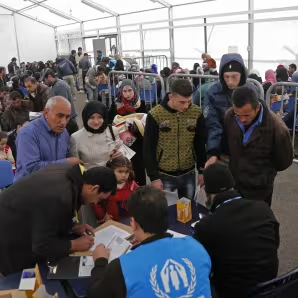
Unaccompanied Child Migrants in U.S. Communities, Immigration Court, and Schools
The U.S. immigration court system has failed to resolve most unaccompanied children's legal status, leaving communities and schools with minimal federal support.


- General Inquiries
- Media Inquiries
-
Michelle Mittelstadt
202 266 1910 [email protected]