U.S. Immigration Policy Program

The U.S. Immigration Policy Program provides thought leadership on ways to improve the U.S. immigration system so that it works most effectively in the national interest. To that end, its work focuses on immigration pathways to the United States and immigration enforcement policies and their impacts. It examines the complex demographic, economic, social, political, foreign policy, and other forces that shape U.S. immigration.
Program staff produce data and analyses of immigration trends and the characteristics of U.S. immigrant populations, including unauthorized immigrants. And they conduct original research on the impacts of policy change and the experiences of immigrant populations in diverse parts of the country. This work is frequently informed by private convenings of policymakers and key stakeholders. For more, click here.
The Latest Research
U.S. Deportations and “Self-Deportations” in the First 18 Months of the Second Trump Term
Filling a gap amid a slowdown in official data reporting from the federal government, this analysis offers a window into deportation and "self…

Featured
Physicians in an Era of Changing Immigration Policy: The Case of Nephrology
The care of kidney disease in the United States relies heavily on international medical graduates (IMGs). Recent policy changes could deepen…

Temporary Visa Holders in the United States
The number of U.S. temporary visas plummeted during the COVID-19 pandemic, rebounded, and then fell again in fiscal year (FY) 2025. Preliminary data…

Following Years of High Border Arrivals, the U.S. Unauthorized Immigrant Population Hits New Peak
MPI estimates the U.S. unauthorized immigrant population reached a new peak of 15.8 million as of mid-2024, after holding steady at around 11 million…

More Featured Work
From Counterterrorism to Immigration Enforcement: 25 Years On, Post-9/11 U.S. Changes Have Been Repointed
Post-9/11 national security tools have been repurposed for immigration, expanding the U.S. government’s capacity for surveillance, data sharing, and…

Attacked as "De Facto Amnesty," U.S. Temporary Protected Status Is Abruptly Eroded
The Trump administration moved to terminate most of the 17 Temporary Protected Status (TPS) designations in place when its second term began,…

Though Rare, Birth Tourism to the United States Sparks Outsized Concern
While rare, birth tourism has become a central but contested justification in the Trump administration's push to end the guarantee of birthright…

Key Statistics
Learn more about immigrants and immigration to the United States
14.8%
The immigrant share of the total U.S. population
Learn how this share has evolved (opens in a new tab)50.2 million
The number of immigrants in the United States
Explore Data Profiles by State (opens in a new tab)18.4%
The share of workers in the U.S. civilian labor force who are immigrants
Get the data at U.S. and state levels (opens in a new tab)
Showing 431–440 of 824 results
Increased Central American Migration to the United States May Prove an Enduring Phenomenon
Enduring unauthorized U.S. immigration of children and families from the Northern Triangle has been propelled by factors including violence and drought.
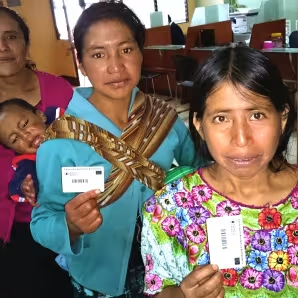
Deferred Action for Unauthorized Immigrant Parents: Analysis of DAPA's Potential Effects on Families and Children
Deferred action for unauthorized immigrant parents could raise family incomes by 10 percent and alleviate documented psychological harms for millions of children, most U.S.-born.

With Little Debate, Congress Enacts Broad Range of Immigration Changes in Spending Bill
Congress used a must‑pass 2016 spending bill to quietly reshape visas, enforcement, and Central America aid, hinting at a new path for U.S. immigration reform.
A Profile of Children with Unauthorized Immigrant Parents in the United States
This webinar offers a discussion of the economic, linguistic and educational disadvantage experienced by U.S. children with unauthorized immigrant parents. The researchers discuss their finding that 86 percent of the 5.1 million such children in the United States have a parent who could potentially benefit from the Deferred Action for Parents of Americans and Lawful Permanent Residents (DAPA) program.

Trends in Unaccompanied Child and Family Migration from Central America
After reaching record highs in 2014, Central American child migration fell for a few months before rising again, showing enforcement surges cannot resolve the structural causes of this emigration.
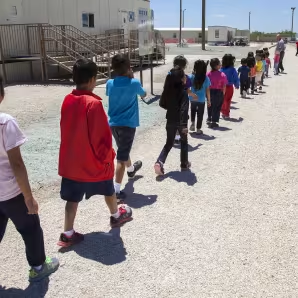
A Profile of U.S. Children with Unauthorized Immigrant Parents
Children with unauthorized immigrant parents face sharply higher poverty and linguistic isolation than other U.S. children. State policies risk worsening these disadvantages.
Border Metrics: How to Effectively Measure Border Security and Immigration Control
Without reliable border metrics, Congress and the U.S. public cannot assess whether immigration enforcement works or make informed decisions about legislative reform.
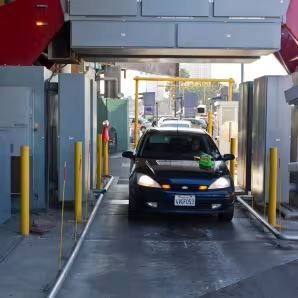
Under Executive Actions on Immigration, Who Can Apply for Protection from Deportation?
Learn who could be eligible for the DAPA and expanded DACA programs, should the Supreme Court permit the programs to go forward.

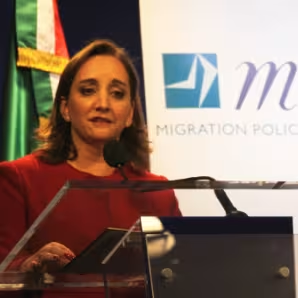
Leadership Visions: A Discussion with Mexican Foreign Minister Claudia Ruiz-Massieu
An MPI Leadership Visions discussion with the Foreign Minister of Mexico, Claudia Ruiz-Massieu, for her first public appearance in Washington, DC.
Reception and Reintegration Services in Central America: Ending the Deportee Revolving Door
A webinar releasing a report examining deportations to Central America and reception and reintegration services in El Salvador, Guatemala, and Honduras.


- General Inquiries
- Media Inquiries
-
Michelle Mittelstadt
202 266 1910 [email protected]