U.S. Immigration Policy Program
The U.S. Immigration Policy Program provides thought leadership on ways to improve the U.S. immigration system so that it works most effectively in the national interest. To that end, its work focuses on immigration pathways to the United States and immigration enforcement policies and their impacts. It examines the complex demographic, economic, social, political, foreign policy, and other forces that shape U.S. immigration.
Program staff produce data and analyses of immigration trends and the characteristics of U.S. immigrant populations, including unauthorized immigrants. And they conduct original research on the impacts of policy change and the experiences of immigrant populations in diverse parts of the country. This work is frequently informed by private convenings of policymakers and key stakeholders. For more, click here.
The Latest Research
U.S. Deportations and “Self-Deportations” in the First 18 Months of the Second Trump Term
Filling a gap amid a slowdown in official data reporting from the federal government, this analysis offers a window into deportation and "self…

Featured
Physicians in an Era of Changing Immigration Policy: The Case of Nephrology
The care of kidney disease in the United States relies heavily on international medical graduates (IMGs). Recent policy changes could deepen…

Temporary Visa Holders in the United States
The number of U.S. temporary visas plummeted during the COVID-19 pandemic, rebounded, and then fell again in fiscal year (FY) 2025. Preliminary data…

Following Years of High Border Arrivals, the U.S. Unauthorized Immigrant Population Hits New Peak
MPI estimates the U.S. unauthorized immigrant population reached a new peak of 15.8 million as of mid-2024, after holding steady at around 11 million…

More Featured Work
From Counterterrorism to Immigration Enforcement: 25 Years On, Post-9/11 U.S. Changes Have Been Repointed
Post-9/11 national security tools have been repurposed for immigration, expanding the U.S. government’s capacity for surveillance, data sharing, and…

Attacked as "De Facto Amnesty," U.S. Temporary Protected Status Is Abruptly Eroded
The Trump administration moved to terminate most of the 17 Temporary Protected Status (TPS) designations in place when its second term began,…

Though Rare, Birth Tourism to the United States Sparks Outsized Concern
While rare, birth tourism has become a central but contested justification in the Trump administration's push to end the guarantee of birthright…

Key Statistics
Learn more about immigrants and immigration to the United States
14.8%
The immigrant share of the total U.S. population
Learn how this share has evolved (opens in a new tab)50.2 million
The number of immigrants in the United States
Explore Data Profiles by State (opens in a new tab)18.4%
The share of workers in the U.S. civilian labor force who are immigrants
Get the data at U.S. and state levels (opens in a new tab)
Showing 411–420 of 824 results
Despite Hard-Line Immigration Campaign Pledges, Trump Policy Remains in Flux
Incoming President Donald Trump's postelection comments reflected narrower deportation targets, but the choice of Jeff Sessions attorney general signaled a tougher line.

Untapped Talent: The Costs of Brain Waste among Highly Skilled Immigrants in the United States
Brain waste affects nearly 2 million college-educated immigrants, costing the United States $39 billion in forgone earnings and $10 billion in lost tax revenues each year.

The Costs of Brain Waste among Highly Skilled Immigrants in Select States
Brain waste among highly skilled immigrants costs U.S. states billions in forgone earnings annually, with Florida posting the highest underutilization rate, as these state fact sheets show.

Unauthorized Immigrants with Criminal Convictions: Who Might Be a Priority for Removal?
Even as President-elect Donald Trump claimed 2 million to 3 million unauthorized immigrants were criminals, MPI estimates 820,000 had criminal convictions in 2012.
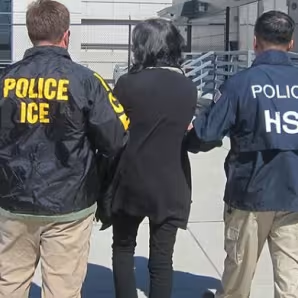
United States Abandons its Harder Line on Haitian Migrants in the Face of Latest Natural Disaster
Hurricane Matthew forced the United States to suspend Haiti deportations in October 2016, just weeks after resuming them for the first time since the 2010 earthquake.

Farm to Table: The Role of Immigrants in U.S. Farm Labor in 2016
A discussion featuring data on immigration trends and farm labor that could help inform future reform debates, including what adjustments farm employers are making, including increased mechanization, improved wages and benefits, and the increased use of the H-2A program.

Immigration to the Heartland: A Profile of Immigrants in the Kansas City Region
The Kansas City region's immigrant population grew more than 300 percent between 1990 and 2015, with immigrants establishing deep roots and contributing broadly across industries.

U.S. Meets 2016 Syrian Refugee Admission Goal; Opposition to New Resettlement Mounts
After admitting fewer than 2,000 Syrian refugees in the first seven months of FY 2016, the United States surpassed its goal of 10,000 for the year, reaching 12,391 by late September.

13th Annual Immigration Law & Policy Conference
With issues of immigration policy very much at the forefront of the 2016 elections, this annual conference offers policy and legal analysis on key immigration topics facing the country and the incoming administration and Congress in 2017.
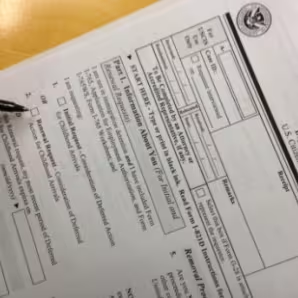
DACA at Four: Estimating the Potentially Eligible Population and Assessing Application and Renewal Trends
Marking the fourth anniversary of the implementation of the DACA program, this webinar presents findings on the most current estimates of potential DACA beneficiaries, trends in requests and application rates, and discussion of recent policy and political developments. Experts also discuss how DACA has affected the integration of qualifying young unauthorized immigrants.

- General Inquiries
- Media Inquiries
-
Michelle Mittelstadt
202 266 1910 [email protected]