U.S. Immigration Policy Program
The U.S. Immigration Policy Program provides thought leadership on ways to improve the U.S. immigration system so that it works most effectively in the national interest. To that end, its work focuses on immigration pathways to the United States and immigration enforcement policies and their impacts. It examines the complex demographic, economic, social, political, foreign policy, and other forces that shape U.S. immigration.
Program staff produce data and analyses of immigration trends and the characteristics of U.S. immigrant populations, including unauthorized immigrants. And they conduct original research on the impacts of policy change and the experiences of immigrant populations in diverse parts of the country. This work is frequently informed by private convenings of policymakers and key stakeholders. For more, click here.
The Latest Research
U.S. Deportations and “Self-Deportations” in the First 18 Months of the Second Trump Term
Filling a gap amid a slowdown in official data reporting from the federal government, this analysis offers a window into deportation and "self…

Featured
Physicians in an Era of Changing Immigration Policy: The Case of Nephrology
The care of kidney disease in the United States relies heavily on international medical graduates (IMGs). Recent policy changes could deepen…

Temporary Visa Holders in the United States
The number of U.S. temporary visas plummeted during the COVID-19 pandemic, rebounded, and then fell again in fiscal year (FY) 2025. Preliminary data…

Following Years of High Border Arrivals, the U.S. Unauthorized Immigrant Population Hits New Peak
MPI estimates the U.S. unauthorized immigrant population reached a new peak of 15.8 million as of mid-2024, after holding steady at around 11 million…

More Featured Work
From Counterterrorism to Immigration Enforcement: 25 Years On, Post-9/11 U.S. Changes Have Been Repointed
Post-9/11 national security tools have been repurposed for immigration, expanding the U.S. government’s capacity for surveillance, data sharing, and…

Attacked as "De Facto Amnesty," U.S. Temporary Protected Status Is Abruptly Eroded
The Trump administration moved to terminate most of the 17 Temporary Protected Status (TPS) designations in place when its second term began,…

Though Rare, Birth Tourism to the United States Sparks Outsized Concern
While rare, birth tourism has become a central but contested justification in the Trump administration's push to end the guarantee of birthright…

Key Statistics
Learn more about immigrants and immigration to the United States
14.8%
The immigrant share of the total U.S. population
Learn how this share has evolved (opens in a new tab)50.2 million
The number of immigrants in the United States
Explore Data Profiles by State (opens in a new tab)18.4%
The share of workers in the U.S. civilian labor force who are immigrants
Get the data at U.S. and state levels (opens in a new tab)
Showing 381–390 of 824 results
The Trump Administration at Six Months: A Sea Change in Immigration Enforcement
In a sharp departure from the Obama administration, the first six months of the first Trump term shifted immigration enforcement practices and generated deep anxiety among some immigrant communities.

MPI Estimates of Who Might Benefit under 2017 DREAM Act Bills in Congress
Learn which unauthorized immigrant populations could potentially be covered under the DREAM Act.

Strengthening Mexico’s Protection of Central American Unaccompanied Minors in Transit
Mexico's child protection framework for unaccompanied Central American minors is undermined by screening gaps, detention conditions, and near-zero asylum rates.

Despite Political Resistance, Use of Temporary Worker Visas Rises as U.S. Labor Market Tightens
Despite political headwinds, use of temporary work visas surged to record or near-record levels by 2016 and 2017, as a tightening U.S. labor market drove employer demand.
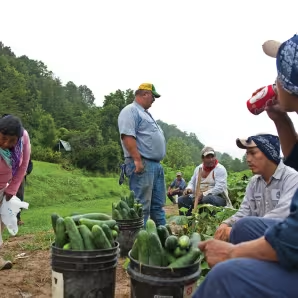
New Brain Gain: Rising Human Capital among Recent Immigrants to the United States
The share of recently arrived immigrants who are college educated nearly doubled from the late 1980s to 2011–15, driven by growing flows from Asia and global gains in educational attainment.

How Are Refugees Faring? Integration at U.S. and State Levels
Refugee integration outcomes in four major U.S. states vary more by national origin than by state policy, suggesting state placement matters less than previously assumed.

Immigrants and the New Brain Gain: Ways to Leverage Rising Educational Attainment
Nearly half of immigrants who arrived in the United States between 2011 and 2015 held college degrees, triple the 1990 share. Yet close to 2 million remain underemployed.

The Supreme Court’s Opinion on the Revised Trump Executive Order: What Does It Mean For Refugees?
Overlooked in the Supreme Court’s 2017 opinion allowing aspects of the Trump travel ban to take effect was its support for refugees coming in via resettlement.
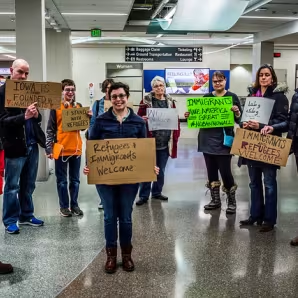
Texas Leads Resurgence in Restrictive State Actions on Immigration Enforcement
Texas's 2017 Senate Bill 4, requiring local law enforcement to cooperate with immigration authorities, revived a wave of state-level activity.
Recognizing Changing Enforcement and Crossing Trends at the U.S.-Mexico Border
As the Trump administration makes significant changes to border policy and Congress considers potential funding for a border wall, this discussion focuses on the recent and current state of the U.S.-Mexico border, in terms of the effectiveness of enforcement strategies, crossing trends, and what these changing realities mean for the United States and Mexico.


- General Inquiries
- Media Inquiries
-
Michelle Mittelstadt
202 266 1910 [email protected]