U.S. Immigration Policy Program
The U.S. Immigration Policy Program provides thought leadership on ways to improve the U.S. immigration system so that it works most effectively in the national interest. To that end, its work focuses on immigration pathways to the United States and immigration enforcement policies and their impacts. It examines the complex demographic, economic, social, political, foreign policy, and other forces that shape U.S. immigration.
Program staff produce data and analyses of immigration trends and the characteristics of U.S. immigrant populations, including unauthorized immigrants. And they conduct original research on the impacts of policy change and the experiences of immigrant populations in diverse parts of the country. This work is frequently informed by private convenings of policymakers and key stakeholders. For more, click here.
The Latest Research
U.S. Deportations and “Self-Deportations” in the First 18 Months of the Second Trump Term
Filling a gap amid a slowdown in official data reporting from the federal government, this analysis offers a window into deportation and "self…

Featured
Physicians in an Era of Changing Immigration Policy: The Case of Nephrology
The care of kidney disease in the United States relies heavily on international medical graduates (IMGs). Recent policy changes could deepen…

Temporary Visa Holders in the United States
The number of U.S. temporary visas plummeted during the COVID-19 pandemic, rebounded, and then fell again in fiscal year (FY) 2025. Preliminary data…

Following Years of High Border Arrivals, the U.S. Unauthorized Immigrant Population Hits New Peak
MPI estimates the U.S. unauthorized immigrant population reached a new peak of 15.8 million as of mid-2024, after holding steady at around 11 million…

More Featured Work
From Counterterrorism to Immigration Enforcement: 25 Years On, Post-9/11 U.S. Changes Have Been Repointed
Post-9/11 national security tools have been repurposed for immigration, expanding the U.S. government’s capacity for surveillance, data sharing, and…

Attacked as "De Facto Amnesty," U.S. Temporary Protected Status Is Abruptly Eroded
The Trump administration moved to terminate most of the 17 Temporary Protected Status (TPS) designations in place when its second term began,…

Though Rare, Birth Tourism to the United States Sparks Outsized Concern
While rare, birth tourism has become a central but contested justification in the Trump administration's push to end the guarantee of birthright…

Key Statistics
Learn more about immigrants and immigration to the United States
14.8%
The immigrant share of the total U.S. population
Learn how this share has evolved (opens in a new tab)50.2 million
The number of immigrants in the United States
Explore Data Profiles by State (opens in a new tab)18.4%
The share of workers in the U.S. civilian labor force who are immigrants
Get the data at U.S. and state levels (opens in a new tab)
Showing 371–380 of 824 results
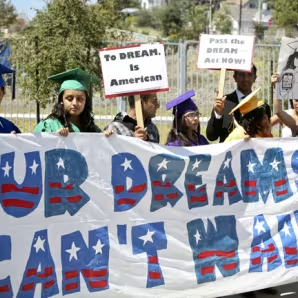
Differing DREAMs: Estimating the Unauthorized Populations That Could Benefit under Different Legalization Bills
The five DREAM Act-type bills introduced in 2017 differed sharply in scope, with MPI estimating eligible pools ranging from 2 million to 3.6 million, depending on each bill's requirements.
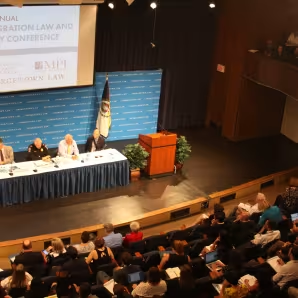
14th Annual Immigration Law and Policy Conference
Missed the annual conference? Audio and video of the discussions by top experts of shifting immigration enforcement under the Trump administration, to policy changes regarding refugee resettlement, treatment of unaccompanied minors, Temporary Protected Status, DACA, and more are available here.
Trump Administration Rescinds DACA, Fueling Renewed Push in Congress and the Courts to Protect DREAMers
In its first term, the Trump administration rescinded the Deferred Action for Childhood Arrivals (DACA) program, seeking to strip protection from roughly 790,000 Dreamers.

All Eyes Turn to Congress, Following Trump Decision to Terminate DACA Program
President Donald Trump's 2017 decision to end DACA passes the onus to Congress, as roughly 790,000 recipients face loss of work authorization and deportation protection.
Why Hide the Facts About Refugee Costs and Benefits?
A government report suppressed by the Trump White House found refugees generated $63 billion more in revenue than costs over 2005 to 2014, undermining claims of fiscal burden.
The U.S. Falls Behind as Others Take on New Leadership Amid Record Humanitarian Pressures
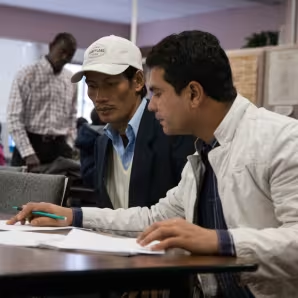
With the Trump administration setting refugee resettlement at a record low in fiscal year 2018, Canada, Australia, and Norway increased their resettlement commitments.

Juan Osuna: A Tribute to an Indispensable Person
MPI Senior Fellow Doris Meissner pays tribute to Juan Osuna, longtime Director of the Executive Office for Immigration Review, who died shortly after retiring in 2017.

Immigration and Farm Labor: From Unauthorized to H-2A for Some?
Slowing Mexico-U.S. migration is aging the U.S. farm workforce and driving H-2A visa usage growth.

The Education and Work Profiles of the DACA Population
Deferred Action for Childhood Arrivals recipients hold higher-skilled jobs and more education than unauthorized peers—gains DACA program termination would largely reverse.

The RAISE Act: Dramatic Change to Family Immigration, Less So for the Employment-Based System
The Trump-endorsed RAISE Act would halve legal immigration by slashing family categories and introduce a points system, while changing employment-based immigration less than anticipated.

- General Inquiries
- Media Inquiries
-
Michelle Mittelstadt
202 266 1910 [email protected]